

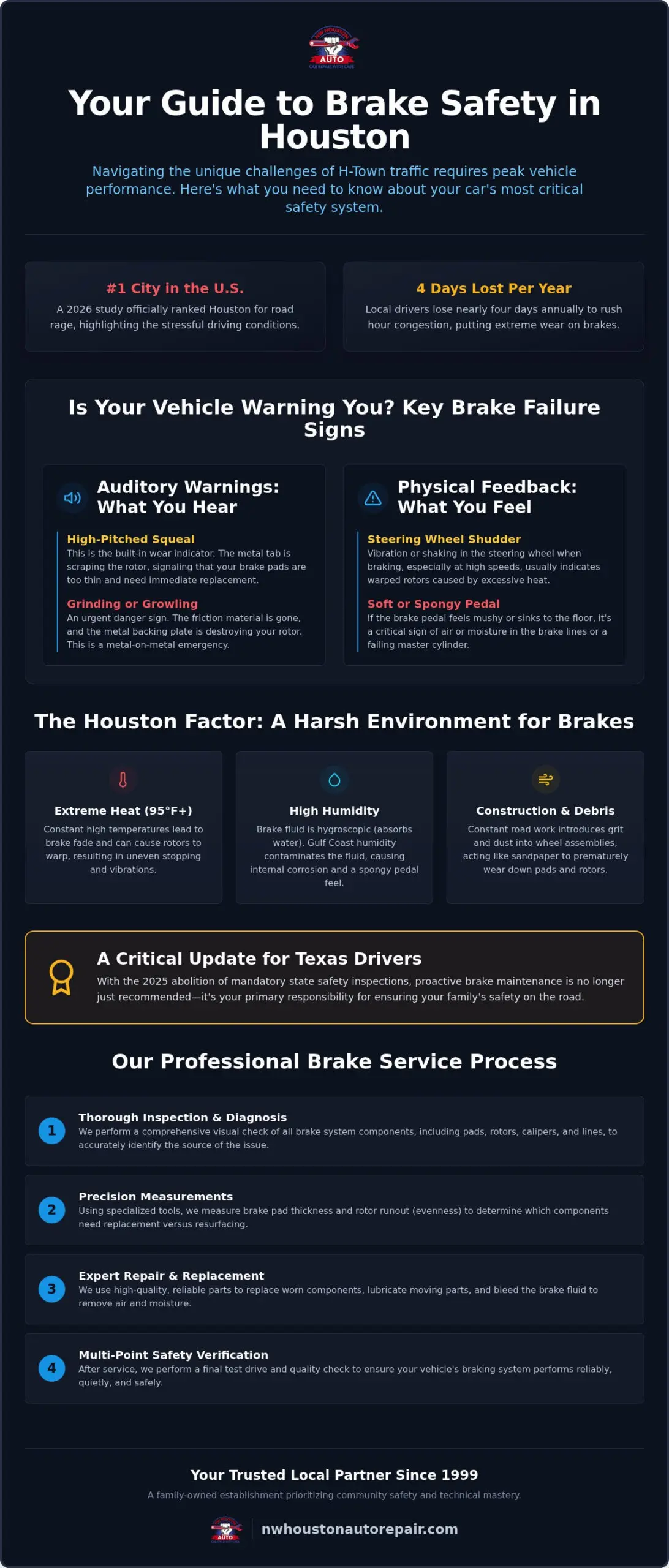
Did you know that a 2026 study officially ranked Houston as the number one city in the United States for road rage? When you combine our stifling humidity with the fact that local drivers lose nearly four days a year to rush hour congestion, it’s clear that your vehicle is working overtime. You need to know that your car will stop the moment you hit the pedal. If you’ve been hearing a high-pitched squeal or feeling a shudder in the steering wheel, you’re likely searching for the most reliable brake repair Houston has to offer. It’s stressful to feel like your family’s safety is at risk, especially when you’re worried about being overcharged by a shop that doesn’t value your community.
We understand that being without a vehicle in this city is more than an inconvenience; it’s a total disruption of your life. This guide will help you diagnose common brake issues, explain how our 95-degree heat affects your stopping power, and show you how to find a fair, transparent repair solution. You’ll learn why the 2025 abolition of mandatory safety inspections in Texas makes your proactive maintenance more critical than ever. Read on to discover how to keep your vehicle dependable and your passengers safe while securing the quick turnaround you deserve.
Key Takeaways
- Learn to identify the specific sounds and sensations, like wear indicator squeals or steering wheel shudders, that signal an immediate need for professional attention.
- Understand the “Houston Factor” and how our city’s unique combination of 95-degree heat and high humidity causes internal corrosion in your braking system.
- Compare the pros and cons of dealerships versus independent shops to find the most transparent and cost-effective brake repair houston has to offer.
- Follow our step-by-step breakdown of a professional brake service, from precision measurements to the final multi-point safety verification.
- Discover the benefits of partnering with a local, family-owned establishment that has prioritized community safety and technical mastery since 1999.
Diagnosing Your Stopping Power: Signs You Need Brake Repair in Houston
Your vehicle’s braking system is a complex network designed to convert kinetic energy into heat. Learning how brakes work helps you recognize when that system is beginning to fail. In a city where stop-and-go traffic is the daily reality, your brakes are your most important safety feature. When they start to wear down, they usually give you clear warning signs through specific sounds and physical sensations. Ignoring these indicators doesn’t just lead to more expensive fixes; it puts your family at risk on the crowded 610 Loop. We take these warnings seriously because we’ve seen how quickly a small squeal can turn into a major collision. Being proactive is the best way to stay safe and keep your car on the road.
Brake issues rarely happen all at once. They usually start as subtle changes in how your car responds to your foot. You might notice you’re pressing the pedal a little harder or that your stopping distance has increased slightly during your morning commute. These small shifts are your car’s way of asking for help before a component fails entirely. By paying attention to these early cues, you can often avoid the dangerous “Grind” or “Soft” pedal scenarios that require more extensive work. We believe in empowering our neighbors with the knowledge to spot these issues early, ensuring you get the brake repair houston experts recommend before a minor problem becomes a major safety risk.
Auditory Warnings: What Your Brakes Are Screaming
Most modern pads use a small metal tab called a wear indicator. When the pad material gets too thin, this tab contacts the rotor and creates a piercing, high-pitched squeal. It’s a built-in alarm clock telling you it’s time for brake repair houston families can rely on. If that squeal turns into a low-frequency grinding or growling sound, you’ve likely reached a metal-on-metal emergency. This means the friction material is completely gone, and the metal backing plate is destroying your rotors. While a stray pebble can sometimes cause a temporary noise, a persistent sound always requires a professional inspection. Brake fade is the temporary reduction or total loss of braking power caused by excessive heat buildup in the system components during heavy or prolonged use.
Physical Feedback: Feeling the Problem Through the Wheel
Sometimes you’ll feel the problem before you hear it. If your steering wheel shakes or vibrates when you apply the brakes at highway speeds, you likely have warped rotors. This happens when the intense heat from Houston traffic causes the rotor surface to become uneven. This vibration might also signal a need for precision wheel alignment, as these systems must work in harmony to keep your vehicle stable. A “soft” or “spongy” pedal that sinks to the floor is even more dangerous. This typically suggests that air or moisture has contaminated your brake lines, or your master cylinder is failing. Since our local humidity is notoriously high, moisture in the brake fluid is a common cause of internal corrosion and dangerous braking delays.
The Houston Factor: How Heat and Humidity Kill Your Brakes
Houston isn’t just a tough city for drivers; it’s a brutal environment for machinery. The combination of triple-digit August temperatures and 90% humidity creates a perfect storm for premature brake failure. While generic maintenance guides might work in milder climates, they often ignore the specific challenges of the Gulf Coast. Our local environment accelerates wear in ways that standard schedules don’t always predict. Understanding these environmental stressors is the first step in ensuring you get the high-quality brake repair houston drivers need to stay safe on the road.
Beyond the weather, our city’s infrastructure plays a role in how your vehicle ages. Constant road construction in NW Houston introduces grit and concrete dust into your wheel assemblies. This debris acts like sandpaper, grinding away at your pads and rotors every time you slow down. When you combine this abrasive dust with the 2026 model year’s complex brake-by-wire electronics, a simple visual inspection is no longer enough. You need technical mastery and specialized diagnostic tools to ensure your safety systems are functioning as intended.
Brake Fluid and the Gulf Coast Humidity
Brake fluid is hygroscopic, which means it naturally absorbs moisture from the air. In our thick Houston atmosphere, this process happens much faster than in drier regions. As water content increases, the fluid’s boiling point drops significantly. This is a major safety concern because how heat affects brake fluid can lead to “vapor lock,” a condition where the fluid boils and prevents the hydraulic system from applying pressure. To prevent internal corrosion and maintain stopping power, we recommend a professional brake service at least every two years to flush out contaminated fluid.
Thermal Cycling in Houston Traffic
Stop-and-go traffic on the 610 Loop or I-45 creates extreme thermal stress. Your brakes reach incredible temperatures during a sudden stop, only to sit in 95-degree ambient heat with no airflow to cool them down. This rapid heating and cooling, known as thermal cycling, is the primary cause of rotor warping. We use high-quality synthetic lubricants on caliper slide pins to ensure they don’t seize up under these harsh conditions. Standard organic brake pads typically begin to lose significant friction and experience “fade” once they reach temperatures between 400 and 500 degrees Fahrenheit. If your car feels sluggish or “off” after a long afternoon in traffic, it is a good idea to consult with a professional team to check for heat damage.
How to Choose a Brake Repair Shop: Houston Comparison Guide
Choosing where to take your vehicle for brake repair houston is a decision that impacts both your wallet and your family’s safety. While large dealerships offer a sense of security, they often come with inflated labor rates and a less personal touch. On the other hand, national budget chains might lure you in with a low price, only to discover that the “lifetime warranty” only covers the friction material on the pads. You still end up paying for labor, rotors, and hardware every time. Seek out a shop with a deep-rooted local reputation. A family-owned establishment that has served NW Houston since 1999 provides the technical mastery you expect with the neighborly warmth you deserve.
Don’t fall for the “Lifetime Brake” myth. These warranties are marketing tools designed to keep you coming back to the same shop, even if their work is subpar. Genuine safety comes from using high-quality components and having them installed by experts who take pride in their heritage. Before you commit, ask about their parts selection and whether they stand behind their labor. A shop that is confident in its work won’t hide behind fine-print exclusions. Look for a partner that prioritizes your safety over a quick sale.
Why a Physical Shop Beats a Driveway Repair
Mobile repair services are convenient, but they have significant limitations. Many critical safety checks require a professional hydraulic lift to perform accurately. For instance, a shaking steering wheel might not just be a rotor issue. It could signal a need for suspension repair that is only visible from underneath the vehicle. Additionally, modern vehicles utilize complex electronics that require advanced car diagnostics to reset ABS sensors or calibrate brake-by-wire systems. A full-service facility ensures every component is measured and tested before you drive away.
Transparency in Pricing and Parts
Choosing between OEM and aftermarket parts depends on your specific driving habits. If you frequently haul heavy loads or navigate the aggressive stop-and-go traffic of the 610 Loop, you need pads that can handle high thermal stress without fading. Be wary of the cheapest quote you receive. Low-cost shops often use “white box” parts that are prone to noise and excessive dust. Ask your mechanic which brands they trust and why. A transparent professional will explain the difference between a ceramic and a semi-metallic pad, helping you make an informed choice for your vehicle’s longevity. Demand a clear, written estimate before any work begins to ensure there are no surprises when you pick up your keys.
The Step-by-Step Brake Repair Process: What to Expect
When you bring your vehicle in for brake repair houston, you deserve a process that is as thorough as it is transparent. We don’t believe in guesswork. Our approach starts with a comprehensive multi-point safety inspection to identify the root cause of your stopping issues. This isn’t just about looking at the pads. We use precision instruments to measure rotor thickness and check for lateral runout, ensuring your parts meet the exact safety tolerances required for heavy city driving. If your components are within a fraction of a millimeter of failing, we’ll let you know immediately.
The next phase involves a deep dive into your vehicle’s hydraulics. We perform a fluid analysis to check for moisture contamination, which is a common byproduct of our Gulf Coast humidity. We also test the master cylinder and ABS modules to ensure the electronic “brain” of your braking system is communicating correctly with the mechanical parts. This methodical transition from immediate needs to technical capabilities is what sets a professional shop apart from a quick-fix alternative. We take pride in being the authoritative guide that keeps your property dependable.
Beyond Just Pads: The Holistic Inspection
A safe stop depends on more than just friction material. During our inspection, we evaluate the health of your car tire repair needs and tread depth. If your tires are bald, even the best brakes won’t stop you in a summer downpour. We also examine brake lines for debris damage or corrosion from road chemicals. Our team checks for leaks in wheel cylinders and calipers to ensure no hydraulic pressure is being lost. This all-inclusive framework guarantees that when we return your keys, every part of your vehicle’s handling system is ready for the road.
Installation and Bedding-In
Precision is the hallmark of a proper brake replacement. We start by meticulously cleaning the wheel hubs to prevent even the slightest misalignment, which can cause annoying pedal pulsations later. Once the new components are installed and calibrated to factory specs, we perform a vital “bedding-in” procedure. This process involves a series of controlled stops to seat the pads to the rotors, ensuring maximum performance from the very first mile. Finally, we conduct a real-world road test to verify that your car stops straight, quiet, and fast. Schedule your multi-point safety inspection today to ensure your vehicle is prepared for Houston’s demanding traffic.
Why NW Houston Auto Repair and Collision is Your Trusted Brake Partner
Since 1999, we’ve seen Houston’s roads become more crowded and demanding, but our commitment to technical mastery hasn’t wavered. We aren’t just another service provider; we’re a family-owned pillar of the NW Houston community. When you search for the brake repair houston drivers have trusted for over 25 years, you’re looking for more than a quick fix. You want the peace of mind that comes from a team specialized in both mechanical precision and complex collision restoration. This dual expertise allows us to view your vehicle holistically, ensuring that every safety system, from the pads to the frame, works in perfect harmony.
Our versatility is a core strength that benefits every customer who walks through our doors. Whether you’re coming in for routine brake repair or your vehicle requires a highly complex restoration after a collision, we handle the task with unwavering reliability. We combine the deep technical knowledge of seasoned experts with the approachability of a local, family-run shop. This ensures that while we’re quick to respond to your immediate automotive needs, we’re also deliberate and methodical in our execution. We aim to alleviate the stress of vehicle repairs by positioning ourselves as your dependable partner rather than just a one-time service stop.
A Family-Owned Legacy of Safety
Our founding in 1999 was built on a simple, enduring promise: treat every car like it belongs to our own family. This long-standing heritage informs every ethical business practice we follow today. You won’t find stiff corporate language or hidden fees here. Instead, you’ll speak directly to the experts who are actually performing the work on your vehicle. This direct line of communication fosters the transparency and neighborly warmth that our community has relied on for decades. We take pride in being the protective figure that keeps your property dependable and your loved ones safe during every commute.
Schedule Your Precision Brake Service Today
Efficiency is vital in a car-dependent city like Houston. To maximize your time and keep your vehicle in peak condition, we often recommend combining your brake inspection with a oil change. This comprehensive approach keeps your engine running smoothly while our technicians verify your stopping power and hydraulic integrity. Don’t wait for a warning light or a frightening noise to take action. Our booking process is functional and direct, designed to get you back on the road safely and quickly. Ready to stop with total confidence? Contact our NW Houston team today!
Secure Your Journey Through Houston Traffic
Living in SE Texas means your vehicle faces environmental challenges that most maintenance schedules don’t account for. You’ve seen how Gulf Coast humidity and triple-digit heat compromise hydraulic fluid and warp rotors. By recognizing early auditory warnings and understanding the technical requirements of 2026 braking systems, you’re already ahead of the curve. Selecting the right partner for brake repair houston ensures your family stays safe and your car remains dependable on our most congested road segments.
Our family-owned shop has served the community since 1999, providing expert care for all makes and models. We combine professional authority with the neighborly warmth you deserve, emphasizing transparency and technical mastery. Don’t let a small squeal turn into a major safety emergency. Take control of your vehicle’s health today and drive with the peace of mind that comes from precision service. We’re ready to help you navigate the city safely.
Book Your Precision Brake Inspection in NW Houston. We look forward to keeping you and your family safe on the road for many miles to come.
Frequently Asked Questions
How much does brake repair cost in Houston?
The cost of your service depends on the specific components that need attention, such as pads, rotors, or calipers. We provide transparent, written estimates after a physical inspection to ensure you aren’t overcharged for parts you don’t need. Our goal is to provide fair pricing that reflects our technical mastery and the quality of the materials we use for your family’s safety. We believe in providing value through thoroughness and long-lasting results.
How often should I have my brakes inspected in Texas?
You should have your brakes inspected at least once every six months or every 6,000 miles, especially given Houston’s aggressive stop-and-go traffic. Since Texas abolished mandatory annual safety inspections on January 1, 2025, the responsibility for your vehicle’s safety falls entirely on you. Regular checks during a routine oil change help catch wear before it leads to a dangerous metal-on-metal emergency. Staying proactive is the best way to keep your car dependable.
Can I just replace my brake pads and not the rotors?
You can replace just the pads if your rotors are still above the minimum safety thickness and are not warped or deeply scored. However, we always measure your rotors with precision tools during every brake repair houston drivers request. If the rotors show signs of heat damage from our local summer traffic, replacing them alongside the pads ensures a quiet, vibration-free stop. This holistic approach prevents premature wear and keeps your stopping power consistent.
Why do my brakes squeak even though they are new?
New brakes might squeak if they haven’t been properly “bedded-in” or if a small amount of moisture or dust has settled on the surface. In some cases, low-quality aftermarket pads lack the proper shims or lubricants to dampen vibrations. We use high-quality components and perform a controlled road test to ensure your new system is seated correctly and operating silently before you leave our shop. If the noise persists, it requires a quick professional inspection.
Is it safe to drive with the brake warning light on?
No, it is not safe to drive when your brake warning light is illuminated. This light often signals a significant drop in hydraulic pressure, low fluid levels, or a failure in the electronic ABS system. Pull over safely and have your vehicle inspected immediately. Ignoring this warning can lead to a total loss of stopping power, putting you and other Houston drivers at risk on the highway. We treat these lights as urgent safety emergencies.
What is the difference between ceramic and semi-metallic brake pads?
Ceramic pads are known for being quiet and producing very little dust, making them ideal for daily commuting in passenger vehicles. Semi-metallic pads offer better heat dissipation and are more durable for heavy-duty trucks or aggressive driving styles. We help you choose the right material based on your specific vehicle and how you navigate the demanding 610 Loop environment every day. Our experts ensure your pad selection matches your vehicle’s factory specifications and performance needs.
How long does a typical brake repair take at your Houston shop?
A standard brake service, such as replacing pads and rotors on one axle, typically takes between one and two hours at our NW Houston facility. We prioritize a quick turnaround because we know how difficult it is to be without a car in this city. While we work efficiently, we never rush the safety checks or the final road test required to ensure your vehicle is safe. We aim to get you back to your routine quickly.
Does Houston’s heat affect my brake fluid?
Yes, Houston’s extreme heat and high humidity can significantly degrade your brake fluid over time. Because the fluid is hygroscopic, it absorbs moisture from our thick Gulf Coast air; this lowers its boiling point and can lead to internal corrosion. This is why we include a fluid analysis as part of the brake repair houston residents expect from our expert technicians. Catching contaminated fluid early prevents vapor lock and ensures your pedal remains firm.