

You are cruising down I-45 at 65 miles per hour when the tire pressure light suddenly flashes on your dashboard. In Houston, this isn’t just an inconvenience; it’s often the start of a stressful debate between spending hundreds on a new tire or risking a dangerous blowout. With our city’s aggressive road construction and the constant threat of debris, finding a reliable car tire repair Houston drivers can trust is about more than just convenience. It’s about your family’s safety on some of the most congested roads in the country.
We understand that you want to avoid the cost of a brand new tire whenever possible, but you also need the peace of mind that your repair will hold up under the Texas heat. This guide will teach you exactly when a flat can be safely fixed and when it’s time to walk away. We’ll break down the critical differences between temporary plugs and permanent patch-plug combos. You will also learn the non-negotiable sidewall rule and how to ensure your vehicle handles perfectly after the job is done. From tread depth requirements to post-repair alignments, we have you covered.
Key Takeaways
- Learn why Houston’s heavy construction on 290 and 610 makes professional car tire repair Houston a critical safety check rather than a simple DIY task.
- Master the “1/4-inch rule” to determine if a puncture is too large to safely mend according to industry safety standards.
- Understand why the patch-plug combination is the only repair method that ensures your tire can handle high-speed freeway driving and extreme Texas heat.
- Identify the “no-repair zones” on your tire’s sidewall and shoulder where any damage requires an immediate replacement to avoid dangerous blowouts.
- Discover why scheduling a wheel alignment after a flat repair is essential for maintaining vehicle handling and extending the life of your remaining tires.
Understanding Car Tire Repair in Houston’s Harsh Environment
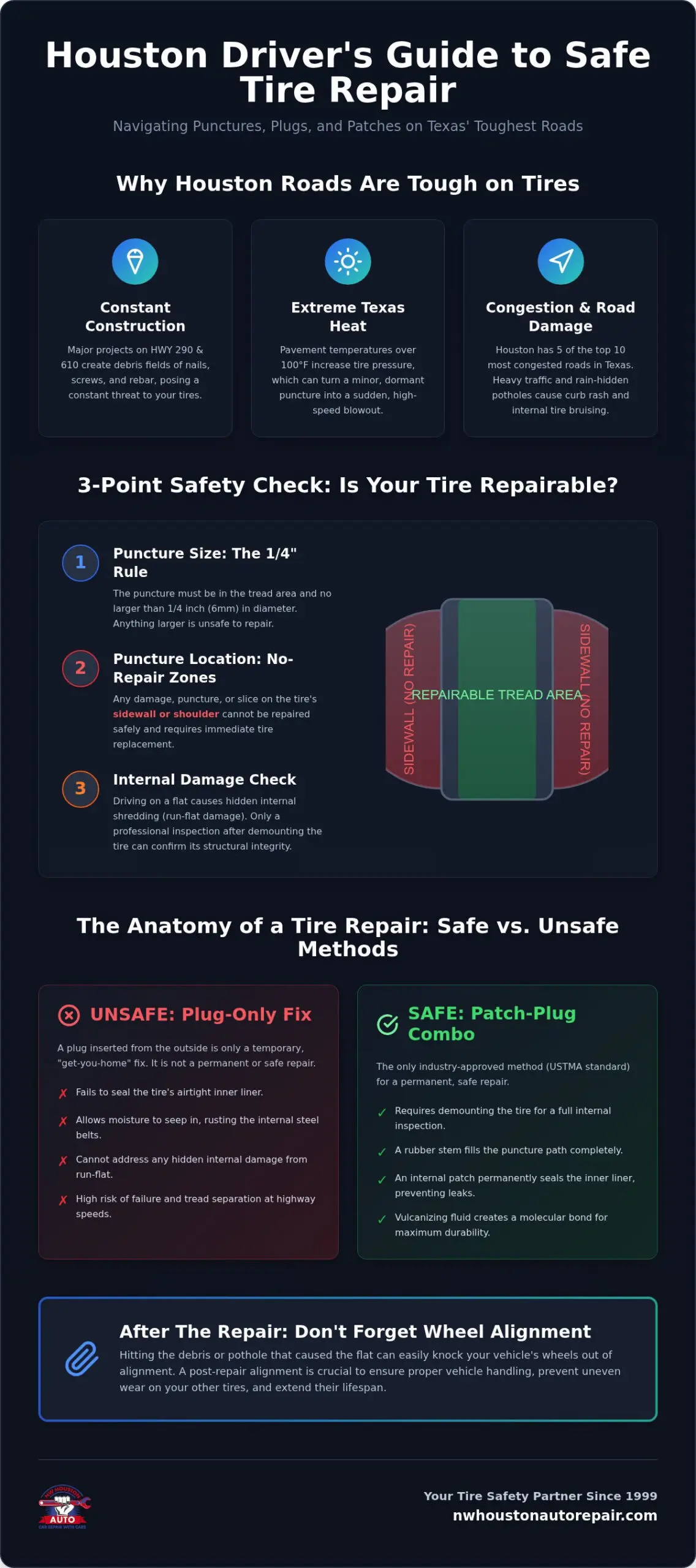
Houston drivers face some of the most punishing road conditions in the country. In 2026, data shows Houston is the 7th worst city in the U.S. for traffic congestion, with average commutes lasting nearly 30 minutes. With the 2026 FIFA World Cup approaching, our highways are only getting busier and more cluttered. Professional car tire repair Houston services are essential because a simple plug isn’t enough to withstand 100-degree pavement and stop-and-go traffic on I-10. At NW Houston Auto Repair and Collision, we treat every flat as a high-heat safety procedure. We don’t just plug a hole. Our family-owned shop, serving the community since 1999, performs a comprehensive internal inspection to ensure the tire’s structural integrity hasn’t been compromised by our brutal environment.
Common Houston Road Hazards
Construction never stops in the Bayou City. Major expansion projects on Highway 290 and the 610 Loop are constant sources of road hazards that can ruin your day. Nails, screws, and even jagged rebar fragments frequently migrate from these construction zones into the path of your vehicle. Houston actually claims five of the top 10 most congested roads in Texas, meaning you have a high probability of encountering debris during your daily drive. During our heavy rainstorms, hidden potholes become tire-killing traps that cause curb rash and internal bruising. The extreme Texas heat also plays a major role. As pavement temperatures soar, the air inside your tires expands; this pressure fluctuation can turn a tiny, dormant puncture into a sudden, high-speed failure.
Just as you rely on professionals to fix your tires, maintaining the integrity of the concrete you drive on every day is essential for preventing vehicle wear; for property owners, Foundation Werks offers the specialized concrete repair needed to keep driveways and foundations in top condition.
The Cost of Ignoring a Slow Leak
Don’t let a small leak wait until it becomes a full-blown emergency. With local commuters spending so much time behind the wheel, a tire with low pressure significantly hurts your fuel economy. Driving on a soft tire causes the sidewalls to flex excessively, generating internal heat that destroys the rubber’s bond with the steel belts. This leads to irreversible structural decay. Run-flat damage is the permanent, internal shredding of a tire’s sidewall structure caused by driving with insufficient air pressure, and it is the hidden killer of repairable tires. While a basic tire repair kit might seem like a convenient temporary fix, it cannot address the structural damage caused by a long commute on a flat. If you notice your TPMS light flickering, pull over safely and seek professional help immediately.
The Anatomy of a Safe Tire Repair: Patch vs. Plug
Many drivers think a “plug” is a permanent solution for a flat. It isn’t. For a reliable car tire repair Houston residents can count on, we follow strict industry-recommended puncture repair procedures. This requires a combination of a rubber stem to fill the physical hole and a patch to seal the inner liner. A plug alone is merely a temporary roadside measure. It fails to permanently seal the tire’s interior, which is why the U.S. Tire Manufacturers Association (USTMA) mandates the combo repair as the only safe standard. We take the time to do it right because your safety at highway speeds is our priority.
To perform this correctly, we must demount the tire from the rim. You simply cannot see internal damage from the outside. If you’ve driven even a short distance on a soft tire, the sidewall can shred internally. By removing the tire, our technicians can inspect for these hidden structural failures. If the inner liner shows “marbling” or signs of scorching, the tire is fundamentally unsafe. We won’t gamble with your safety; if the tire’s structure is compromised, we’ll provide a transparent explanation of why it needs replacement rather than repair.
Why We Don’t Just ‘Plug’ Tires
On-the-wheel plugs are inherently risky. They don’t seal the tire’s airtight inner liner, allowing air and moisture to seep into the tire’s internal layers over time. This moisture causes the steel belts to rust while the air pressure works to delaminate the rubber. At high speeds on I-10, this internal degradation can lead to sudden tread separation. A plug is a “get home” fix, not a long-term solution. Our team focuses on a permanent bond that keeps your vehicle dependable for the long haul.
The Vulcanization Process
The secret to a repair surviving a 100-degree Houston summer is vulcanization. This is much more than just applying glue. We use a specialized chemical vulcanizing fluid that creates a molecular bond between the patch and the tire rubber. First, we carefully clean and buff the inner liner to create a pristine, textured surface. Then, the cement triggers a chemical reaction that fuses the patch into the tire itself. This creates a heat-resistant seal that won’t fail when the pavement temperatures hit 150 degrees in mid-July.
Precision matters when your family’s safety is on the line. If you’re worried about a recent puncture or a slow leak, reach out to our team for a professional inspection and a permanent fix you can trust.
Is Your Tire Repairable? The 2026 Safety Checklist
Safety isn’t a gray area; your tire is either structurally sound or it’s a liability. At NW Houston Auto Repair and Collision, we don’t guess. We use a precise safety checklist based on NHTSA tire safety guidelines to determine if a fix is responsible. While we always aim to save you the cost of a new tire, we’ll never compromise your safety on a high-speed freeway for the sake of a quick fix. If your tire meets our criteria, we’ll get you back on the road with confidence. If it doesn’t, we’ll explain why replacement is your only safe option.
The first factor we examine is the size of the puncture. According to industry standards, any hole larger than 1/4 inch (6mm) is considered a structural failure. At this size, the steel belts and internal cords have been severed too extensively for a patch to maintain the tire’s integrity. Even if the hole looks small from the outside, we measure it from the inside to be certain. We also check your tread depth. In Texas, the minimum legal tread depth is 2/32 of an inch. If your tires are already at or below this limit, a repair is no longer a viable or legal option.
The Non-Repairable Zone
Location is just as critical as size. We only perform a car tire repair Houston drivers can trust within the “crown” of the tire. This is the center area of the tread, roughly one to one and a half inches away from the shoulders. The sidewall and the shoulder are strictly off-limits. These areas experience the most flex during every rotation of the wheel. This constant movement prevents a patch from creating a permanent bond and can lead to a sudden blowout. If a nail is in the shoulder, the tire’s structural foundation is gone.
Signs of Internal Damage
Driving on a flat tire, even for a few blocks, can cause hidden internal destruction. When we demount your tire, we look for a marbling effect on the inner liner. This dark, powdery ring indicates that the sidewall has been crushed between the rim and the road, effectively shredding the rubber. If we see exposed steel cords or frayed fabric belts, the tire is officially dead. These are signs of run-flat damage that no patch can fix. Additionally, we follow the rule of two: a tire can generally only be repaired twice, and those repairs must not overlap. If you’re unsure about your tire’s condition, bring it in for a professional inspection.
Flat Tire Road Service and Emergency Safety
Few things are more stressful than seeing your Tire Pressure Monitoring System (TPMS) light flash while you’re navigating the heavy traffic on the 610 Loop. In a city like Houston, where congestion ranks among the worst in the nation, your reaction in the first thirty seconds determines your safety. While your first instinct might be to pull over immediately, you must prioritize finding a location that won’t put you in the path of distracted drivers. A professional car tire repair Houston specialist can fix the rubber, but they can’t fix a collision caused by stopping in a dangerous spot.
Many drivers carry cans of chemical tire sealant as a backup. While these can provide a temporary fix to get you to a shop, they come with significant downsides. These sealants are messy and can gum up your expensive TPMS sensors, leading to additional repair costs. More importantly, the residue can interfere with the vulcanization process we discussed earlier, making a permanent patch more difficult to apply. If you use a sealant, tell your technician immediately so they can properly clean the tire’s interior before attempting a professional repair.
What to Do When You Get a Flat
- Step 1: Grip the wheel firmly and avoid slamming the brakes. Sudden braking can cause your vehicle to pull violently toward the flat tire, potentially leading to a loss of control. Maintain a steady course and let the vehicle slow down naturally.
- Step 2: Find a flat, level surface away from traffic. Driving a short distance on a flat to reach a parking lot or a wide side street is often safer than changing a tire on a narrow highway shoulder. Your safety is worth the potential cost of a ruined rim.
- Step 3: Check your spare tire’s air pressure. This is the most common mistake we see. A spare tire loses air over time; if it’s flat, your roadside emergency just got twice as complicated.
The Role of Roadside Assistance
Houston’s highways are notoriously dangerous for pedestrians, even those just trying to change a tire. If the flat occurs on the left side of your vehicle or on a narrow shoulder, calling for a tow is the smartest choice. A professional flat tire road service provider has the lighting and equipment to mount your spare safely and quickly. They will ensure the lug nuts are torqued to the correct specification, preventing the wheel from wobbling or coming loose.
Once your “donut” spare is on, remember the 50/50 rule. You should never drive faster than 50 miles per hour or further than 50 miles on a temporary spare. These tires are not designed for the high-speed demands of Houston’s freeways or the extreme heat of our summers. They lack the traction and durability of a standard tire, so head straight to a shop for a permanent solution. Keeping your entire vehicle road-ready also means ensuring your stopping power is reliable; if you notice any shuddering or squealing when you slow down, our guide to brake repair in Houston can help you identify warning signs before they become dangerous. If you’re currently stranded or need an expert to inspect a damaged tire, contact our team for immediate assistance.
Why NW Houston Auto Repair and Collision is Your Tire Safety Partner
Choosing a shop for your vehicle shouldn’t feel like a gamble. Since 1999, our family-owned business has operated on a simple, honest philosophy: repair if possible, replace if necessary. We don’t believe in upselling you a brand new set of tires if a professional car tire repair Houston procedure can safely restore your current one. At NW Houston Auto Repair and Collision, we treat every vehicle as if our own family were sitting in the passenger seat. This community-oriented approach has made us a dependable partner for thousands of drivers navigating the unpredictable roads of Northwest Houston. For those who also manage industrial machinery or heavy equipment in North Texas, you can explore Hydraulic Cylinder Rebuilds to maintain the same level of reliability in your specialized systems.
Our technical mastery goes beyond just fixing a puncture. We understand that a flat tire is often a symptom of larger issues or can lead to secondary problems if not handled with precision. Whether you need a quick patch or a complex collision restoration, our team brings the same level of care and transparency to every job. We prioritize your long-term safety over a quick profit, providing clear explanations and ethical service every time you walk through our doors.
Beyond the Patch: Total Wheel Care
A professional repair is about more than just sealing a hole. Every time we demount a tire, the weight distribution changes. This is why we include a precision re-balance with our tire services. Driving on an unbalanced wheel leads to vibrations that can prematurely wear out your steering components. We also take the time to inspect your rims for any hidden damage caused by the flat or the impact that triggered it. To maximize the lifespan of your rubber, we highly recommend regular tire rotation and periodic alignment checks. You can learn more about protecting your investment in our Precision Wheel Alignment guide, which details how proper geometry keeps your car safe and efficient.
Visit Us in Northwest Houston
We are conveniently located to serve our neighbors in Cypress, Jersey Village, and Willowbrook. When you bring your vehicle to us, you’ll experience a calm, transparent approach to pricing with no hidden shop fees or surprise charges. We know your time is valuable, so we work with a sense of urgency to get you back on the road without cutting corners on safety. Don’t risk your safety by ignoring a slow leak or a suspicious bulge. Our experts are ready to provide the definitive car tire repair Houston drivers need to stay safe. Contact us now to schedule your tire inspection and experience the difference that 25 years of local expertise makes.
Drive with Confidence on Houston Roads
Your safety on the 610 Loop or I-45 depends on tires that can withstand extreme Texas heat and unpredictable road debris. By understanding the critical difference between a temporary plug and a professional patch-plug combo, you’re already ahead of the curve. Remember to always respect the 1/4-inch puncture limit and the “no-repair” zone on the sidewall to avoid dangerous blowouts. Maintaining your vehicle with regular rotations and alignments is the best way to extend the life of your investment and keep your family safe. Beyond automotive care, finding specialists for your personal aesthetic needs, such as the hair extension experts at The Collective ATX, ensures you receive the same high level of professional attention and quality results in your personal grooming as you do for your vehicle.
Since 1999, our family-owned and operated shop has provided the meticulous car tire repair Houston drivers depend on. Our certified technicians combine technical mastery with a neighborly approach, ensuring you never pay for a replacement when a safe repair is possible. We take pride in being your trusted partner for every mile of your commute. Don’t let a slow leak turn into a highway emergency. Book Your Professional Tire Repair in Houston Today and let us get you back on the road with total peace of mind. We look forward to serving you.
Frequently Asked Questions
How much does a typical car tire repair cost in Houston?
The cost of car tire repair Houston drivers experience depends on the complexity of the damage and the labor involved in a professional demounting. While a simple plug is a minor expense, a permanent patch-plug combo requires more time and specialized materials. Factors like wheel size and the need for re-balancing also influence the total. We suggest calling for a direct quote to ensure you receive transparent, upfront pricing.
Can a tire with a nail in the sidewall be fixed?
No, you cannot safely repair a puncture in the sidewall. This area experiences the most flex and heat during every rotation, which causes patches to fail quickly. A sidewall puncture is a structural failure that compromises the entire tire’s integrity. For your safety on high-speed Houston freeways, a tire with sidewall damage must be replaced immediately to avoid a catastrophic blowout.
How long does it take to repair a flat tire?
A professional tire repair typically takes between 30 and 60 minutes. This timeframe allows our technicians to demount the tire from the rim, perform a thorough internal inspection, and complete the multi-step vulcanization process. We also take the time to re-balance the wheel and check your remaining tires for proper pressure. This ensures your vehicle is safe and handles correctly before you leave our shop.
Is it safe to drive on a tire that has been patched?
Yes, it’s perfectly safe to drive on a tire that has received a professional car tire repair Houston service using a patch-plug combo. When performed according to industry standards, this method restores the tire’s airtight seal and structural strength. Unlike a simple roadside plug, a permanent repair allows the tire to maintain its original speed rating. You can drive with confidence knowing the fix is designed to last the life of the tire.
Why is my tire pressure light still on after I added air?
Your TPMS light might stay on because the system requires a manual reset or a short drive to recalibrate. In some cases, a slow leak from a second puncture or a faulty valve stem keeps the pressure below the threshold. If you’ve added air and the light persists after driving for 10 miles, bring it in for a professional check to rule out sensor damage or hidden internal leaks.
What happens if I use a tire sealant (Fix-a-Flat) before bringing it to the shop?
Using a chemical sealant provides a temporary fix, but it makes a permanent repair much more difficult. The liquid residue coats the inner liner and must be meticulously cleaned away before a patch will bond correctly. These sealants can also clog your TPMS sensors, potentially leading to an expensive replacement. Always inform your technician if you’ve used a sealant so they can take the necessary cleaning precautions.
Can you repair a tire that has already been patched once before?
Most tires can be repaired a second time if the new puncture is in the tread area and doesn’t overlap with the existing patch. Industry standards generally allow for two repairs per tire, provided they are at least 90 degrees apart. If the punctures are too close together, the structural integrity of the steel belts is compromised. Our technicians will inspect previous work to ensure a second fix is safe.
Do I need an alignment after getting a tire repaired?
We highly recommend a wheel alignment after a tire repair, especially if your flat was caused by a Houston pothole or curb impact. These jarring events often knock your suspension out of spec, leading to rapid and uneven tread wear. An alignment ensures your vehicle travels straight and handles predictably. It’s a proactive step that protects your tires and keeps your steering components from wearing out prematurely. Pairing your tire care with attention to your full braking system is equally important; learn what to watch for in our expert brake repair Houston guide to ensure your vehicle stops as reliably as it rolls.