
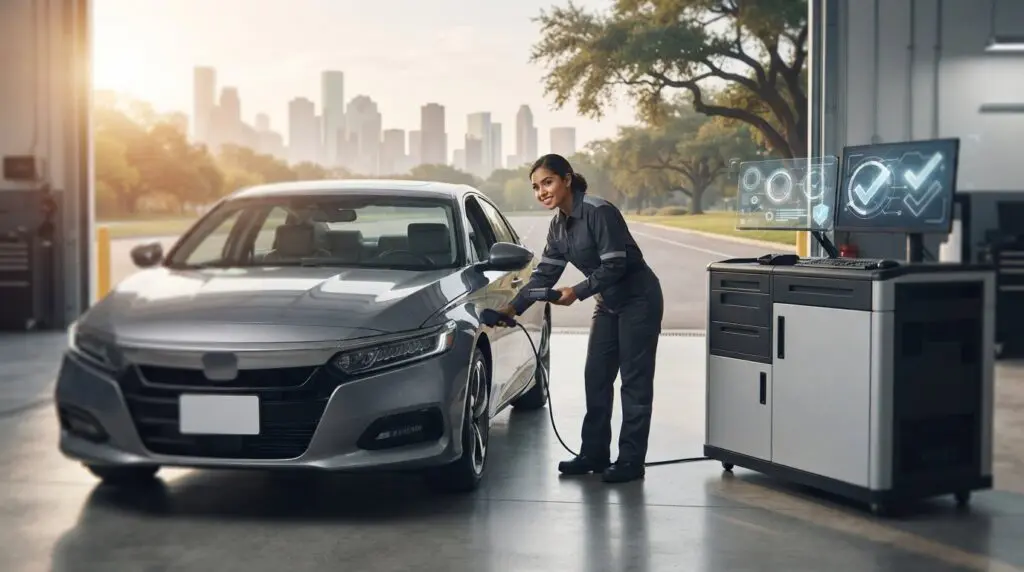
Texas abolished annual vehicle safety inspections, but skipping your station visit could still freeze your vehicle registration renewal in Houston. While physical safety checks ended statewide under House Bill 3297, understanding the state inspection requirements Texas 2026 mandates is essential for local drivers. If you live in Harris County or neighboring communities like Fort Bend and Montgomery, the state still requires an annual emissions test for most gasoline passenger vehicles between 2 and 24 model years old.
It’s completely natural to feel confused about the updated rules. Many car owners assume testing vanished entirely, only to face registration holds, unresolved Check Engine lights, or incomplete OBD-II readiness monitors at the testing lane. You don’t have to deal with wasted time or repeat visits. In this guide, you’ll learn exactly how 2026 Houston emissions testing works, what documentation to bring, and how to verify your vehicle’s readiness for a smooth, same-day pass. Here is your straightforward roadmap to staying road-legal and getting your renewal sticker without the stress.
Key Takeaways
- Understand how the state inspection requirements Texas 2026 mandates affect you, including why safety checks ended while Houston emissions testing remains mandatory.
- Identify whether your gasoline vehicle falls into the required 2-to-24 model-year testing bracket before heading to an inspection station.
- Discover the leading culprits behind surprise test failures, including illuminated Check Engine lights and incomplete OBD-II readiness monitors.
- Follow a practical preparation checklist and drive-cycle routine to ensure your car’s computerized monitors are set for testing.
- Navigate the Two Steps, One Sticker process seamlessly so you can renew your vehicle registration without tax office delays.
Texas Vehicle Inspection Rules in 2026: What Changed and What Remains?
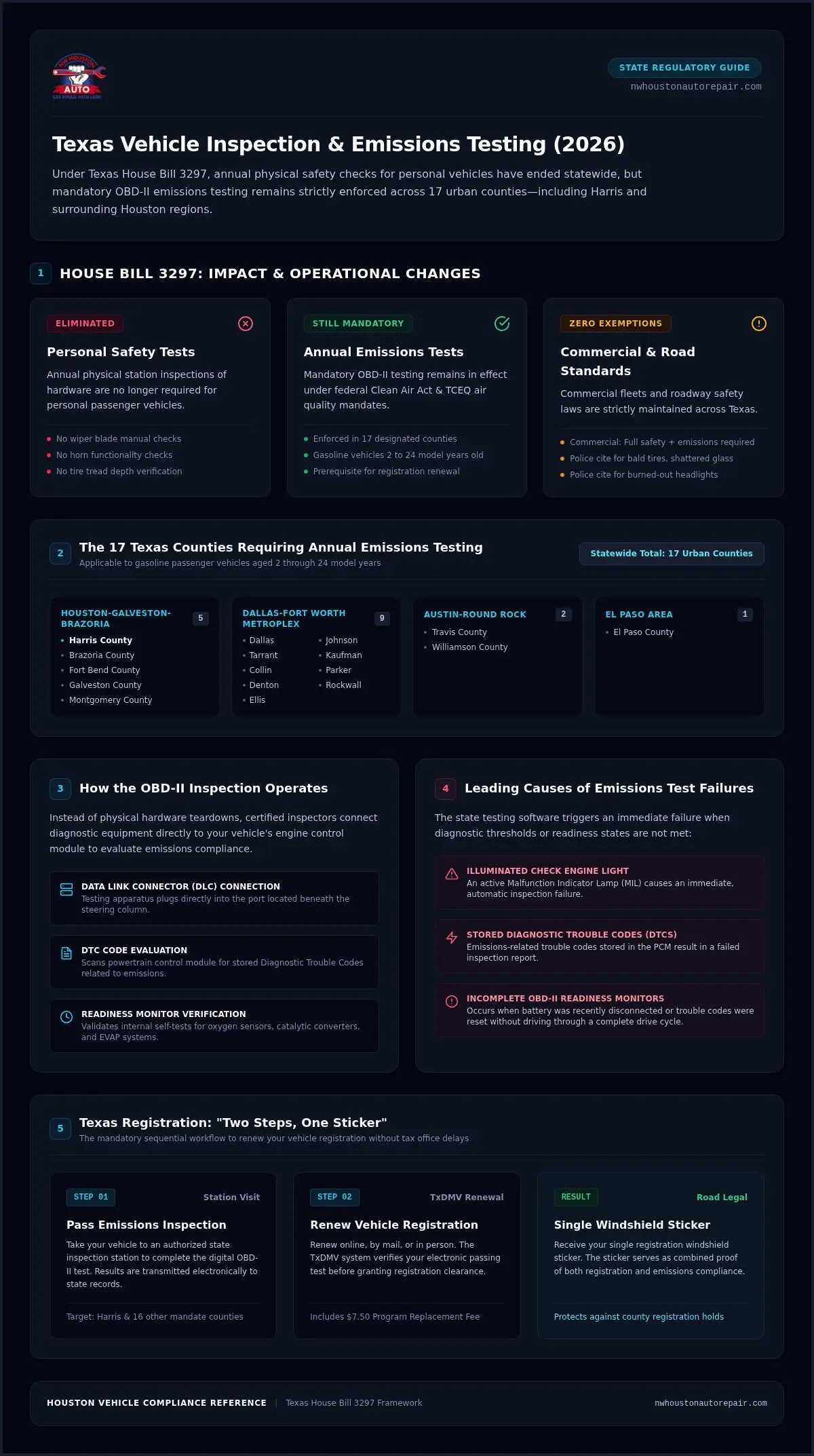
The biggest misconception circulating among Texas motorists today is that vehicle inspections are entirely a thing of the past. When Texas House Bill 3297 took effect, it eliminated the annual physical safety inspection for personal, non-commercial passenger vehicles. Technicians no longer perform hands-on tests of your windshield wipers, horn, or tire tread depth to issue an inspection certificate. However, this statutory change did not eliminate all vehicle oversight. Grasping the true scope of the state inspection requirements Texas 2026 enforces will save you from surprise registration rejections.
Commercial fleets, for instance, saw zero exemptions under the new legislation. Every commercial vehicle operating on Texas roads must still pass an extensive annual physical safety and emissions evaluation statewide. If you drive a standard passenger car, your obligations depend entirely on where your vehicle is registered.
Understanding the End of Personal Vehicle Safety Inspections
While technicians no longer check mechanical hardware during a state testing visit, drivers aren’t free from roadway standards. Texas law enforcement officers continue to cite motorists for hazardous safety defects like burned-out headlamps, bald tires, or shattered glass under the Texas Transportation Code. Additionally, eliminating the safety test did not remove your financial contribution to state programs. The state replaced the old station safety fee with an annual $7.50 Inspection Program Replacement Fee, billed directly on your registration renewal notice through the Texas Department of Motor Vehicles (TxDMV).
The 17 Texas Counties That Still Require Annual Inspections
Clean air mandates establish a completely separate testing track. Under the federal Clean Air Act and Texas Commission on Environmental Quality (TCEQ) frameworks, metropolitan regions with elevated ozone levels must preserve mandatory emissions testing. Looking at broader vehicle inspection regulations in the United States, targeted regional emissions programs are common in densely populated urban corridors.
Across Texas, 17 specific counties enforce mandatory annual emissions testing for gasoline vehicles aged 2 through 24 model years:
- Houston-Galveston-Brazoria Area: Harris, Brazoria, Fort Bend, Galveston, and Montgomery counties.
- Dallas-Fort Worth Metroplex: Dallas, Tarrant, Collin, Denton, Ellis, Johnson, Kaufman, Parker, and Rockwall counties.
- Austin-Round Rock Area: Travis and Williamson counties.
- El Paso Area: El Paso County.
Before attempting to renew your registration in Harris County, schedule a professional state inspection at an authorized facility. Complying with these updated state inspection requirements Texas 2026 guidelines ensures your vehicle passes without administrative delays.
Emissions Testing in Harris County: Mandatory Requirements for Houston Drivers
Living in the Houston metroplex means staying on top of strict environmental standards. Under the state inspection requirements Texas 2026 framework, all gasoline-powered passenger cars and light trucks between 2 and 24 model years old registered in Harris County must undergo annual On-Board Diagnostics (OBD-II) testing. Rather than checking mechanical components by hand, certified inspectors use digital analysis to verify that your vehicle’s engine control module complies with state tailpipe thresholds.
Drivers can review official vehicle inspection guidelines to confirm local testing rules before scheduling an appointment.
How the OBD-II Computerized Inspection Works
The core of the evaluation takes place through your car’s Data Link Connector, located under the steering column. An inspector plugs the state testing equipment directly into your vehicle’s onboard diagnostic computer to read diagnostic trouble codes (DTCs). If your powertrain control module stores any active emissions trouble codes, or if the malfunction indicator lamp stays triggered, the vehicle fails instantly.
The state computer also evaluates your OBD-II readiness monitors. These internal self-tests continuously check functions like oxygen sensors, catalytic converter efficiency, and the evaporative emissions system. For 2001 and newer model-year vehicles, Texas allows only one unset monitor to pass. Model years 1996 through 2000 are allowed up to two unset monitors under official TCEQ vehicle emissions inspection requirements.
Visual and Functional Hardware Checks
Digital testing is only one half of the process. Technicians also perform hands-on verifications to ensure anti-pollution equipment has not been removed, bypassed, or damaged:
- Catalytic Converter Verification: Inspecting the exhaust system to confirm all original catalytic converters remain intact.
- Gas Cap Pressure Testing: Connecting the fuel filler cap to a pressure testing rig to ensure hazardous fuel vapors cannot escape into the air.
- Tailpipe Smoke Screening: Checking for visible plumes of blue, black, or heavy white smoke during engine operation, which triggers an immediate failure.
Vehicles Exempt from Texas Emissions Testing in Houston
Not every vehicle requires an OBD-II hookup at registration renewal. Fully electric vehicles (EVs) produce zero tailpipe emissions and bypass station testing entirely. Brand-new gasoline cars are exempt during their initial multi-year window, covered by the state’s initial registration fee. Historic and antique vehicles 25 model years or older, along with diesel-powered passenger vehicles and motorcycles, are also exempt from Houston’s annual emissions test.
If your car is approaching its test window and you notice an engine alert, you can contact our experienced diagnostic team to inspect your OBD-II readiness before taking your vehicle through the lane.
Common Reasons Vehicles Fail Texas Emissions Inspections in 2026
Failing an emissions test wastes valuable time and delays your vehicle registration. Under the state inspection requirements Texas 2026 enforces, testing stations connect directly to your powertrain control module, leaving zero room for manual overrides. A single unaddressed fault code or unprepared computer monitor leads to an automatic rejection. Understanding what triggers these diagnostic rejections helps you resolve issues before you pull into the inspection stall.
If your instrument cluster displays active warnings, getting professional car diagnostics before inspection day pinpoints the root mechanical malfunction so you pass on your first attempt.
The Check Engine Light and Diagnostic Trouble Codes
An illuminated Check Engine light triggers an immediate inspection failure under Texas administrative rules. Simply clearing active trouble codes with a handheld scanner in the parking lot does not solve the problem. Doing so actually guarantees a rejection because clearing codes wipes out stored diagnostic data. Inspectors also distinguish between pending codes and confirmed trouble codes; while a pending code might not trigger the light yet, recurring faults quickly escalate into active failures that disrupt fuel efficiency and spike exhaust emissions.
Unset OBD-II Readiness Monitors
Replacing a weak car battery or jump-starting a dead vehicle clears internal computer memory. When power is interrupted, every internal OBD-II readiness monitor resets to “Not Ready.” These monitors must evaluate critical subsystems during real-world operating conditions before the vehicle accepts testing. Driving your vehicle through specific manufacturer drive cycles allows the powertrain computer to test its sensors fully. Check your system’s readiness status beforehand to prevent a preventable rejection.
EVAP Leaks and Defective Gas Caps
Evaporative emission control (EVAP) systems prevent gasoline vapors from venting directly into our Houston air. Small leaks frequently stem from simple, inexpensive components:
- Deteriorated Gas Cap O-Rings: Rubber gaskets harden and crack over time, preventing a proper seal and setting off P0440-series trouble codes.
- Faulty Purge or Vent Valves: Sticking solenoids allow fuel vapors to flow uncontrolled into the intake manifold.
- Charcoal Canister Saturation: Overfilling the fuel tank forces liquid gasoline into the vapor canister, destroying internal filters.
Replacing a dried-out fuel cap or damaged vacuum line costs very little, but addressing these minor flaws prevents inspection rejections. Once your emissions systems are verified and clear of trouble codes, you can confidently proceed through the TxDMV vehicle registration renewal guide to finalize your sticker.
Step-by-Step Checklist: How to Prepare Your Vehicle for Inspection
Passing your annual test on the first try comes down to careful preparation. While the state inspection requirements Texas 2026 mandates focus purely on computer diagnostics and emissions gear for Houston passenger cars, arriving unprepared leads to unnecessary delays. Running through a quick pre-test routine ensures your vehicle meets state standards before an inspector plugs into your diagnostic port.
For more in-depth preparation methods, explore our comprehensive Houston passing checklist before heading to the station.
Completing an OBD-II Drive Cycle
Clearing a trouble code or reconnecting a car battery wipes your vehicle’s internal computer memory. To reset those crucial readiness monitors, you must drive through an OBD-II drive cycle. This routine typically requires between 50 and 100 miles of mixed driving over several trips. Start by letting the engine idle smoothly from a cold start, accelerate gradually to 55 miles per hour on the highway, maintain steady cruising speeds, and let the vehicle decelerate naturally without sudden braking. You can verify whether your monitors have switched from “Not Ready” to “Ready” using an affordable OBD-II pocket scanner, or stop by a qualified shop to confirm status.
Gathering Required Documentation
Texas testing stations require valid proof of financial responsibility before starting an inspection. Prepare these items ahead of time:
- Current Auto Insurance: Present a physical insurance card or a digital policy copy on your smartphone.
- Matching VIN: Verify that the Vehicle Identification Number on your insurance document matches your dashboard and door jamb plate exactly.
- Active Policy Dates: Check that your effective dates cover the day of the test; expired coverage results in immediate refusal of service.
Basic Self-Checks for Road Safety and Performance
State inspectors no longer fail passenger cars for bald tires or streaky wiper blades, but your vehicle still needs to be genuinely safe for Houston freeways. Walk around your vehicle to verify functional headlights, brake lamps, and turn signals. Check tire tread depths for uneven edge wear, which signals an urgent need for an alignment. If your vehicle pulls to one side, grinds during stops, or exhibits a soft brake pedal, arrange professional brake repair to keep your family protected on the road.
Ready to guarantee your vehicle passes its annual testing requirements? Schedule your diagnostic inspection with our team to verify all system monitors and get back on the road quickly.
Texas Registration Renewal: Completing Two Steps, One Sticker in Houston
Completing your vehicle registration renewal in Harris County follows the state’s unified “Two Steps, One Sticker” system. Even with recent legislative revisions, meeting the state inspection requirements Texas 2026 enforces remains your required first step before the county issues your updated windshield sticker. Step one requires earning a passing emissions result at an authorized station. Step two allows you to process your registration payment online, by mail, or in person.
How the Digital Inspection Database Connects to TxDMV
Gone are the days of keeping track of paper inspection certificates to prove your vehicle is road-ready. When an inspector completes your OBD-II test, the station immediately transmits your vehicle identification number and passing score directly to the Texas Information Management System database. The Texas Department of Motor Vehicles links this electronic record in real time.
You can complete your test up to 90 days before your registration expiration date. Testing early gives you ample time to renew online through the Texas by Texas portal, visit your local county tax assessor-collector branch, or stop by participating grocery retail partner counters without facing registration holds.
Understanding the 15-Day Free Re-Test Rule
Receiving an inspection rejection can feel frustrating, but Texas law protects you from double charges. Motorists who fail an emissions evaluation receive one free re-test within 15 calendar days. To claim this free re-test, you must return your vehicle to the exact inspection station that performed the original evaluation. Tackling minor repairs promptly allows you to return, clear the re-test, and complete your registration well before the deadline.
Fast Diagnostics and Inspection Support at NW Houston Auto Repair and Collision
Navigating emissions standards shouldn’t feel like guesswork. Family-owned and operated since 1999, NW Houston Auto Repair and Collision provides trusted automotive care to keep Houston drivers moving. Our facility is equipped with advanced computerized diagnostics to evaluate your OBD-II readiness, pinpoint evaporative leaks, and resolve stubborn Check Engine codes before you test. We help you meet state inspection requirements Texas 2026 standards efficiently so you can renew your sticker without unnecessary delays.
Don’t let a lingering warning light block your registration renewal. Schedule your pre-inspection diagnostic check with NW Houston Auto Repair and Collision by visiting our contact page today to book your evaluation and ensure your car is fully prepared to pass.
Drive with Confidence Through Your Next Inspection
Complying with the updated state inspection requirements Texas 2026 enforces doesn’t have to disrupt your schedule. While routine safety checks are gone for passenger cars, keeping your vehicle emissions-ready protects our Houston air and guarantees your vehicle registration renewal clears without administrative holds. Taking time to resolve active trouble codes and verifying your computer monitors beforehand ensures a quick pass on your very first visit.
At NW Houston Auto Repair and Collision, we take pride in being your dependable neighborhood partner. As a family-owned and operated automotive facility serving Houston since 1999, our certified technicians use advanced computer diagnostics to solve complex emissions faults and clear dashboard warnings properly. Visit our convenient Northwest Houston location on North Freeway for complete peace of mind. Schedule your pre-inspection diagnostic check with NW Houston Auto Repair today, and hit the road knowing your vehicle is fully compliant, road-tested, and ready to roll.
Frequently Asked Questions
Do cars in Texas still need a safety inspection in 2026?
Personal passenger vehicles no longer require annual physical safety inspections in Texas. Under House Bill 3297, manual checks on wipers, tires, and horn mechanisms ended statewide. However, commercial vehicles must still undergo full annual safety checks across every county. Additionally, non-commercial passenger vehicles registered in urban regions like Houston still require mandatory annual emissions testing before registration renewal.
Which Texas counties require vehicle emissions testing in 2026?
Seventeen Texas counties enforce mandatory annual emissions tests for gasoline vehicles aged 2 through 24 model years. This includes the Houston area (Harris, Fort Bend, Montgomery, Brazoria, and Galveston), nine counties across Dallas-Fort Worth, Travis and Williamson counties in Austin, and El Paso County. If you live in these areas, meeting the state inspection requirements Texas 2026 mandates is required to renew your vehicle registration.
Can my car pass a Texas state inspection with the Check Engine light on?
No, an illuminated Check Engine light triggers an immediate, automatic inspection failure. State inspection equipment communicates directly with your powertrain control module and flags active trouble codes instantly. Never clear trouble codes right before pulling into an inspection stall; clearing codes wipes out stored internal memory and sets monitors to unready, causing another automatic failure. Fix the underlying mechanical fault first.
What documents do I need to bring to a Texas state inspection?
You only need to present valid proof of Texas auto liability insurance at the station. Inspectors accept physical printed insurance cards or digital policy cards saved on your smartphone. Verify that your policy is active on test day and check that the Vehicle Identification Number on the insurance card matches your car’s dashboard plate perfectly to avoid delays.
What should I do if my battery was disconnected right before an inspection?
Drive your vehicle for several days before heading to an inspection lane. Disconnecting a battery resets your onboard computer and sets internal OBD-II readiness monitors to “Not Ready.” Complete an OBD-II drive cycle by accumulating roughly 50 to 100 miles of mixed highway and stop-and-go driving. This allows your vehicle’s computer to evaluate emission controls and record passing statuses.
How long after passing my inspection do I have to renew my vehicle registration?
Texas gives drivers a 90-day window to complete registration renewal after passing an inspection. Under state inspection requirements Texas 2026 protocols, you should complete testing within 90 days of your sticker expiration month. The inspection station transmits your passing score electronically to the state database immediately, allowing you to renew online through TxDMV portals or at local tax offices.
What happens if my vehicle fails the Texas emissions inspection?
Texas law grants motorists one free re-test within 15 calendar days of a failed evaluation. To qualify for the waiver, you must bring the vehicle back to the exact station that conducted your initial inspection. Review the trouble codes on your Vehicle Inspection Report, complete the required repairs quickly, and return before the 15-day window expires to avoid paying another testing fee.