

Your annual vehicle inspection didn’t actually disappear when the state safety stickers were abolished in 2025. If you live in Harris County, skipping your trip to the shop could lead to a rejected registration and a major headache. Many drivers searching for an emissions inspection near me are surprised to learn that while safety checks are gone, the computer diagnostics for NW Houston remain strictly mandatory for gasoline vehicles between 2 and 24 years old. It’s frustrating to keep track of shifting Texas laws, especially when you’re worried about a check engine light or a long wait at the station.
You deserve a process that is transparent and efficient, not a guessing game that ends in a failed report and a second trip. Our team understands the local landscape and the technical mastery required to keep your car compliant and your schedule intact. We’re here to help you secure that passing status without the stress. This guide provides everything you need to pass your 2026 Texas state emissions test on your first attempt. We will break down the specific OBDII requirements for our local area, offer professional prep tips to avoid common failures, and show you how to find fast, expert service right here in your neighborhood.
Key Takeaways
- Understand why Harris County still mandates annual emissions testing in 2026 despite the statewide elimination of safety inspections.
- Learn how simple fixes like tightening your gas cap or clearing a check engine light can save you from an automatic failure.
- Discover the primary mechanical culprits behind a failed test, including faulty oxygen sensors and failing catalytic converters.
- Locate a reliable emissions inspection near me in NW Houston that provides expert diagnostics and fast, professional service.
- Find out why choosing a full-service repair shop for your inspection ensures you can fix any issues immediately and get back on the road.
Texas Emissions Requirements: Does Your Vehicle Need a Test?
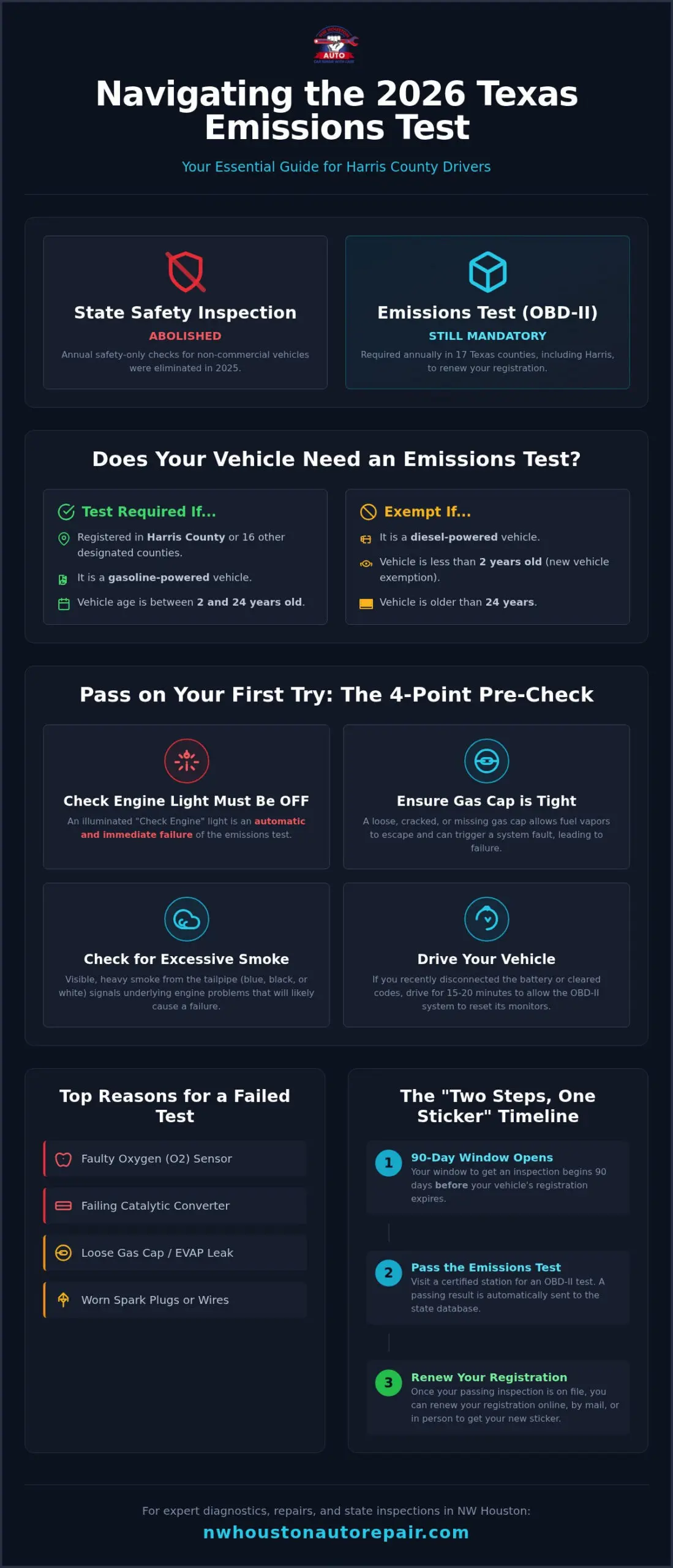
As of January 1, 2025, Texas shifted its approach to vehicle maintenance by eliminating the annual safety inspection for non-commercial vehicles. However, if you’re searching for an emissions inspection near me in the Houston area, don’t let that news mislead you into skipping your appointment. The Texas Department of Public Safety (TxDPS) still mandates annual emissions testing for gasoline-powered vehicles registered in 17 specific counties, including Harris, Fort Bend, and Montgomery. This requirement targets vehicles between 2 and 24 years old to ensure our local air quality remains within federal standards. While rural parts of the state may have moved away from these checks, our high-density metropolitan environment necessitates a more rigorous standard.
New vehicles are exempt from this requirement for their first two model years, as they typically feature the most advanced pollution control technology. Diesel-powered vehicles are also currently exempt from the emissions portion of the state test. Understanding vehicle inspection in the United States reveals that Texas is part of a broader national effort to balance driver convenience with environmental health. For Houstonians, this means your car’s computer system must be fully operational and communicating correctly with state databases to secure your registration.
Harris County vs. Non-Emissions Counties
Houston’s unique geography and traffic volume contribute to higher ozone levels, which is why Harris County residents face stricter rules than those in rural West Texas. The primary tool for this check is the On-Board Diagnostic (OBD-II) system. This internal computer monitors your engine’s performance and exhaust output in real time. If you live in a non-emissions county but work in Houston, your requirements are based strictly on where the vehicle is registered. However, if your commute involves heavy stop-and-go traffic, your emissions components often work harder and wear out faster. If you’re concerned about your car’s health, our team at NW Houston Auto Repair and Collision can perform a professional vehicle inspection to verify your system is ready for the official state test.
Identifying Your Inspection Deadline
Texas uses the “Two Steps, One Sticker” program, which syncs your inspection date with your registration renewal. You must pass your test before you can renew your tags. You have a 90-day window before your registration expires to complete this task. Check your windshield sticker for the expiration month. Don’t wait until the final week. Finding an emissions inspection near me early in that 90-day window provides a safety net. If your vehicle fails due to a minor sensor issue, you’ll have plenty of time to perform repairs without risking a citation from the City of Houston for expired registration. During this preparation period, you can also discover AMCO.NET LLC to ensure your vehicle is covered by a reliable local insurance provider.
The Ultimate Pre-Inspection Checklist: Passing the First Time
Failing an inspection is more than just a nuisance; it’s a drain on your time and your wallet. When you search for an emissions inspection near me, you want to be sure you’re walking away with a passing result on the first try. The most common hurdle is the “Check Engine” light. In Harris County, an active warning light is an immediate, non-negotiable failure. This happens because the state’s computer communicates directly with your vehicle’s On-Board Diagnostics (OBD-II) system. If that light is on, the computer is signaling a fault that could impact air quality, even if the car seems to be running perfectly.
Another simple but overlooked failure point is the fuel system. A cracked, loose, or missing gas cap can trigger a failure because it allows fuel vapors to escape into the atmosphere. Before you pull into our station, give your gas cap a firm twist to ensure it’s clicked into place. These small details are often the difference between a new sticker and a “failed” report.
The 15-Minute Self-Inspection
Walk around your vehicle before your appointment. Look for visible leaks or excessive smoke from the tailpipe, as these are clear indicators of engine inefficiency. Check your dashboard to ensure all warning lights illuminate briefly when you start the car and then turn off. While you’re at it, check your tire tread and pressure. Even though the state has shifted its focus away from safety-only stickers, maintaining these basics ensures your vehicle remains dependable in Houston’s unpredictable traffic. Reviewing the Texas emissions inspection criteria shows that the state still looks for fundamental system integrity during the process.
The OBD-II Readiness Hack
One of the biggest mistakes drivers make is clearing a check engine light right before pulling into the shop. This doesn’t work. When codes are cleared, or if you’ve recently had a car battery replacement, the internal monitors are reset to a “Not Ready” status. OBD-II readiness is a specific digital confirmation that your car’s computer has finished checking all emissions-related components. To fix this, you must complete a “drive cycle,” which typically involves 50 to 100 miles of varied driving to allow the monitors to reset. Finding an emissions inspection near me that understands these technical nuances makes the process much smoother.
What to Bring to the Station
You only need a few things to complete your visit. Ensure you have valid Texas liability insurance; we can accept either paper or digital versions on your phone. You also need a method of payment, as the state-mandated fee is paid directly to the station. In 2026, you don’t need to bring old inspection reports or registration paperwork. Your vehicle and your proof of insurance are all it takes. If you’re worried about a specific dashboard light, ask our team for advice before we start the official process.
Common Reasons for Emissions Failure and How to Fix Them
If your vehicle doesn’t pass, don’t panic. Most failures stem from a handful of common mechanical issues that our team handles daily. The most frequent culprit is a faulty Oxygen (O2) sensor. These sensors monitor the amount of unburned oxygen in the exhaust. If they fail, your engine computer can’t maintain the correct air-fuel ratio, leading to increased pollution and poor fuel economy. Replacing a sensor is a straightforward fix that restores both your car’s efficiency and its legal status.
A more serious concern involves the catalytic converter. This component converts toxic gases into less harmful emissions. You might notice a “rotten egg” smell or excessive heat under the car if it’s failing. Similarly, a contaminated Mass Air Flow (MAF) sensor can disrupt combustion by sending incorrect data about the air entering the engine. Lastly, Evaporative Emission Control (EVAP) leaks, even small ones, will trigger a failure. These leaks prevent the system from trapping gasoline vapors before they escape. Whether it is a cracked hose or a complex valve issue, these problems require technical mastery to resolve correctly. A failing or damaged exhaust system can also contribute directly to these issues, which is why addressing muffler repair Houston drivers rely on is often a critical step before your official state test.
Understanding the ‘Fail’ Report
When a car fails at an emissions inspection near me, the technician provides a report containing Diagnostic Trouble Codes (DTCs). These alphanumeric codes, like P0420 or P0171, act as a starting point for repairs. It is vital to understand that while the safety inspection was abolished for many vehicles in 2025, you still cannot Register Your Vehicle without a passing emissions result. If you’re confused by the codes on your paperwork, we provide expert car diagnostics to pinpoint exactly which sensor or valve is causing the headache.
The Path to a Re-Test
Texas law offers a silver lining for drivers who fail. You are entitled to one free re-test at the same station within 15 days of the initial failure. This window gives you time to address the underlying problem properly. Avoid the temptation to simply “reset the light” by disconnecting the battery. As we discussed earlier, this resets your OBD-II monitors to “Not Ready,” which leads to another automatic failure. Instead, invest in professional engine repair to ensure your vehicle is truly compliant. We take pride in solving these complex issues the first time, keeping you safe and legal on Houston roads.
Why Local Mastery Matters for Your Houston Inspection
When you look for an emissions inspection near me, you will find plenty of gas stations and “test-only” kiosks. These facilities are built for speed, not solutions. If your vehicle fails at a kiosk, the technician often hands you a printed report and sends you on your way. You are then left to find a real mechanic while your registration deadline looms. Choosing a full-service facility like NW Houston Auto Repair and Collision means you have a partner who can diagnose, repair, and re-test your vehicle in one convenient location. We have provided technical mastery to our neighbors since 1999, ensuring that every car we touch is both legal and dependable.
Houston summers put extreme stress on your car’s cooling system. During an emissions test, your vehicle often idles for extended periods while connected to the diagnostic computer. If your cooling system is weak, this prolonged idling can lead to sudden overheating. Our deep experience in auto air conditioning repair and engine cooling allows us to spot these vulnerabilities before they become roadside emergencies. We handle everything from routine oil changes to the most complex mechanical restorations with the same level of precision and care.
A Community-Focused Approach
Being family-owned means we answer to you, not a corporate board in another state. We believe in total transparency throughout the inspection process. If we find a problem, we don’t just tell you; we show you exactly what is happening under the hood. This neighborly approach has made us a trusted partner for thousands of local drivers. For those looking for more than just a sticker, our comprehensive auto services cover every inch of your vehicle to prevent future breakdowns and keep your property safe.
Specialized Electrical Expertise
Modern emissions testing is essentially a high-stakes digital conversation between our equipment and your car’s computer. It is an electrical system check at its core. Many shops shy away from complex wiring issues or stubborn diagnostic codes that won’t clear. Our auto electrical repair team thrives on these challenges. A flickering dashboard light or dimming headlights during idle can signal a failing charging system, which is why drivers experiencing these symptoms should also consider car alternator repair in Houston before arriving for their official state emissions test. We have the advanced tools and the technical patience to solve “unfixable” emissions codes that other stations simply cannot handle. With over 25 years of Houston automotive heritage, we have seen every evolution of vehicle technology and know exactly how to keep your car compliant with Texas law. Don’t risk a failure at a generic kiosk. Contact our NW Houston team today to schedule an inspection with experts who can actually provide a solution if a problem arises.
Book Your Emissions Inspection in NW Houston Today
Securing your registration shouldn’t be a source of anxiety. When you choose a professional emissions inspection near me, you are opting for a streamlined experience that respects your time. Our facility is designed to handle the technical requirements of the Texas Department of Public Safety with surgical precision. While generic stations might leave you waiting in the heat, we invite you to relax in our comfortable waiting area. Our experts handle the digital communication with the state’s database, ensuring your results are transmitted accurately and immediately. It’s a professional health check that confirms your vehicle is operating at peak efficiency.
We understand that Houston drivers lead busy lives. That is why our process is built for speed without sacrificing thoroughness. Once you arrive, our technicians perform a swift yet comprehensive scan of your vehicle’s emissions control systems. We check everything from your exhaust integrity to the internal computer monitors. If your vehicle is ready, the entire process is finished before you’ve even finished your coffee. You walk away with the peace of mind that your car is safe for the environment and fully compliant with local laws.
Beyond the Inspection
Efficiency is about more than just a fast test. You can maximize your visit by combining your state mandate with a synthetic oil change to keep your engine running cool in the Texas humidity. We also include a complimentary tire pressure check with every inspection because we believe in proactive care. Our location is strategically positioned to serve the NW Houston community with the neighborly warmth you expect from a family-owned establishment. Whether you need routine maintenance or complex collision repair, we are equipped to handle your vehicle’s entire lifecycle under one roof.
Ready to Pass?
Avoid the frustration of long lines and generic service. Contact us directly to check current wait times or to schedule your visit at a time that fits your calendar. Don’t settle for a long line at a generic emissions inspection near me when you can have expert service in minutes. Remember our final checklist before you head our way: bring your valid Texas liability insurance and ensure your gas cap is tightened. These two simple steps prevent the most common administrative and mechanical delays. We take pride in our heritage and our ability to solve problems that other shops simply ignore. Take the stress out of your registration renewal and trust the experts who have been serving this community for over 25 years. Schedule Your Inspection at NW Houston Auto Repair and Collision today and experience the difference that professional mastery makes.
Drive Legal and Safe: Secure Your Houston Registration Today
Navigating the 2026 Texas emissions requirements doesn’t have to be a stressful ordeal. While the state has simplified the process by removing safety stickers, the smog check remains a vital gatekeeper for your vehicle registration in Harris County. By checking your gas cap and addressing any active warning lights before your visit, you significantly increase your chances of passing on the first try. Remember that your vehicle’s computer tells the story of its health, and staying ahead of maintenance keeps that story positive.
When you are looking for an emissions inspection near me, choose a partner that offers more than just a checklist. Since 1999, our family-owned shop has combined neighborly warmth with the expert diagnostic equipment needed to handle all makes and models. We don’t just identify problems; we provide the technical mastery to fix them correctly the first time. Our goal is to keep you safe, legal, and confident behind the wheel. Stop worrying about your registration deadline and let our seasoned team handle the details for you.
Book Your Houston State Inspection & Repair Today and experience the reliability of a shop that treats you like community. We look forward to seeing you soon!
Frequently Asked Questions
How much does an emissions inspection cost in Houston?
The state of Texas sets a maximum fee for emissions testing that you pay directly to the inspection station at the time of service. While the annual safety inspection was abolished in 2025, the emissions component remains a separate cost for Harris County residents. You don’t pay this fee to the DMV during registration; instead, it is collected by our technicians when we perform the digital diagnostics.
Can I pass the Texas emissions test if my check engine light is on?
You cannot pass the Texas emissions test with an active check engine light. The state’s diagnostic system is designed to trigger an automatic failure if the On-Board Diagnostic (OBD-II) system reports a current fault. If your light is on, we recommend professional diagnostics to identify the underlying issue before you begin the official inspection process. This saves you from the frustration of a failed report and a mandatory re-test.
What happens if my car fails the emissions inspection?
If your vehicle fails, you will receive a diagnostic report detailing the specific trouble codes that caused the rejection. Texas law provides a 15-day window for you to perform repairs and return to the same station for one free re-test. This window is essential for fixing sensors or valves that prevent your car from meeting local air quality standards. Our team can help interpret these codes and provide the necessary repairs to get you back on the road.
How long does a vehicle emissions inspection take?
A typical emissions inspection usually takes between 15 and 30 minutes once your vehicle is in the service bay. The process involves connecting your car to the state’s computer system and performing a digital handshake to verify all monitors are functioning. While you wait in our comfortable lobby, we handle the technical paperwork and data transmission to the state. This efficiency ensures you can get back to your day with a passing status quickly.
Do I need an appointment for a state inspection in NW Houston?
While we welcome walk-ins, scheduling an appointment is the best way to avoid peak wait times at our shop. Searching for an emissions inspection near me often leads to long lines at generic gas stations. Calling ahead ensures our team is ready to serve you immediately. This proactive approach helps you secure your passing status without disrupting your entire afternoon schedule. We pride ourselves on providing fast, professional service to our NW Houston neighbors.
Does a diesel vehicle need an emissions test in Harris County?
Diesel-powered vehicles are currently exempt from the emissions portion of the Texas state inspection in Harris County. Only gasoline-powered vehicles between 2 and 24 years old require the OBD-II test to meet local air quality standards. However, diesel owners should still perform regular maintenance to ensure their vehicles remain efficient and dependable on Houston’s busy highways. We can provide a comprehensive safety check even if the state no longer mandates the annual safety sticker.
How many miles should I drive after resetting my battery before an inspection?
You should typically drive between 50 and 100 miles of varied city and highway traffic after a battery reset. This “drive cycle” allows your car’s computer to complete its internal self-tests and reach a “Ready” status. If you come in for an emissions inspection near me too soon after a battery change, the system will reject the test because the internal monitors haven’t finished their diagnostics. This is a common reason for unexpected inspection failures. Houston’s extreme heat can also accelerate wear on your vehicle’s charging system, so if you notice dimming lights or electrical irregularities after a battery reset, it may be worth exploring expert car alternator repair in Houston to rule out a failing alternator before your inspection appointment.
Is there a grace period for expired inspections in Texas?
Texas law does not provide a formal grace period for expired inspections. You must have a passing inspection result within the 90-day window before your vehicle registration expires to renew your tags successfully. Driving with an expired registration sticker can result in citations from local law enforcement. It is best to complete your inspection early in that three-month window to ensure you have time for any repairs if a failure occurs.