
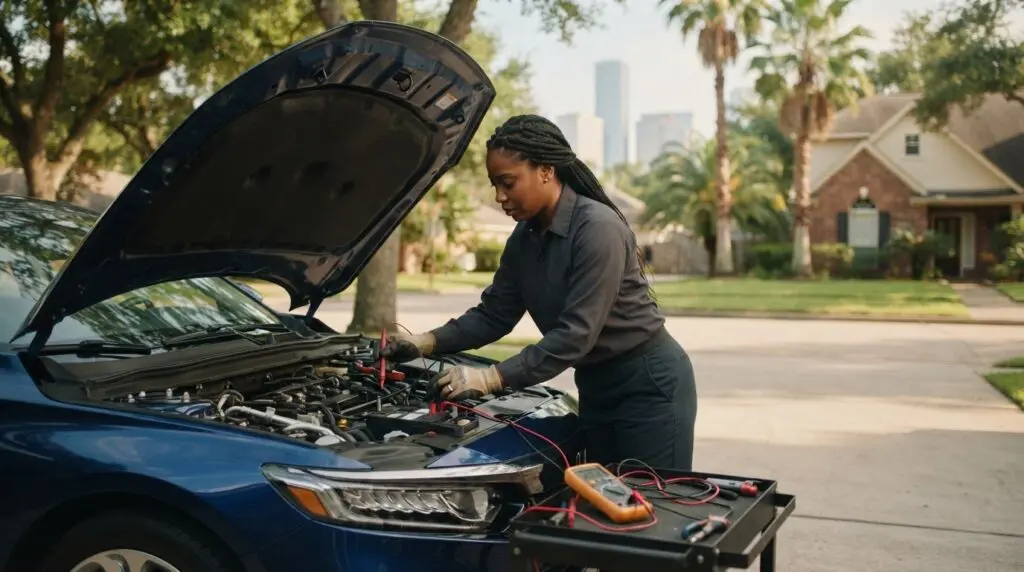
A new battery may not solve the problem. If your car keeps needing a jump in Houston, the cause could be a weakened battery, a charging-system fault, or an electrical component drawing power while the car is parked. Troubleshooting car battery drain in Houston starts with separating these possibilities instead of replacing parts and hoping for the best.
It’s frustrating when your vehicle won’t start just when you need it. Houston’s heat can put added strain on a battery, but repeated starting trouble deserves a closer look. A basic visual check may reveal an obvious cause, while testing the charging system or tracing a parked-car drain may require professional equipment.
This guide explains clues that can point to a weak battery, a charging issue, or a parasitic drain, along with safe checks you can make at home and signs it’s time for professional help. NW Houston Auto Repair and Collision is a family-owned Houston business, established in 1999, that offers auto electrical repair for drivers who need help with an electrical problem.
Key Takeaways
- A car that won’t start has lost usable battery charge, but that symptom alone doesn’t reveal why.
- A weak battery, charging-system fault, and parked-car electrical drain can all contribute to repeated starting trouble.
- For troubleshooting car battery drain in Houston, note when the battery goes flat and what changed before the problem began.
- Use basic observations as a starting point, then seek professional testing if the cause remains unclear or the battery keeps going flat.
- Replacing the battery without checking the charging system and parked circuits may leave the original problem unresolved.
Why Does a Car Battery Keep Dying in Houston? Start With the Symptoms
A car that starts one day and struggles the next can make it hard to know whether you can count on it for your next trip. Start with the clues. In troubleshooting car battery drain in Houston, remember that “drain” describes a loss of usable charge, not its cause. The Automotive battery supplies power to start the vehicle and support its electrical system, but a no-start doesn’t explain why the charge ran low.
The battery may be worn or unable to hold charge. It may also be in usable condition but undercharged because of a charging-system fault, or drained while the car is parked. These problems can look alike from the driver’s seat, so treat symptoms as clues rather than a diagnosis.
What signs suggest a battery-drain problem?
Repeated slow cranking, dim lights, or a vehicle that won’t start after sitting can all point to low battery charge. A click when you turn the key or a warning light may also be part of the picture, but neither proves the battery is the cause. Starting trouble can stem from more than one electrical or vehicle issue.
Keep a short record of when the problem happens, how long the car sat, and whether it starts more reliably after a drive. Note recent repairs or changes too, such as a newly installed accessory. These details help a technician look for a pattern instead of relying on a single no-start episode.
Is the battery bad, or is something draining it?
A worn battery may no longer hold enough charge to start the car. A discharged battery, on the other hand, may still be usable but have lost charge. An ongoing electrical draw while the vehicle is off, or a charging system that isn’t replenishing the battery during operation, can repeatedly leave it low.
A jump-start may get the engine running, but it doesn’t fix the reason the battery went flat. Don’t assume replacement is the answer based on a no-start alone. Battery and charging-system testing can help determine whether the battery is failing or another issue is affecting its charge.
How can Houston conditions factor into battery concerns?
Houston heat can affect battery condition, so it’s worth mentioning when starting trouble appears. But heat by itself doesn’t identify a failed battery or an electrical drain. Share your usual driving pattern, including frequent short trips or long periods parked, since that context may help guide the investigation.
Symptoms provide clues, while battery and circuit tests help identify the cause. If the problem repeats or remains unclear, professional testing can help distinguish battery trouble from a charging or electrical issue. You can also review car diagnostics information.
Three Common Causes of Car Battery Drain: Battery, Alternator, or Parked Circuit
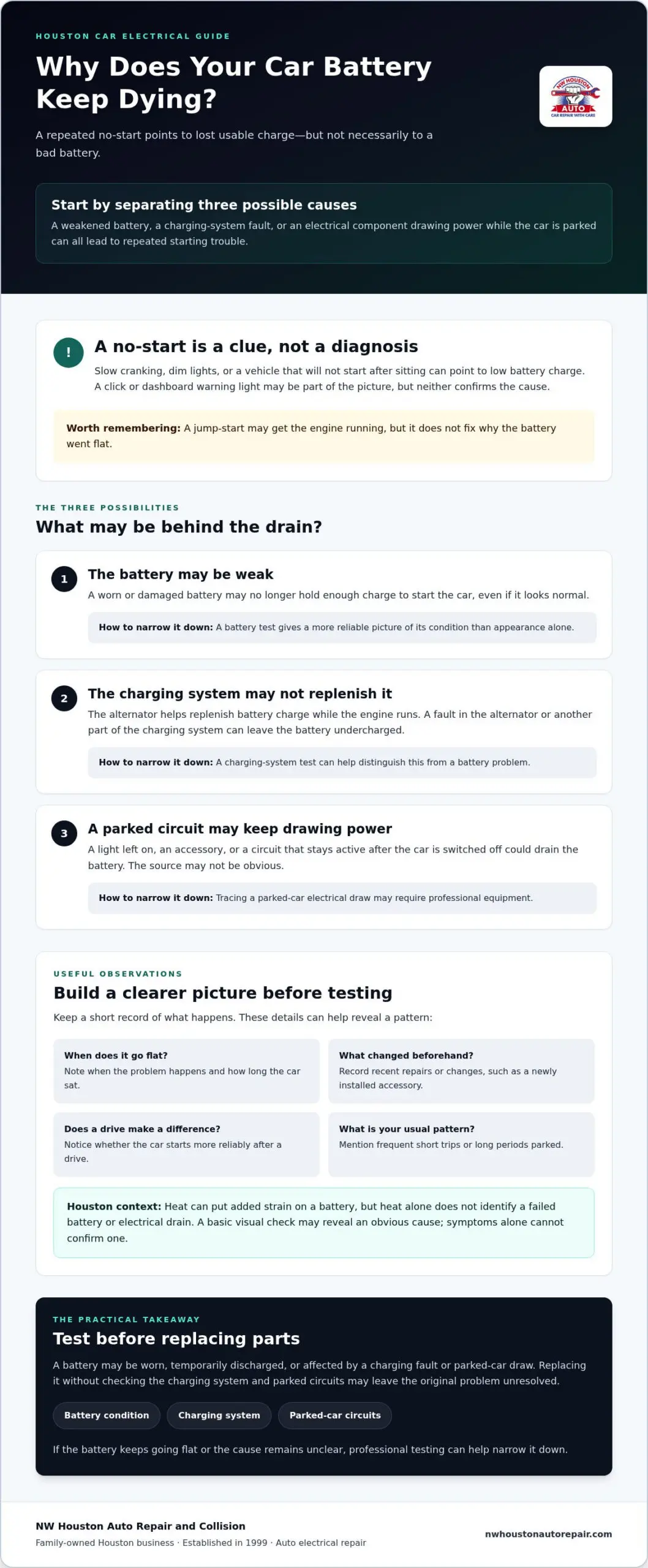
A battery that keeps losing charge can point to three different problems: the battery may be weak, the charging system may not replenish it, or an electrical circuit may continue drawing power while the car is off. These causes can produce similar starting trouble, so no single symptom confirms which one is responsible. In troubleshooting car battery drain in Houston, testing helps narrow the possibilities before parts are replaced.
Could the battery itself be failing?
A worn or damaged battery may struggle to supply enough power to start the vehicle, even if its exterior looks normal. A battery test gives a more reliable picture of its condition than appearance alone. If testing indicates replacement is needed, explore the shop’s car battery replacement service. Have the cause of the discharge checked too, rather than assuming a new battery will resolve repeated trouble.
Could the alternator or charging system be responsible?
The alternator helps replenish the battery’s charge while the engine runs. If it or another part of the charging system isn’t working properly, the battery may remain undercharged during normal vehicle use. A charging-system test can help distinguish this from a battery problem. A dashboard light or a no-start is a reason to investigate, not enough on its own to diagnose an alternator fault. For more background, see this car alternator repair guide.
What can keep drawing power after the car is parked?
Some electrical use continues after a vehicle is switched off, but an excessive or persistent draw can drain the battery. A light left on, an accessory, or a circuit that stays active could be involved. The source may not be obvious: an interior light can be hard to spot in daylight, and an electrical fault may leave no visible clue. A systematic test can help identify where power is going. The Common Car Electrical Problems overview from Universal Technical Institute also explains how issues beyond the battery can affect a vehicle’s electrical system.
A weak battery can’t hold charge, a charging fault can leave it undercharged, and a parked circuit can draw power after shutdown. NW Houston Auto Repair and Collision offers auto electrical repair for drivers who need help narrowing down an electrical concern. The next step is to check the possibilities rather than guess at a part.
How to Troubleshoot Car Battery Drain in Houston Without Guessing
Use a steady sequence: observe the pattern, make basic visual checks, then arrange professional testing if the problem continues. For troubleshooting car battery drain in Houston, a useful record of what happens can give a technician better clues than a guess about which part has failed.
What can you check before arranging service?
After parking, check that the doors and trunk are fully closed and that interior lights appear to be off. Look for an accessory you may have left plugged in or switched on, but don’t remove parts or disturb wiring. Think back to recent repairs or added accessories, and note when the battery goes flat.
Track whether the issue follows frequent short trips, overnight parking, or a longer period without driving. Record how often the vehicle is used and whether it starts after being driven. This simple timeline can help distinguish a recurring pattern from a one-time no-start.
When should you stop DIY battery-drain checks?
Stop if troubleshooting would require exposing wires, removing fuses, or using electrical equipment you don’t know how to operate. Don’t bypass fuses, probe unfamiliar wiring, disconnect components, or change vehicle settings without guidance specific to your vehicle. These steps can create safety risks or complicate diagnosis.
Take extra care with hybrid vehicles. Don’t inspect or handle high-voltage components yourself. A parasitic draw test involves measuring electrical use while the vehicle is off, and the guide to performing a parasitic draw test from Universal Technical Institute provides technical background. Leave hands-on testing to someone with the appropriate knowledge and equipment.
What should you tell a Houston repair shop?
Share the vehicle’s year, make, and model, plus the battery’s age if you know it. Describe warning lights, recent repairs, accessories that were added, how often you drive, and how long the vehicle typically sits before it won’t start. Clear details help the shop understand the conditions around the problem.
Before arranging service, ask whether the evaluation includes checks of the battery, charging system, and parked-current draw. A professional assessment can help separate these possible causes. NW Houston Auto Repair and Collision offers auto electrical repair for drivers seeking help with vehicle electrical concerns. Confirm what testing is appropriate for your vehicle rather than attempting checks that feel unfamiliar.
How a Technician Can Narrow Down a Repeated Battery-Drain Problem
A repeated battery problem calls for a methodical diagnosis, not a guess about which part to replace. A technician can begin by checking the battery’s condition and the charging system’s performance, then investigate whether power is being drawn while the vehicle is parked. The exact process depends on the vehicle and its symptoms, but each step helps narrow the possibilities.
Why test the battery and charging system first?
Battery testing can show whether it can hold and provide charge. Charging-system checks help determine whether the battery is being replenished while the engine runs. Considering both results gives more useful context than treating a dead battery as proof that the battery itself has failed. Ask what was tested and how the results support the recommended repair. A clear explanation should distinguish confirmed findings from assumptions.
How can a technician trace a parked-car electrical draw?
If the battery and charging performance don’t explain the repeated discharge, a technician may investigate current draw while the vehicle is off. Vehicle systems may need time to settle after shutdown. The waiting period and test method can vary by make and model.
To narrow down the source, the technician may isolate circuits methodically and observe whether the draw changes. This can point to a specific circuit or component instead of relying on random parts replacement. The process requires appropriate equipment and vehicle-specific knowledge, so leave electrical testing to a professional if it’s outside your experience.
How do you make sense of the diagnosis?
Ask for a plain-language summary: which component or circuit failed, what test results support that finding, and whether any other suspected causes remain unconfirmed. It’s reasonable to ask what has been established and what would require further investigation before approving a repair.
For troubleshooting car battery drain in Houston, a clear explanation matters as much as the test sequence. NW Houston Auto Repair and Collision offers auto electrical repair for drivers who need help addressing electrical concerns. If your vehicle keeps losing charge, contact the Houston team to discuss your electrical concern.
When to Get Professional Battery-Drain Help in Houston
Repeated battery trouble is a good reason to seek professional auto electrical repair, especially when the battery goes flat again after a boost or the cause isn’t clear. A replacement alone may not resolve the issue if a charging fault or parked circuit is still affecting the battery. Testing can help identify what needs attention before you decide on a repair.
What should you do if the car will not start?
Put safety first. If you’re considering a jump-start, follow your vehicle owner’s manual. If you’re unsure about the procedure or the battery appears damaged, seek qualified assistance instead. Avoid repeated attempts when the vehicle still won’t start, and don’t handle unfamiliar electrical components.
What should you ask before authorizing repairs?
Ask which tests identified the problem, what the results show, and whether other likely causes were considered. Request a plain-language explanation of the recommended repair and any uncertainty that remains. Confirm service details directly with the shop rather than assuming availability or timing.
Where can Houston drivers go for electrical diagnosis?
NW Houston Auto Repair and Collision is a family-owned and operated Houston business established in 1999. Its services include auto electrical repair, a relevant option when repeated no-start trouble may involve more than the battery itself.
If your vehicle keeps losing charge, contact NW Houston Auto Repair and Collision to discuss next steps.
Take the Guesswork Out of the Next No-Start
A battery that keeps going flat needs more than another jump-start. The cause may be a battery that can’t hold charge, a charging-system issue, or an electrical draw while the vehicle is parked. Note when the problem happens and what changed beforehand, then leave unfamiliar electrical testing to a professional. For troubleshooting car battery drain in Houston, testing the battery, charging system, and parked circuits can help identify the right next step instead of relying on symptoms alone.
NW Houston Auto Repair and Collision is a family-owned and operated Houston business established in 1999. The shop offers auto electrical repair for drivers looking into repeated starting or battery concerns. Ask what was tested, what the results show, and whether any possible causes remain unconfirmed.
Ready to discuss your vehicle’s symptoms? Contact NW Houston Auto Repair and Collision to discuss battery-drain diagnosis. With a clearer picture of the issue, you can move forward with greater confidence and get back to planning your trips.
Frequently Asked Questions
Why does my car battery keep dying overnight?
A battery that’s flat by morning may be weak, undercharged, or losing power through a circuit while the vehicle is parked. A light left on, an accessory, or a component that doesn’t switch off could be involved, but none of these possibilities is a diagnosis. Note when the problem occurs and how long the car sat. Before replacing parts, ask for battery, charging-system, and parked-current checks.
Can Houston heat cause a car battery to drain?
Houston heat can contribute to battery wear and may make an existing battery concern more noticeable, but hot weather alone doesn’t explain every no-start. Repeated discharge can also involve charging performance or power being drawn while the car is parked. Have the battery and electrical system tested to find the likely cause. Tell the technician how long the vehicle typically sits between drives, since that context may help guide the evaluation.
How can I tell if my battery or alternator is causing the problem?
Starting symptoms alone usually can’t distinguish a weak battery from a charging-system fault. A battery test assesses the battery’s condition, while charging-system testing checks whether it’s being replenished as intended while the engine runs. If the battery goes flat after the vehicle has been parked, a parked-current check may also be appropriate. Ask how each test result supports the diagnosis before deciding which repair is needed.
Can I test for a parasitic battery drain at home?
You can look for obvious causes, such as a light that remains on or a recently added accessory, and keep track of when the battery loses charge. Measuring current or isolating circuits involves electrical testing that varies by vehicle. Don’t probe unfamiliar wiring, bypass fuses, or handle high-voltage components in a hybrid. If basic visual checks don’t reveal the cause, professional troubleshooting car battery drain in Houston can help identify what’s happening safely.
Should I replace my car battery if it keeps going dead?
Not automatically. A battery may be worn or damaged, but repeated discharge can also come from a charging-system issue or an electrical draw while parked. Testing helps determine whether the battery itself needs replacement and whether another fault could drain a new one. Ask the technician to explain what was tested, what the results showed, and how those findings support the recommended repair before authorizing work.
When should I take a car with battery drain to an auto electrical shop?
Arrange professional diagnosis if the battery repeatedly goes flat, the vehicle needs frequent boosts, warning lights appear, or the cause remains unclear after safe visual checks. A technician can evaluate battery condition, charging performance, and possible current draw while parked. Stop DIY checks if they involve unfamiliar wiring or electrical components. When contacting a Houston shop, describe the symptoms, recent repairs, and how often the vehicle is driven.