

Did you know that while Texas officially scrapped safety inspections for most passenger cars, failing to prepare for your 2026 registration could still leave you stuck without a valid sticker? It’s confusing to keep track of what changed with House Bill 3297, especially when you’re just trying to get through your Houston commute without a headache. We know the frustration of waiting in line only to be told your car failed for a simple fix you could have handled at home. That’s why we created this comprehensive Texas vehicle inspection checklist to help you master the 2026 landscape with total confidence.
You likely feel a bit of relief that the old safety checks are gone, but don’t let your guard down just yet. If you live in Harris County, your gas-powered vehicle still faces mandatory annual emissions testing. A single glowing light on your dashboard will trigger an immediate failure and a wasted trip. We’ve helped our neighbors stay on the road since 1999, and we want to ensure you get that “pass” result on your very first try. This guide breaks down the exact 2026 Harris County requirements and explains how to solve common issues before they become expensive problems. Follow our lead to save time, avoid unnecessary fees, and keep your vehicle dependable.
Key Takeaways
- Master the updated 2026 regulatory standards and use our expert Texas vehicle inspection checklist to verify your car’s status before your registration expires.
- Clarify the impact of House Bill 3297 on non-commercial safety inspections while maintaining the stopping power and visibility your family needs on Houston roads.
- Prepare for mandatory Harris County emissions testing by learning how to troubleshoot “Check Engine” lights and OBD-II computer errors before they cause a failure.
- Perform quick, effective DIY checks on your tires and exterior lighting to catch simple fixes that often lead to unnecessary re-test fees.
- Experience the efficiency of fast-track inspection lanes at a trusted, family-run station dedicated to getting you back on the road safely and quickly.
Navigating the 2026 Texas Vehicle Inspection Requirements
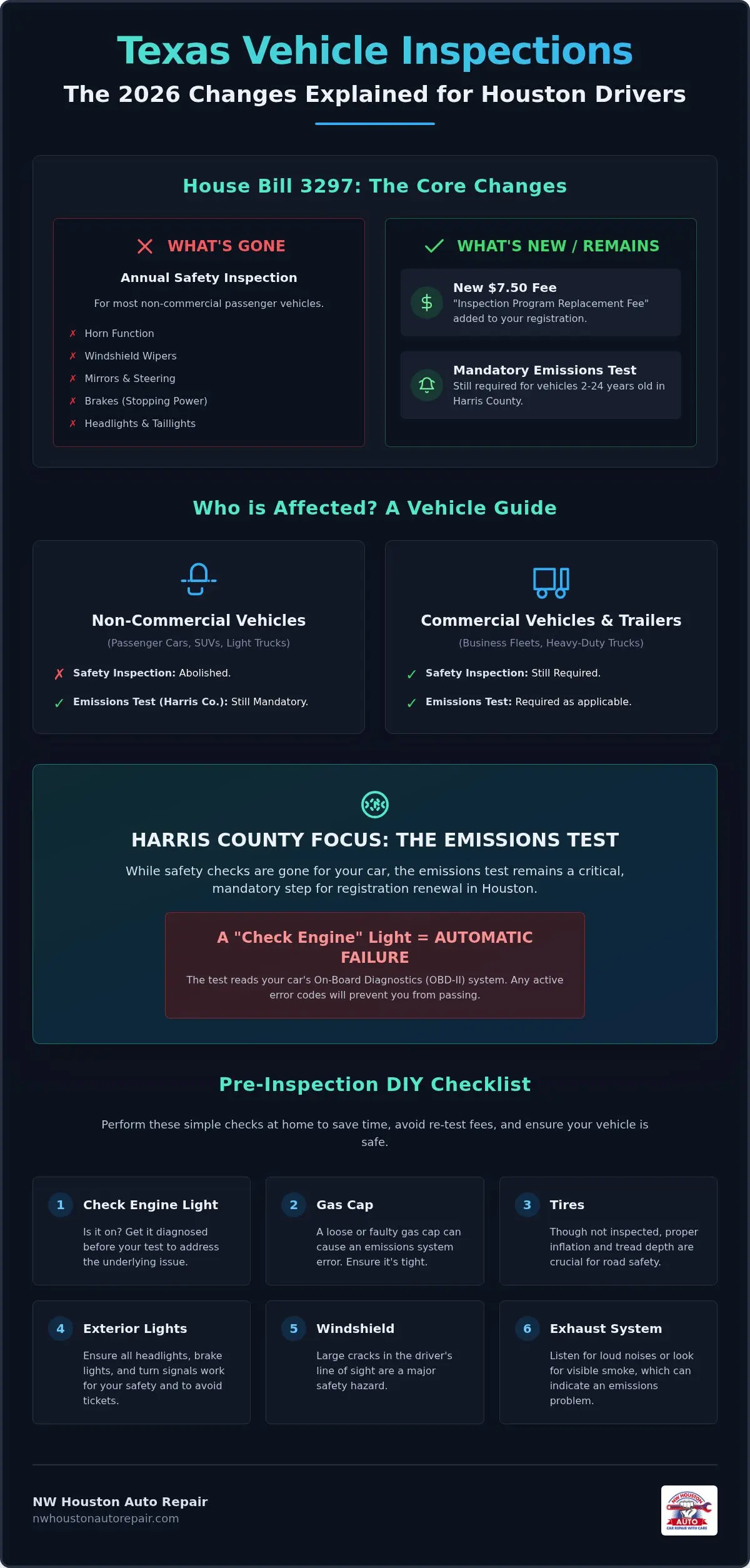
Since January 1, 2025, the way we handle car registration in Texas has undergone a massive transformation. House Bill 3297 effectively ended the requirement for annual safety inspections for non-commercial vehicles across the state. However, don’t throw away your Texas vehicle inspection checklist just yet. If you drive a standard passenger car or truck, you no longer need a technician to check your wipers, horn, or mirrors to get your sticker. Instead, you’ll pay a $7.50 Inspection Program Replacement Fee when you renew your registration. This fee supports the same state programs previously funded by the safety inspection, so the cost to the state hasn’t actually vanished.
Across the Vehicle inspection in the United States, programs vary wildly; Texas has carved out a unique path that separates mechanical safety from environmental health. While the state relaxed the rules on mechanical components for most drivers, it maintained strict standards for air quality in populous areas. This means your preparation shifts from checking tread depth to ensuring your engine’s computer is communicating correctly with state systems.
What Has Changed for Houston Drivers in 2026?
Houstonians now experience a simplified process, but it’s not a complete free pass. The shift to the State Administrative Fee means you handle the financial part at the tax office, but the mechanical part still happens at a certified station if your car is between 2 and 24 years old and gas-powered. Some key distinctions for 2026 include:
- Non-commercial vehicles skip the annual mechanical safety check.
- A $7.50 administrative fee is added to your registration bill automatically.
- Commercial vehicles and trailers still require full annual safety inspections.
- Emissions testing remains mandatory for all vehicles registered in Harris County.
Your registration renewal is still legally tied to your vehicle inspection status. You can’t skip the shop if you’re registered in Harris, Montgomery, or Fort Bend counties, as these areas require an annual smog check to maintain air quality standards.
The Role of the Texas Department of Public Safety (DPS)
The Texas Department of Public Safety (DPS) still manages the digital infrastructure that connects your emissions results to your registration profile. While safety checks are gone for most, the digital link remains vital. Your passing emissions result is uploaded instantly to the state’s database so you can renew your sticker online or in person. If you’re looking for a certified station in the NW Houston area, our family-owned shop has been a trusted partner since 1999. We can help you walk through your Texas vehicle inspection checklist to ensure your emissions systems are ready for the state’s computer. Remember that your emissions test must be completed within 90 days of your registration expiration to avoid late penalties and potential fines.
The Essential Safety Checklist: What Inspectors Verify
While the 2025 legislative shift removed the annual safety sticker requirement for personal cars, the Texas Vehicle Inspection Program still mandates rigorous mechanical checks for commercial vehicles and trailers. Even if you drive a standard SUV, following a Texas vehicle inspection checklist remains the best way to ensure your car is roadworthy for the high speeds of the Sam Houston Tollway. Mechanical failures don’t care about new laws. Staying proactive about these core systems prevents accidents and protects your liability in the event of a collision.
Steering and suspension systems are often overlooked until a part snaps. Inspectors for commercial fleets look for excessive play in the steering wheel and worn ball joints that can cause a vehicle to wander across lanes. For Houston drivers, the constant stress of potholes and construction zones can quickly degrade your shocks and struts. A stable suspension isn’t just about comfort; it’s about maintaining tire contact with the road during emergency maneuvers.
Visibility and Glass Requirements
Visibility is non-negotiable. Your windshield wipers must effectively clear moisture without streaking or chattering. If your blades are torn or the rubber has hardened from the Texas sun, they will fail a professional inspection. We also look for cracks in the driver’s field of vision. While a small chip might be okay, a long spiderweb crack often requires a professional windshield repair to restore structural integrity. Mirrors must be present, secure, and free of major cracks that distort your rear view. Additionally, Texas law remains strict on window tint; front side windows must allow at least 25% of light to pass through to remain legal in 2026.
Brakes and Tires: The Safety Foundation
Brakes and tires are the most critical items on any Texas vehicle inspection checklist. Inspectors use a specialized gauge to ensure your tires have at least 2/32-inch of tread depth. Anything less is considered “bald” and creates a massive hydroplaning risk during our frequent Houston downpours. Your braking system must also demonstrate consistent stopping power without pulling the vehicle to one side. Beyond the pads, every bulb counts. This includes your headlights, turn signals, and the often-forgotten third brake light in the rear window. A common hidden failure is the parking brake; it must be able to hold the vehicle on a grade, yet many drivers never use it until inspection day. If you’re worried about a shimmy in your pedal or a flickering dash light, connect with our experts for a comprehensive safety review.
Houston Emissions Testing: Passing the Harris County Standard
While most of Texas has moved away from annual safety checks, Harris County remains a mandatory emissions testing zone in 2026. This requirement exists to meet federal air quality standards in our densely populated region. If you drive a gasoline-powered vehicle between 2 and 24 years old, your Texas vehicle inspection checklist must prioritize the On-Board Diagnostics (OBD-II) test. This digital handshake between your car’s computer and the state’s equipment determines if your engine is running clean or polluting the Houston air.
Inspectors focus on how your vehicle manages fuel and exhaust. This isn’t just about what comes out of the tailpipe. It’s about the sensors that monitor the process. Common culprits for failure include faulty oxygen (O2) sensors or a dirty Mass Air Flow (MAF) sensor. These small components tell your engine how much fuel to burn. When they fail, your car might run “rich,” wasting gas and increasing emissions. Even a simple gas cap can cause a major headache. If the seal is cracked or the cap fails a pressure test, fuel vapors escape into the atmosphere, resulting in an immediate failure.
The OBD-II System and Your Check Engine Light
A glowing Check Engine Light is an automatic failure in Harris County. Don’t ignore it and hope for the best. This light indicates that your car’s computer has detected a fault in the emissions system. If you’re seeing that amber glow, you need professional car diagnostics to identify the specific trouble code before you head to the inspection station. You also can’t simply clear the codes and drive straight to the shop. Your car uses “Readiness Monitors” to verify that systems are functioning over time. If these monitors aren’t “Ready,” the inspector’s computer will reject the test. At NW Houston Auto Repair, we specialize in resetting these monitors and ensuring your vehicle’s brain is ready to talk to the state.
Exhaust and Fuel System Integrity
Beyond the computer, a visual and physical inspection of the exhaust and fuel systems is essential. Inspectors check for audible exhaust leaks or cracks in the manifold that could skew sensor readings. The catalytic converter must be present and show no signs of tampering. We also verify the integrity of the Evaporative Emission (EVAP) system, which prevents raw gasoline vapors from leaking. Common failure points include:
- Leaking exhaust pipes or mufflers.
- Damaged or missing catalytic converters.
- Cracked vacuum lines in the EVAP system.
- Worn fuel cap seals that fail to hold pressure.
Fixing these issues before your test saves you the stress of a “fail” result and the time required for a re-test. Our team has been troubleshooting these complex systems since 1999, ensuring our neighbors pass their emissions tests with ease.
Pre-Inspection DIY: How to Avoid a Failing Grade
Nothing kills a productive morning like a failed inspection over a five dollar lightbulb. While the 2026 rules have simplified the process for many, the Harris County emissions requirement and general roadworthiness standards still catch plenty of drivers off guard. Using a simple Texas vehicle inspection checklist at home can save you the frustration of a re-test fee and a wasted trip. Start by walking the perimeter of your vehicle with your hazard lights on. Check every bulb, including the small one above your rear license plate. If any lamp is dark, replace it before you arrive at the station.
Next, grab a penny for your tires. Insert it into the tread with Lincoln’s head upside down. If you can see the top of his head, your tread is below the 2/32-inch limit mentioned earlier, and you’ll need new tires to pass. While you’re down there, look for active fluid leaks. A small drip might be okay, but a steady stream of oil or coolant can be a safety hazard that prevents a passing grade. Finally, flip on your wipers and spray the fluid. They must clear the glass without leaving streaks that obscure your vision. If your DIY walk-through reveals issues you can’t fix yourself, don’t wait until the last minute. Contact our team today to schedule a quick service and ensure your vehicle is ready for the state.
The 5-Minute Interior Check
Jump inside and buckle every seat belt. Inspectors verify that all factory-installed belts retract properly and click securely into place. This is a common failure point for families with older vehicles where the mechanisms have become gummed up. Check your dashboard for any active warning lights. As we discussed, a Check Engine light is a dealbreaker in Houston. Finally, give your horn a firm press. It needs to be audible from 200 feet, so if it sounds muffled or weak, it’s time for a repair to ensure you can signal other drivers in an emergency.
Documentation and Preparation
Before you pull into the lane, ensure your paperwork is in order. You must provide valid proof of Texas liability insurance. Digital versions are usually fine, but a printed card is often faster for the inspector to process. Double-check that your VIN on the insurance matches the one on your dashboard. Also, take a moment to wipe down your license plates. If they are covered in mud or road grime, the state cameras cannot read them, which can lead to an administrative rejection before the test even begins. Following this Texas vehicle inspection checklist ensures you move through the line quickly and without stress.
Certified State Inspections at NW Houston Auto Repair
NW Houston Auto Repair and Collision has served our community as a family-owned establishment since 1999. We understand that a state inspection can feel like a frustrating hurdle in your busy week. That’s why we’ve optimized our process to be as fast and painless as possible. When you bring your Texas vehicle inspection checklist to us, you’re getting more than just a sticker. You’re getting the peace of mind that comes from a team with decades of technical mastery. Our fast-track lanes are designed to get you in and out quickly, but we never compromise on the thoroughness of our work. If your vehicle doesn’t pass the first time, don’t worry. We provide on-site auto repair to fix the issue immediately. This saves you from the frustration of driving around with a “failed” report and the hassle of scheduling a separate appointment elsewhere.
Expert Diagnostics for Emissions Failures
Stubborn emissions issues are our specialty. In Harris County, the OBD-II test is the primary gatekeeper for your registration. If your Check Engine Light is on, our certified technicians use advanced electrical troubleshooting to pinpoint the exact sensor or circuit causing the problem. We handle everything from catalytic converter replacements to precision oxygen sensor repairs. We know the 2026 Texas regulatory nuances inside and out. Our goal is to be your protective guide, ensuring your property is dependable and your family stays safe on the road. We maintain a calm, transparent approach to every service explanation, so you always know exactly what your car needs to meet the Texas vehicle inspection checklist requirements.
Schedule Your 2026 Inspection Today
We are conveniently located to serve Northwest Houston and the surrounding neighborhoods. To ensure your appointment goes smoothly, please have your current proof of Texas liability insurance ready. Our team takes immense pride in our ethical business practices and our long-standing reputation for excellence. We’ve spent over 25 years building trust with our neighbors through personalized care and unwavering reliability. Don’t wait until your registration is about to expire to find a shop you can trust. Book your Texas State Inspection now and let us handle the technical details while you enjoy the neighborly warmth of a local, family-run business. We are ready to help you pass the first time without the stress.
Get Road-Ready with Confidence in 2026
Navigating the 2026 registration process doesn’t have to be a source of stress. While the legal landscape has shifted, the goal remains the same: keeping your vehicle safe and environmentally compliant for Houston’s busy highways. By following our Texas vehicle inspection checklist and performing a quick five-minute walk-around at home, you can head to the station knowing exactly what to expect. Remember that gas-powered vehicles in Harris County still face mandatory emissions testing; a single dashboard light can lead to an immediate failure.
Since 1999, our family-owned shop has served as a trusted partner for Northwest Houston drivers. We are a Certified Texas Inspection station with the expert emissions diagnostics needed to solve even the most stubborn electrical issues. We take pride in our technical mastery and our commitment to transparent, neighborly service. Don’t let your registration lapse or waste time on a failed test. Schedule Your Certified Texas State Inspection in NW Houston today and let us get you back on the road with a pass. We’re here to keep your property dependable and your family safe.
Frequently Asked Questions
Is the Texas safety inspection still required in 2026?
No, annual safety inspections are no longer required for non-commercial vehicles as of January 1, 2025. This major change resulted from the passage of House Bill 3297. You still pay a $7.50 Inspection Program Replacement Fee during your annual registration renewal. However, commercial vehicles must still undergo a full safety check. Even without the mandate, it’s wise to use a Texas vehicle inspection checklist to keep your brakes and tires in top shape for Houston traffic.
Which Texas counties require emissions testing in 2026?
Emissions testing is mandatory in 17 Texas counties, including Harris, Brazoria, Fort Bend, Galveston, and Montgomery. This list will expand to 18 counties when Bexar County begins testing on November 1, 2026. If your vehicle is registered in these metropolitan areas, you must pass a smog check to complete your registration. Gasoline-powered vehicles between 2 and 24 years old are the primary targets for these essential environmental standards.
Can I pass the Texas inspection with my Check Engine Light on?
You cannot pass the emissions inspection in Harris County if your Check Engine Light is illuminated. This light indicates a fault that the state’s computer will automatically reject. Simply clearing the codes won’t work because the system needs to complete its readiness monitors through normal driving. If your light is on, visit us for expert diagnostics to identify the specific sensor or electrical issue before you attempt the official test.
What documents do I need for a Texas vehicle inspection?
You must provide valid proof of Texas liability insurance to complete your inspection. While most stations accept digital insurance cards on your phone, having a printed copy often speeds up the process for the technician. Ensure the insurance policy is current and that the Vehicle Identification Number (VIN) on the card matches the one on your car’s dashboard. No other documents are typically required to begin the emissions testing process.
How much does the 2026 Texas vehicle inspection cost?
For drivers in the Houston area, the maximum fee for an emissions inspection is $18.50. This is paid directly to the inspection station at the time of service. Separately, you’ll pay a $7.50 Inspection Program Replacement Fee to the state when you renew your vehicle registration. These costs are set by state regulation. New vehicles pay a one-time fee of $16.75 at their initial registration to cover the first two years of the program.
How long do I have to fix my car if it fails the state inspection?
If your vehicle fails, you typically have 15 days to perform the necessary repairs; this allows you to receive one free retest at the same station. This window helps you address issues like a faulty gas cap or an O2 sensor without paying the inspection fee twice. We recommend addressing failures immediately to avoid driving on an expired status. Our team can often perform these repairs on-site to get you back on the road quickly.
What happens if I drive with an expired inspection sticker in Houston?
Driving with an expired status can lead to traffic citations and fines from local law enforcement. More importantly, you cannot renew your vehicle registration without a passing emissions test on file with the state. Since Texas uses a digital system, the tax office knows instantly if you’ve skipped this step. Avoid the stress of a last-minute rush by consulting a Texas vehicle inspection checklist and scheduling your test before your sticker expires.
Do electric vehicles (EVs) need a state inspection in Texas?
Electric vehicles are exempt from emissions testing because they don’t produce tailpipe pollutants. However, EV owners still pay the $7.50 Inspection Program Replacement Fee at the time of registration renewal. Since the annual safety inspection was abolished for passenger cars, most EV owners in Houston no longer need to visit an inspection station at all. You can proceed directly to your online registration renewal once you’ve paid the required state administrative fees.