

What if a clunk over a bump is more than an annoying noise? A rough, bouncy ride, pulling to one side, uneven tire wear, or a front end that dips when braking can all point to suspension trouble, but steering and alignment issues may feel similar. A careful assessment is the first step toward suspension repair Houston drivers can trust, and it helps identify what needs attention before the symptoms worsen.
It’s reasonable to wonder how serious a change in handling is and what repair might involve. This guide explains common warning signs, how suspension concerns differ from alignment problems, and how worn components can affect comfort, control, and tire wear. You’ll also learn what to expect when arranging service in Houston, so you can make a clear next-step decision. NW Houston Auto Repair and Collision is family-owned and operated, serving the community since 1999.
Key Takeaways
- Learn which changes in ride, tire wear, or noise can warrant a professional assessment, without treating one symptom as a diagnosis.
- Understand how suspension and steering work together while serving different roles in your vehicle’s ride and handling.
- See why alignment concerns and suspension problems can share symptoms, and why an assessment helps determine the right next step.
- Prepare for suspension repair houston by noting what you’ve noticed, when it happens, and any recent impacts or changes you remember.
- Find out what to expect from NW Houston Auto Repair and Collision, a family-owned and operated business established in 1999.
Suspension Repair in Houston: Signs Your Vehicle Needs Attention
A new clunk, a ride that suddenly feels rough, or handling that seems unfamiliar can make even a routine drive unsettling. These changes are worth paying attention to, but no single symptom confirms a specific suspension fault. The same clues can involve tires, steering, or alignment, so a professional assessment is a better starting point than guessing which repair your vehicle needs.
The car suspension system supports controlled vehicle movement and helps manage the impact of uneven roads. When its performance changes, you may notice it through the ride, the way the vehicle settles after a bump, or how stable it feels in a turn. Record what you observe and whether it’s becoming more frequent or pronounced.
What suspension problems can feel or sound like
Persistent bouncing after a bump, a ride that feels rougher than usual, or reduced stability can all be reasons to arrange an assessment. You might also notice the front end dipping during braking or the vehicle taking longer to settle after uneven pavement. Unusual tire wear can appear alongside these symptoms, though it can have other causes too.
Clunks or rattles may occur over bumps or while turning. Their timing is useful information, but sounds alone don’t identify the source. Note when the noise happens, what you were doing, and whether it repeats. Describe changes in ride or handling in everyday language; you don’t need to name a component.
When to stop delaying an assessment
Arrange an assessment promptly if the vehicle’s control or stability has changed noticeably, or if symptoms are getting worse. Don’t dismiss persistent bouncing or unusual noises when they occur alongside uneven tire wear. These observations don’t diagnose the problem, but they help explain why a closer look matters.
Persistent bouncing, unusual clunks or rattles, changes in stability or handling, and uneven tire wear, especially when symptoms worsen or appear together, warrant a professional suspension assessment. If your vehicle feels difficult to control, prioritize safety and avoid driving it in conditions that feel unsafe.
For suspension repair Houston drivers can arrange an assessment with NW Houston Auto Repair and Collision. The shop’s suspension repair service focuses on concerns affecting ride and handling. Share what you’ve noticed and when it occurs; that context can help guide the next step without treating a symptom as a diagnosis.
How Suspension Components Affect Ride, Handling, and Tire Wear
The suspension is the group of parts that supports controlled, stable vehicle movement. It helps absorb road impacts and manage how the wheels move beneath the vehicle, while working alongside the steering system. Suspension condition can shape ride comfort, stability through turns, and how consistently the tires meet the road, which can also influence tire wear and driver control.
Suspension and steering interact, but they do different jobs. Steering guides the vehicle’s direction; suspension supports and controls wheel movement over changing road surfaces. Since designs vary by vehicle, the components and their arrangement aren’t identical in every car.
What shocks, struts, springs, and control arms do
Springs support the vehicle’s weight and compress over bumps. Shocks help control spring movement, while struts combine a shock-absorbing role with structural support in vehicles designed to use them. Control arms connect the wheel assembly to the vehicle and help guide its movement. If a component wears, the driver may notice a change in ride or handling, but inspection is needed to identify the cause.
Why suspension symptoms can overlap with other issues
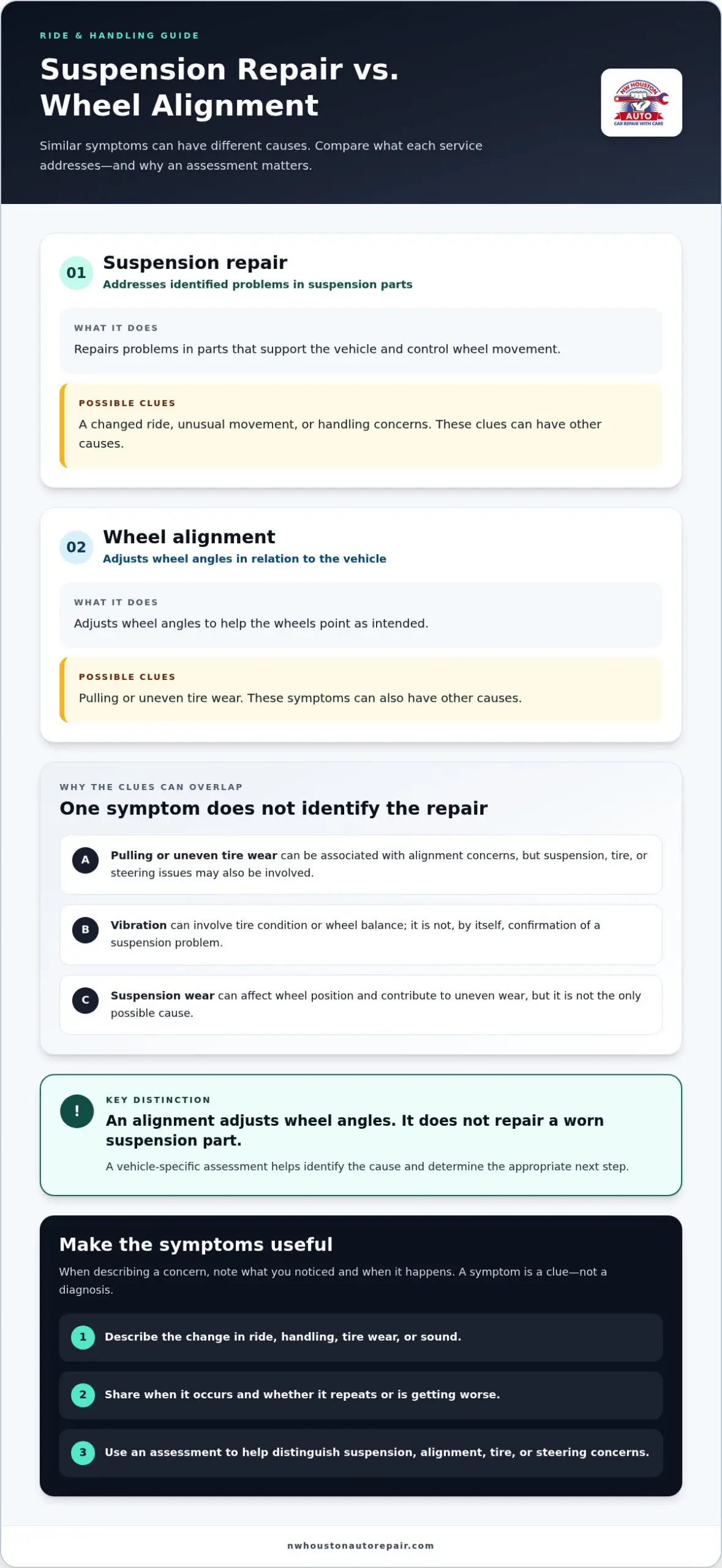
A pull, vibration, or uneven tire wear is a clue, not a confirmed diagnosis. Tire condition or wheel balance can contribute to vibration; steering concerns may affect direction or response; and alignment describes the angles of the wheels relative to the vehicle. Suspension wear can also affect wheel position and contribute to uneven wear, but it isn’t the only possible cause. An alignment adjusts wheel angles; it doesn’t repair a worn suspension part. Explore the shop’s wheel alignment service to understand that related, distinct service.
For broader consumer guidance, the National Highway Traffic Safety Administration provides information about vehicle safety standards and vehicle safety resources. That information can support general awareness, but it can’t identify the cause of a particular noise, pull, or wear pattern. A vehicle-specific assessment matters.
If symptoms persist, note what you’ve noticed and arrange an assessment through the contact page. For suspension repair Houston drivers can make better-informed decisions by having the concern assessed rather than assuming that a single symptom points to one part.
Suspension Repair or Alignment? How to Understand the Difference
A vehicle that pulls, wears tires unevenly, or feels different on the road may need attention, but those clues don’t identify the repair by themselves. Suspension concerns and alignment needs can affect one another, and tire or steering issues can create similar symptoms. Use this comparison as a starting point, not a diagnosis.
| Suspension repair | Wheel alignment |
|---|---|
| Addresses identified problems in the parts that support and control wheel movement, which may affect ride or handling. | Adjusts wheel angles in relation to the vehicle, helping the wheels point as intended. |
| Possible clues include a changed ride, unusual movement, or handling concerns, though other causes are possible. | Possible clues include pulling or uneven tire wear, but these can also have other causes. |
| The repair depends on the vehicle and what an assessment finds. | Correcting alignment angles won’t repair a worn or damaged suspension component. |
What suspension repair addresses
Suspension repair aims to address an identified problem in the system that supports the vehicle and helps control wheel movement. The goal is to resolve a concern affecting ride or handling, not to replace parts based on a symptom alone. The appropriate repair depends on the vehicle and assessment findings; a pull or rough ride can’t confirm which component needs attention.
When wheel alignment may also matter
Alignment is a separate service focused on wheel direction and angles. A suspension concern and an alignment need can exist at the same time, but there’s no fixed repair sequence that applies to every vehicle. An assessment helps determine what’s contributing to the symptoms. Learn more about the shop’s wheel alignment service and how it relates to tire wear.
For additional background on automotive repair credentials, ASE provides a resource about ASE-certified technicians. It’s general information, not a diagnosis of your vehicle or a substitute for assessing its specific symptoms.
For suspension repair houston drivers can arrange an assessment and discuss what they’re noticing through the contact page. Share the symptoms and when they occur; that context can help guide the next step without assuming one clue points to one repair.
What to Do Before Scheduling Suspension Repair in Houston
You don’t need to identify the faulty part before arranging service. A clear account of what has changed can help make the assessment more useful. Keep the process simple: record what you notice, note when it happens, and arrange a professional assessment. For suspension repair houston service planning, useful observations are more helpful than a guess about the cause.
How to describe the symptoms clearly
Use everyday language. Say whether you hear a clunk, feel a change in steering, notice a rougher ride, or see uneven tire wear. Note where you hear or feel it, what the road was like, and whether it happens repeatedly or only in certain situations. If you remember a recent impact or other change, mention it as context, not proof of a cause.
Don’t crawl beneath the vehicle or handle parts to investigate a suspected fault. Observe only what you can safely notice during ordinary use, and write down whether the symptom is becoming more frequent or pronounced.
How to plan the next service step
Arrange a professional assessment rather than choosing a repair from one clue. Similar symptoms can have different causes, and the right plan depends on the vehicle and what the assessment finds. The repair scope may vary with those findings and the vehicle’s needs, so avoid assuming a particular repair or timeline in advance.
- Record the symptom. Describe the sound, ride, steering feel, or tire-wear pattern in plain language.
- Note when it occurs. Include the road conditions, whether you were turning or braking, and if the symptom recurs.
- Arrange an assessment. Share your observations and any remembered impacts or changes, without treating them as a confirmed cause.
Bring your notes to the conversation. You can also review the Houston suspension repair service to learn more about the service focused on concerns affecting ride and handling. A professional assessment connects your observations to the next appropriate step without relying on guesswork.
Ready to discuss what your vehicle is doing? Talk with our team about your suspension concerns.
Choose NW Houston Auto Repair for Suspension Repair in Houston
Suspension concerns can make a familiar drive feel different. If your vehicle’s ride or handling has changed, a professional assessment can help clarify what needs attention and what the next step should be. NW Houston Auto Repair and Collision provides suspension repair for Houston drivers, with service focused on concerns affecting ride and handling.
A local, family-owned team for vehicle repair needs
NW Houston Auto Repair and Collision is family-owned and operated, and has been established since 1999. That long-standing local background is part of the shop’s story. You don’t need to arrive with a technical diagnosis or know the name of a specific suspension component. Start with what you’ve noticed, such as a change in ride, an unfamiliar noise, or handling that feels different.
Suspension repair Houston drivers arrange should begin with the vehicle’s actual symptoms and needs, not assumptions based on one clue. The assessment helps guide a suitable repair plan. The specific work depends on what’s found and the needs of the vehicle, so repair scope, cost, and timing should be discussed in relation to those findings rather than guessed in advance.
Arrange the next step for suspension repair
Make a note of what changed and when you notice it. You can describe the symptoms in everyday language; there’s no need to know their technical cause. Share whether the concern involves ride comfort, handling, noise, or tire wear, and mention any recent impact or change you remember as context. These details help start a focused conversation without treating an observation as a diagnosis.
Learn more about the suspension repair service, then reach out to discuss your vehicle and arrange the next step. Clear information and a professional assessment can help you move from uncertainty toward an appropriate plan, without committing to a repair based on guesswork.
Contact NW Houston Auto Repair and Collision to discuss suspension repair.
Take the Next Step Toward a More Confident Ride
Bouncing, unusual noises, pulling, or uneven tire wear can point to a concern, but one symptom alone can’t confirm whether the cause is suspension, steering, tires, or alignment. Note what you experience and when it happens, then let a professional assessment guide the repair decision. That’s a practical starting point for suspension repair houston drivers can plan with greater confidence.
NW Houston Auto Repair and Collision is a family-owned and operated business established in 1999, offering suspension repair for concerns that affect ride and handling. You don’t need to know the technical cause before reaching out. Describe what you’ve noticed, and the team can help arrange the next step based on your vehicle’s needs.
Contact NW Houston Auto Repair to discuss suspension repair. A clear conversation is a good first move toward understanding what your vehicle needs and getting back to a more comfortable, dependable drive.
Frequently Asked Questions
What are the common signs that a car needs suspension repair?
Common signs include a persistently bouncy or rough ride, unusual clunks or rattles over bumps, changes in handling, pulling, or uneven tire wear. The vehicle may also dip forward during braking or feel less stable than usual. Any one sign can have more than one possible cause, so treat it as a reason to arrange an assessment, not proof that a particular suspension part has failed.
Can I drive with a suspension problem?
It depends on how the vehicle is behaving, but a noticeable loss of control or stability deserves prompt attention. A suspension concern can affect handling and may contribute to longer stopping distances or additional wear. If the vehicle feels difficult to control, don’t continue driving it in conditions that feel unsafe. Arrange a professional assessment and describe what has changed so you can decide on a safe next step.
How do I know if I need suspension repair or wheel alignment?
You can’t reliably choose between them based on one symptom alone. Suspension repair addresses an identified problem in the system supporting and controlling wheel movement; alignment adjusts wheel angles relative to the vehicle. Pulling or uneven tire wear may be associated with either, as well as tire or steering concerns. An assessment can help distinguish the cause. Alignment won’t repair a worn or damaged suspension component.
What happens if I ignore worn suspension components?
Ignoring a worsening suspension concern can affect ride comfort, handling, and control. Depending on the problem, it may also contribute to uneven tire wear or further stress on tires and steering components. Symptoms alone can’t show how serious the underlying issue is, so don’t wait for a small change to become harder to manage. Arrange an assessment, especially if the vehicle’s stability has noticeably changed.
How much does suspension repair cost in Houston?
There isn’t one set price for suspension repair in Houston because the cost depends on the vehicle, the parts involved, and the work indicated by the assessment. A noise or handling change doesn’t identify the repair scope by itself. Once the concern has been assessed, discuss the recommended work and its cost before proceeding. NW Houston Auto Repair and Collision can help you arrange the next step for suspension repair Houston drivers need.
Can suspension problems cause uneven tire wear?
Yes, a worn or damaged suspension component can affect how a wheel meets the road and contribute to uneven tire wear. But uneven wear doesn’t confirm a suspension problem. Tire condition, alignment, and other issues can also be involved. Note which tires show wear and whether you’ve noticed changes in handling or ride, then share those observations during an assessment to help guide diagnosis.
What should I tell the shop when scheduling suspension repair?
Describe what you notice in everyday language: a clunk, a bouncy ride, a change in steering feel, pulling, or unusual tire wear. Explain when and where it happens, such as over bumps or during turns, and whether it’s recurring or getting worse. Mention a recent impact or change only if you remember one. You don’t need to identify the cause; your observations help start the assessment.