
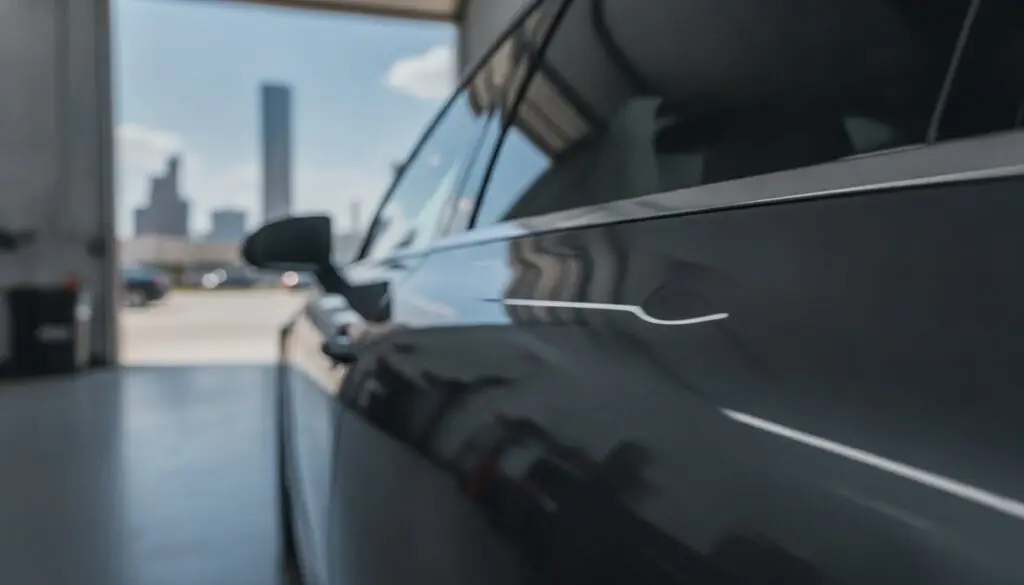
Fix your car. Save your finish. What if your car’s body panels actually remembered their original shape from the factory floor? It sounds like science fiction, but it’s the foundation of the professional paintless dent repair houston drivers trust to keep their vehicles looking brand new. You likely feel that familiar knot in your stomach when you spot a fresh door ding or the dimples of hail damage after a sudden Texas storm. You worry about high repair costs, the anxiety of mismatched paint, and being without your ride for weeks. We understand those concerns because we’ve served this community since 1999. Trust the science of metal memory. Protect your investment.
You deserve a restoration process that respects both your time and your vehicle’s integrity. This guide will show you how to erase those dents while preserving your factory finish and protecting your car’s resale value. We’ll walk through the precision tools used in restoration, explain when PDR is the superior choice over traditional repairs, and help you understand the technical mastery required for a flawless result. Discover how easy restoring your car to perfection can be without the traditional body shop stress.
Key Takeaways
- Understand why choosing an established shop for paintless dent repair houston provides more long-term accountability and warranty security than hiring a temporary mobile technician.
- Learn how the science of “metal memory” allows specialists to restore your car’s original shape without using heavy body fillers or aftermarket paint.
- Discover the “Carfax factor” and how restorative techniques help you avoid the negative stigma of an accident report on your vehicle’s history.
- Follow our simple two-step evaluation to determine if your dent’s depth and paint condition make it a perfect candidate for non-invasive restoration.
- Compare the restorative nature of PDR against traditional “additive” methods to see how you can save time while preserving your vehicle’s factory integrity.
What is Paintless Dent Repair (PDR) and Why Does Houston Need It?
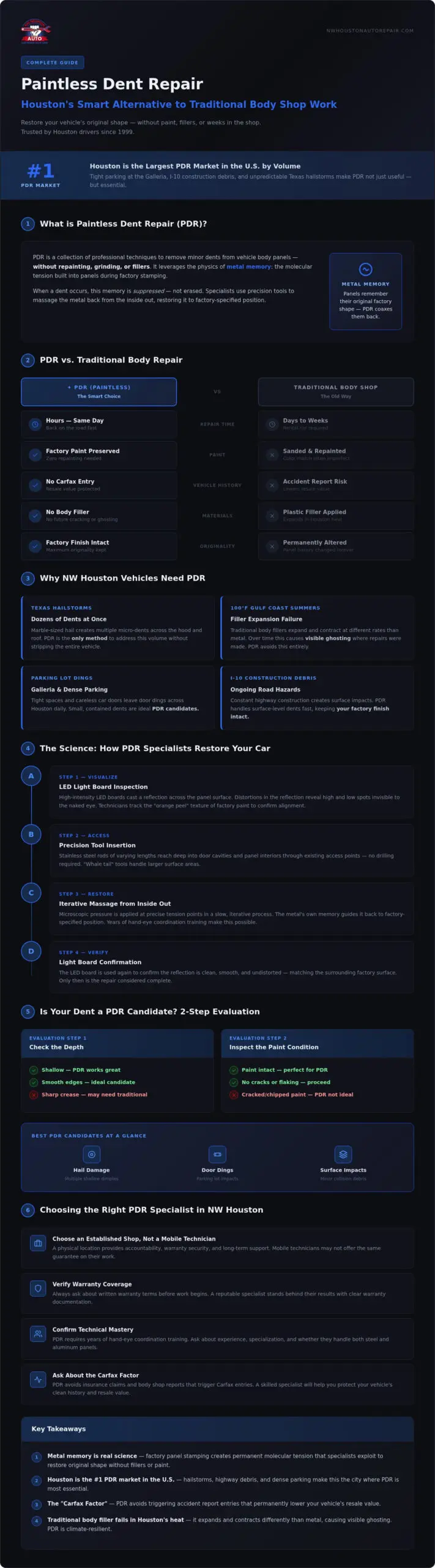
Imagine your car’s exterior as a living skin rather than a static shell. Professional paintless dent repair houston relies on a fascinating engineering concept called metal memory. Modern vehicle panels are stamped into specific shapes during manufacturing. This creates a physical tension that remembers its original form. Specialists use this physics to their advantage. They apply precise pressure to the backside of the panel to massage the metal back into place. According to Wikipedia, What is Paintless Dent Repair (PDR) is a collection of techniques used to remove minor dents from the body of a motor vehicle without the need for repainting.
This approach is essential for local drivers. Houston is actually the largest PDR market in the U.S. by volume. Our city presents a unique gauntlet of hazards for your car’s exterior. From the tight parking spots at the Galleria to the constant construction debris on I-10, your vehicle is always a target. Traditional repair methods often involve sanding down your factory paint, applying heavy plastic fillers, and attempting to match your paint color in a booth. PDR skips the chemical shortcuts and focuses on pure mechanical restoration.
The Environmental Factors of NW Houston
Texas hailstorms are legendary for their unpredictability and destructive power. When a storm drops marble-sized ice on your hood, it creates dozens of micro-dents. PDR is the only way to address this volume of damage without stripping the entire car. There is also the factor of our oppressive humidity and 100-degree summers. Traditional body fillers can expand and contract at different rates than the underlying metal. Over time, this leads to visible “mapping” or ghosting where the repair was made. By keeping the metal and paint original, you avoid these heat-related failures entirely. It’s a smarter way to protect your property in the Gulf Coast climate.
PDR vs. The ‘Old Way’ of Dent Repair
For decades, the old way was the only way. If you had a ding, a technician would grind the paint to bare metal, drill holes to pull the dent, and slather the area in filler. Today, we prioritize conservation. Car enthusiasts and collectors in Houston demand PDR because it maintains the vehicle’s originality. Once you repaint a panel, you’ve permanently altered the car’s history. PDR keeps the factory finish intact, which is your best defense against the elements and the most reliable way to maintain your car’s maximum resale value. It’s a cleaner, faster, and more ethical approach to automotive care.
The Science of Metal Memory: How PDR Specialists Restore Your Car
Metal has a natural tendency to return to its original form. During the manufacturing process, your car’s body panels are stamped into shape under immense pressure, which creates a permanent “memory” within the molecular structure of the steel or aluminum. When a dent occurs, this memory is suppressed but not lost. Effective paintless dent repair houston relies on more than just tools; it requires a deep understanding of metallurgy to coax the metal back to its factory-specified position. Our specialists utilize a slow, iterative process of massaging the metal from the inside out, applying microscopic pressure to the exact points of tension until the surface is perfectly level once again.
Visualizing the damage is the most technical part of the job. Specialists in paintless dent repair houston use high-intensity LED light boards to cast a reflection across the vehicle’s surface. This allows them to see the “orange peel” texture of the factory paint. If the reflection is distorted, the metal beneath it is still out of alignment. By tracking how the light bends, a technician can identify high and low spots that are invisible to the naked eye. This level of precision is a craft that requires years of hand-eye coordination training. When Choosing a qualified PDR technician, it’s vital to look for someone who understands this delicate balance of tension and pressure.
The Toolset of a Collision Specialist
To move metal with such extreme accuracy, we employ a diverse array of specialized equipment. Stainless steel rods of varying lengths allow us to reach deep into door cavities, while “whale tails” are designed to slide into the narrow gaps behind hood braces. If a dent is located in an area where “behind the panel” access is physically impossible, we use glue pulling techniques. This involves adhering a specialized tab to the exterior of the dent and using a slide hammer to gently lift the metal. We also use knock-down tools, often made of polished resin or wood, to tap down high spots and release the tension that holds a dent in place. If you’re unsure if your vehicle is a candidate for these methods, you can reach out to our team for a quick assessment.
Accessing the Damage Without Dismantling the Car
The goal of a master technician is to preserve the structural integrity of your vehicle by minimizing disassembly. We often gain entry to the back of a panel through existing factory holes, window channels, or by temporarily removing a taillight or a few interior trim clips. This non-invasive approach ensures that factory seals and wiring looms remain undisturbed. Access points are the specific entryways, such as window channels or factory holes, that allow a technician to reach the back of a panel without drilling or cutting. By utilizing these natural pathways, we provide a thorough restoration that keeps your car’s safety ratings and factory warranties intact.
PDR vs. Traditional Body Repair: Comparing Your Options
Choosing between traditional body work and restorative techniques depends on the nature of the damage. Traditional body repair is an additive process. It requires technicians to sand away your factory finish, apply plastic body fillers, and spray layers of primer and paint to mimic the original look. This is often unavoidable for structural damage. However, paintless dent repair houston is fundamentally restorative. We don’t add chemicals or aftermarket coatings to your vehicle. We simply return the existing metal to its intended shape. This distinction is vital for your vehicle’s long-term value and structural integrity.
Consider the “Carfax factor” before you commit to a repair method. Traditional repairs are often documented as an “accident repair” in vehicle history databases. This record can slash your resale value by thousands of dollars. PDR is non-invasive and often categorized as cosmetic maintenance. It frequently avoids the accident stigma on history reports. Speed is another major factor. While a standard collision repair Houston shop might keep your car for two or three weeks, PDR is often completed in a single afternoon. If you are facing a lease return or a trade-in, this quick turnaround saves you from dealership fees for “excessive wear and tear.”
Resale Value and the Factory Finish
Your factory paint is the most valuable asset of your car’s exterior. It is applied in a sterile factory environment with high-heat curing that no local shop can perfectly replicate. PDR preserves this original finish and the vehicle’s E-coat, which is the primary layer of corrosion protection. This prevents long-term issues like paint shrinkage, where fillers settle over time, or color fading that reveals a mismatched panel years later. Following industry best practices ensures your car stays protected from the elements while maintaining its showroom shine.
Insurance and Hail Damage Claims
Houston’s weather is notoriously unpredictable. When a hailstorm hits, insurance adjusters often prefer PDR because it is more efficient and preserves the car’s integrity. For many older vehicles, the high cost of traditional sanding and repainting for dozens of small dents might exceed the car’s market value. This leads insurance companies to “total” the vehicle. PDR provides a path to full restoration at a price point that keeps your car on the road. It is a smarter, faster way to handle cosmetic claims without the headache of a salvage title. To ensure your vehicle and other assets are fully protected against Texas weather, visit J J Wright And Assoc for comprehensive personal coverage options.
Is Your Dent a Candidate for PDR? A Step-by-Step Evaluation Guide
Before you commit to a repair, you can perform a basic assessment right in your driveway. Not every blemish is a perfect fit for restorative techniques, but many common Houston mishaps are easily solvable. Identifying the right candidate for paintless dent repair houston saves you time and prevents the unnecessary cost of a full paint job. Follow these four professional steps to evaluate your vehicle’s damage.
- Step 1: Inspect the paint finish. Look closely at the impact site. Is the paint still smooth and glossy? If you see cracks, flakes, or missing paint, PDR won’t be enough. The metal can still be straightened, but you’ll need traditional touch-up or refinishing to prevent rust.
- Step 2: Measure the depth and shape. Run your hand gently over the area. A shallow, bowl-shaped dent is an ideal candidate. If the dent has a sharp “point” at the center or looks like a deep crease, the metal may be over-stretched.
- Step 3: Check the location. Flat areas like hoods, roofs, and door centers are usually easy to access. Dents located on the very edge of a door or on a double-walled roof pillar are much more difficult because there is no room for tools to reach the backside of the metal.
- Step 4: Identify the panel material. Most cars use steel, which has excellent “memory.” Aluminum is increasingly common in newer trucks and luxury cars. It is stiffer and less elastic than steel, requiring a more experienced specialist to manipulate it correctly.
When PDR is Not the Answer
Sometimes the physics of the damage simply won’t allow for a non-invasive fix. If the metal has been stretched so far that it has lost its elastic properties, it won’t “snap” back into its original shape. Similarly, PDR is strictly for metal panels. Plastic bumpers or carbon fiber components require different restoration methods. We also look for proximity to safety sensors or internal structural braces. If a dent sits directly over a side-impact sensor, we may need to pivot to traditional collision repair to ensure your safety systems remain functional. If your damage resulted from a collision, our car wreck repair checklist for Houston drivers can help you navigate the next steps with confidence.
The ‘Credit Card’ Test
Try this simple DIY trick. Take a standard credit card and try to place it flat inside the dent. If the card can sit against the bottom of the crater without the edges sticking out too far, it’s likely a quick fix. Use your phone’s flashlight at an angle to look for hidden ripples or shadows that might indicate a larger “crown” of tension around the dent. If you see a sharp crease along a body line, don’t panic. While these are complex, a master technician can often restore them. For a definitive answer on your specific damage, send us a photo of your dent for a professional evaluation.
Choosing the Right PDR Specialist in NW Houston
Houston is the largest market for restorative metal work in the country, which means you have plenty of options. However, not all options are equal. Choosing the right provider for paintless dent repair houston is about more than just finding a quick fix; it is about ensuring long-term accountability. Many “hail chasers” or independent mobile technicians operate without a physical location, often moving from city to city after major storms. If a repair fails or a tool slip causes a future paint crack, finding them for warranty work is nearly impossible. A permanent collision center provides the security of knowing exactly where to go if you have questions or need follow-up care.
Why a Shop Environment Matters
Precision requires a controlled environment. In our shop, we use specialized high-intensity LED lighting arrays that are unaffected by moving clouds or the harsh Texas sun. This allows our technicians to see every microscopic ripple in the metal. Maintaining a consistent indoor temperature is also vital because paint becomes more brittle in extreme cold and more pliable in heat. If the impact that caused your dent also cracked a window or mirror, we can perform auto glass repair on-site. This one-stop-shop approach saves you from driving across the city to multiple vendors just to get your car back to normal.
Most drivers think PDR is the final step, but for a true showroom finish, it should be paired with auto paint correction. While PDR restores the metal’s shape, paint correction removes the micro-scratches and scuffs left behind by the object that caused the dent. By combining these services, we don’t just fix the damage; we enhance the entire panel to a level that often looks better than it did before the incident. This integrated approach is a specialty that standalone mobile techs simply cannot offer.
Trusting the NW Houston Auto Repair Legacy
We have been family-owned and operated since 1999. Our team takes pride in being the neighborly experts who protect your vehicle investment with technical mastery. We prioritize transparency above all else. If we evaluate your vehicle and determine that the metal is too over-stretched for a safe PDR application, we’ll tell you immediately. We won’t perform a subpar repair just to make a sale. Our goal is to keep your property dependable and your exterior flawless through ethical business practices. Schedule your paintless dent repair estimate today and see why Houston drivers have trusted us for over 25 years.
Protect Your Vehicle’s Future Today
Your vehicle is one of your most significant investments. Don’t let a sudden hailstorm or a careless door ding diminish its worth. By choosing professional paintless dent repair houston, you are opting for a restorative solution that keeps your factory finish intact and your resale value high. We’ve mastered the science of metal memory to provide fast, flawless results that traditional body shops simply can’t match. Our family-owned shop has delivered technical mastery to this community since 1999, ensuring every car leaves our facility looking its absolute best.
Take the stress out of automotive restoration. We provide the transparency you deserve and the speed you need to get back to your busy schedule. Whether you have a single crease or a hood full of hail damage, we’re here to help you navigate the repair process with confidence. Trust the experts who treat your car like their own. We’re ready to get to work for you.
Restore Your Vehicle’s Value—Get a PDR Quote from NW Houston Auto Repair
Your car deserves a flawless finish, and we’re excited to help you achieve it.
Frequently Asked Questions
How much does paintless dent repair cost in Houston?
Cost is determined by the size, depth, and location of the damage on your vehicle. While we cannot provide a flat rate without an inspection, this method is generally much more affordable than traditional body work that requires sanding and painting. Factors such as panel material and accessibility also influence the final estimate. We recommend a quick physical assessment to give you a transparent and accurate quote for your specific restoration needs.
Will the dent come back after PDR is performed?
No, a professionally repaired dent will never return once the metal is restored. This process works by coaxing the panel back into its original factory shape. Because the molecular structure of the metal is returned to its stable, original state, the repair is permanent. Unless the vehicle is struck in the same spot again, the surface will remain perfectly level and smooth for the entire life of your car.
How long does a typical PDR appointment take?
Most minor repairs are completed within a few hours on the same day. This is a significant advantage for busy commuters who can’t afford to leave their car at a shop for weeks. While extensive projects like full-vehicle hail restoration may require more time, standard door dings and small creases are handled quickly. You can often drop your vehicle off in the morning and have it back by the afternoon.
Does PDR work on aluminum body panels like the Ford F-150?
Yes, specialized paintless dent repair houston techniques are highly effective on aluminum components. Aluminum is stiffer and less elastic than steel, which makes it more difficult to manipulate without the right expertise. It requires a technician with advanced training and specific tools designed for these lighter materials. Our team has the technical mastery to handle these complex restorations on modern trucks and luxury vehicles while ensuring the metal doesn’t crack.
Can PDR fix hail damage covered by my insurance?
Yes, most insurance providers in Texas approve and often prefer this method for hail claims. Because it preserves the factory paint and original panels, it is considered a high-quality, restorative repair. We have extensive experience working with insurance adjusters to streamline these claims. This ensures your vehicle is restored to pre-storm condition efficiently, helping you avoid the long wait times often found at traditional high-volume body shops.
What if the paint is scratched but the dent is eligible for PDR?
We can still restore the metal’s shape, but the scratch will require additional attention. PDR is a mechanical process that addresses the indentation itself. If the finish is marred, we often pair the dent removal with our professional auto paint correction services. This two-step approach first levels the metal and then buffs out surface blemishes, resulting in a comprehensive restoration that brings the panel back to a showroom-quality finish.
Is PDR better than using a DIY dent puller from the store?
Professional restoration is significantly safer and more effective than using retail DIY kits. Store-bought pullers rely on generic suction or adhesives that can easily stretch the metal incorrectly or even peel your factory paint. A master technician uses specialized tools to apply microscopic pressure from behind the panel. This controlled method prevents permanent “high spots” and ensures the structural integrity of the metal is never compromised by amateur mistakes.
Do you offer PDR for luxury vehicles or EVs?
Yes, we provide expert restoration for high-end luxury brands and electric vehicles. These cars often feature sensitive electronics, complex safety sensors, and unique lightweight materials that require a careful touch. Because we are a full-service collision center, we understand how to navigate the internal components of an EV safely. We treat your high-tech investment with the precision and respect it deserves, ensuring all factory warranties and safety ratings remain intact.
While maintaining your car’s exterior is essential, don’t overlook the importance of its mechanical health. For expert support with engine and brake systems, you can learn more about Humbers All Car to see how specialized technicians handle critical vehicle maintenance.