

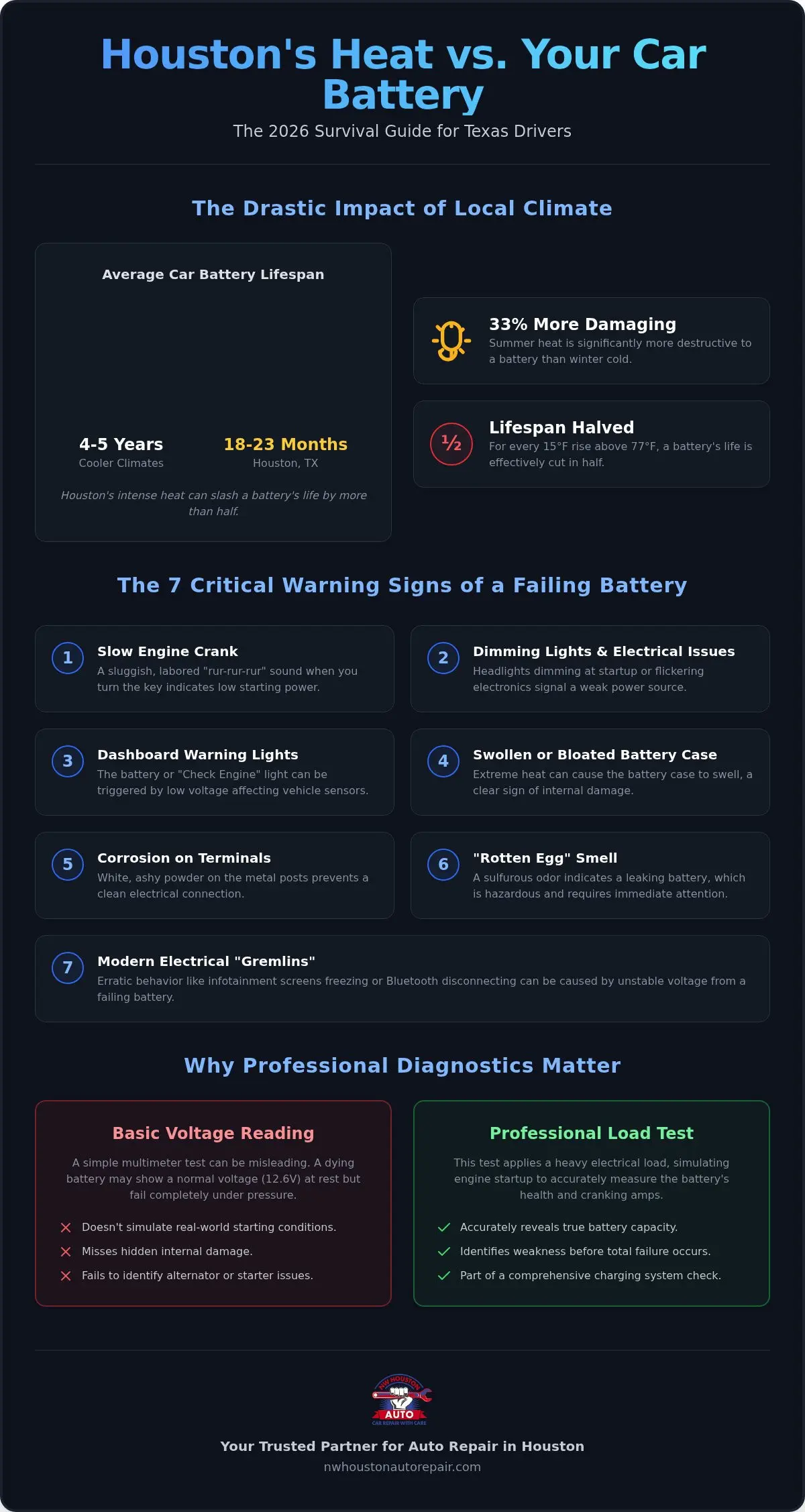
Did you know that the intense Houston sun can slash your car battery’s life by more than half compared to cooler northern cities? While a battery might last four years in the Midwest, our local heat often limits that lifespan to just 18 to 23 months. It’s a stressful reality. Many drivers find themselves stranded because they didn’t realize how quickly the humidity and temperature can degrade their power source. If you’ve noticed dimming headlights or a sluggish crank, you’re likely facing the need for a car battery replacement sooner than you anticipated.
We understand the anxiety of being stuck on the side of a boiling highway. You want clear answers about battery types and honest advice on whether your car has a deeper electrical problem. This comprehensive 2026 checklist provides the professional guidance you need to diagnose issues accurately and navigate the replacement process with confidence. We’ll walk you through the warning signs, explain the impact of our local climate, and help you find a dependable partner to get you back on the road safely.
Key Takeaways
- Understand why Houston’s extreme humidity and heat accelerate internal wear, requiring more frequent checks than in cooler climates.
- Learn to identify the seven critical warning signs, such as slow engine cranks and flickering electronics, before you end up stranded.
- Discover why a professional load test is superior to basic voltage readings for uncovering hidden electrical problems.
- Master the 2026 checklist to determine exactly when you need a car battery replacement and which technology fits your specific vehicle.
- See how a comprehensive system check at a trusted local shop ensures your new battery and charging system work in perfect harmony.
Understanding Car Battery Failure in the Houston Climate
Think of your automotive battery as the heart of your vehicle’s electrical system. It doesn’t just start the engine; it filters and stabilizes power for every computer and sensor in your car. Many people believe that winter is the hardest season for vehicles, but that’s a common misconception for those of us in Southeast Texas. In reality, summer heat is 33% more damaging to a battery than winter cold. While drivers in northern states might see their power cells last five years, the 2026 average lifespan for a battery in Houston is a mere 18 to 23 months. Our relentless humidity and triple-digit temperatures cause internal fluids to evaporate, leaving the lead plates exposed and vulnerable to permanent damage.
The Science of Heat and Lead-Acid Reactions
High temperatures act as a catalyst, accelerating the natural chemical reactions and corrosion that occur inside a lead-acid battery. For every 15°F increase in average operating temperature above 77°F, the lifespan of your battery is effectively cut in half. This creates a “silent killer” effect where the battery is slowly dying during the hottest months of July and August, yet it might still seem to function normally. You won’t notice the degradation until the battery finally lacks the cranking amps needed to turn the engine over. This is why we see so many “dead on arrival” situations during the peak of summer, as the heat has simply exhausted the battery’s ability to store energy.
Houston Driving Conditions and Battery Stress
Our local driving habits add another layer of difficulty. Sitting in stagnant traffic on I-45 or the Beltway means your engine is idling, and the alternator often struggles to provide enough current to power the lights, infotainment, and safety sensors while also charging the battery. This cycle of heavy drain and low charging creates significant wear on the internal components.
- Extreme AC Demand: Houstonians must run the air conditioning at maximum capacity, which places a heavy, continuous load on the electrical system.
- Short Commutes: If your drive is less than fifteen minutes, your alternator doesn’t have enough time to fully replenish the charge lost during the initial startup.
- Vibration: Our bumpy roads can physically loosen battery connections or damage internal plates over time.
Heat soak is the specific condition where engine bay temperatures spike after you turn off the ignition, trapping heat around the battery without any circulating air to cool it down. These constant thermal cycles make a professional car battery replacement a vital part of your maintenance schedule. We recommend having your system tested twice a year to ensure you aren’t the next driver waiting for a jump-start in a sweltering parking lot.
The Ultimate Car Battery Health Checklist: 7 Warning Signs
Recognizing the early signals of a failing battery can be the difference between a smooth morning commute and an expensive tow bill. The most common indicator is the slow engine crank. If you turn the key and hear a sluggish, labored “rur-rur-rur” sound before the engine catches, your battery is struggling to provide the necessary amperage. You might also notice your headlights dimming significantly or interior electronics flickering when you try to start the car. These symptoms suggest the battery is at the end of its functional life, especially when you consider how heat shortens battery lifespan in our local climate.
Modern vehicles often use the dashboard as a first line of defense. While the “battery” light is an obvious clue, a failing power cell can also trigger a “check engine” light because low voltage disrupts the sensors that monitor your powertrain. Don’t ignore physical changes under the hood. Inspect the battery for a bloated or swollen case, which is a telltale sign of heat damage. You should also look for white, ashy corrosion on the metal terminals and sniff for a “rotten egg” scent. This sulfurous odor indicates that the battery is leaking acid, which can damage surrounding components if left unaddressed. If you spot these issues, it is time to prioritize a car battery replacement before the unit fails completely.
Electrical Gremlins and Modern Vehicle Symptoms
Modern cars are essentially rolling computers that require a steady, precise voltage. When a battery weakens, it can cause erratic behavior in your infotainment system, such as screens freezing or Bluetooth disconnecting without reason. You might experience the “ghost in the machine” effect, where power windows move slower than usual or automatic door locks become unresponsive. These glitches often point to deeper issues that require specialized auto electrical repair to rule out alternator failure or parasitic drains. For a comprehensive look at how these interconnected components affect your vehicle, our guide to car electrical system repair in Houston explains how every wire and sensor works together as your vehicle’s nervous system. Keeping your electrical system healthy ensures your safety features and luxury amenities work exactly as designed.
Age as a Critical Indicator
Even if your car starts every morning, age remains a primary factor in reliability. You can usually find a manufacturing date code on a sticker on the top or side of the battery; it typically starts with a letter for the month and a number for the year. In the humid, punishing environment of Houston, any battery over three years old is a ticking clock. We recommend a proactive approach to testing. Asking for a quick battery health check during your next synthetic oil change is the easiest way to stay ahead of a breakdown. If you are unsure about the age of your current unit, feel free to reach out to our team for a quick inspection and peace of mind.
Remember that a car battery replacement is a routine part of vehicle ownership in Texas. By catching these seven warning signs early, you protect your vehicle’s complex electronics and ensure you’re never left waiting for a jump-start in a sweltering parking lot.
Professional Diagnostics vs. Simple Testing: What Your Car Needs
Many drivers carry a basic multimeter in their glovebox, assuming a reading of 12.6 volts means their vehicle is healthy. This is a dangerous oversimplification. While voltage measures the electrical potential, it doesn’t account for the battery’s ability to handle a massive current draw. Think of it like a garden hose; you might have pressure at the nozzle, but if the hose is pinched, you won’t get the volume needed to put out a fire. A professional load test simulates the massive draw required to start your engine, revealing weak cells that a simple voltage check misses. This level of precision is especially critical for modern Absorbent Glass Mat (AGM) and Enhanced Flooded Batteries (EFB) found in 2026 models, which require specialized digital testers to verify their internal resistance.
Proper Battery Maintenance involves more than just checking the terminals for tightness. It requires understanding how the battery interacts with the rest of your vehicle’s nervous system. If you only look at the battery in isolation, you might miss a parasitic drain or a failing module that is slowly killing your power source. Our team uses advanced diagnostic tools to ensure every component is communicating correctly before we ever recommend a car battery replacement. We want to be sure you actually need a new part rather than a simple software update or a loose ground wire repair. Understanding the full scope of your vehicle’s wiring and modules is essential, which is why our resource on expert car electrical system repair in Houston is a valuable reference for any driver experiencing intermittent electrical issues.
The Alternator Connection
The alternator is the unsung hero that keeps your battery charged while you drive. If it malfunctions, it can either undercharge your battery, leaving you stranded, or overcharge it, essentially “cooking” the internal components. Replacing a battery without testing the charging system is a common mistake that leads to a second car battery replacement within just a few weeks. We always perform a full charging system sweep to verify that your alternator is putting out the correct amperage. You can learn more about our process for Expert Car Alternator Repair in Houston to see how we verify the entire system is working in harmony.
The Risk of DIY Battery Swaps in 2026
Modern vehicles are far more complex than the cars of a decade ago. In 2026, most European and many domestic vehicles require “Battery Registration” when a new unit is installed. This software process tells the car’s computer that a new battery is present so it can adjust the charging rate as the battery ages. Skipping this step can lead to premature failure of your brand-new unit. Also, disconnecting power without a memory saver can wipe out your car’s idle-relearn settings, clock, and security codes. Choosing professional car diagnostics ensures your vehicle’s memory remains intact and your new battery is programmed for a long, reliable life.
Choosing the Right Replacement: A Buyer’s Guide for 2026
Buying a battery in Houston requires a different strategy than in cooler climates. You must look past the price tag and focus on specifications that survive the Texas sun. Start by checking the Cold Cranking Amps (CCA) and Cranking Amps (CA). While CA measures power at 32°F, CCA is the industry benchmark for starting reliability at 0°F. Even though we rarely see those temperatures, a higher CCA rating often indicates a more robust internal construction that can withstand thermal stress. A professional car battery replacement should always meet or exceed the original equipment manufacturer’s specifications to maintain your vehicle’s performance.
Reserve Capacity (RC) is another vital metric for local drivers. It measures how many minutes the battery can power your vehicle’s essentials if the charging system fails. In the heavy, stop-and-go traffic on the 610 Loop, a high RC ensures your cooling fans and electronics stay powered even when the engine is at a low idle. Scrutinize the warranty details before you buy. A “Free Replacement” period is much more valuable than a “Pro-rated” warranty, which only offers a small discount on your next purchase based on the age of the failed unit. Always aim for a unit that offers at least a three-year free replacement window for maximum peace of mind.
Standard Flooded vs. AGM: Which is Best?
Traditional flooded batteries are the standard, but Absorbent Glass Mat (AGM) technology is the preferred choice for 2026 vehicles. AGM batteries are designed to handle the frequent cycling of start-stop systems and the high electrical demands of modern safety sensors. You should never “downgrade” to a standard battery if your car came equipped with an AGM from the factory; doing so can lead to rapid failure and electrical glitches. AGM batteries feature lead plates wrapped in fiberglass mats that significantly reduce internal damage caused by the constant vibration of driving on uneven Houston roads.
Proper Fitment and Group Size
Physical dimensions are non-negotiable. Every vehicle is designed for a specific “Group Size” that ensures the battery fits perfectly in the tray and that the terminals are in the correct orientation. If the battery is too small, it will bounce around; if it is too large, it might contact the hood or other metal parts, causing a dangerous short circuit. A secure hold-down bracket is essential to prevent internal plate damage from road shock. Additionally, if your battery is located in the trunk or under a seat, ensure the replacement has the proper venting ports to safely exhaust gases outside the cabin.
Selecting the correct components is the first step in a successful car battery replacement. If you feel overwhelmed by these technical specifications, our team can help you select the perfect unit for your specific vehicle and driving habits. Schedule your professional installation today to ensure your vehicle is ready for the next Houston heatwave.
Professional Car Battery Replacement Service at NW Houston Auto Repair
Since 1999, NW Houston Auto Repair and Collision has served as a dependable partner for drivers across Southeast Texas. We aren’t just a service provider; we are a family-owned establishment built on the values of trust and neighborly warmth. When you choose us for a car battery replacement, you’re getting more than a new part. You’re getting the peace of mind that comes from twenty-seven years of technical mastery. We treat every vehicle as if it belonged to our own family, ensuring that every connection is tight and every computer setting is preserved.
Our process is methodical and thorough. We don’t believe in the “swap and drop” approach common at big-box retailers. Every service includes a Complete System Check to verify your alternator’s output and identify any hidden parasitic draws. This ensures your new battery won’t be drained by an underlying electrical fault. We pride ourselves on clear communication, explaining every step of the diagnostic process without confusing jargon. You’ll know exactly why a component needs attention before any work begins; we believe transparency is the foundation of a good relationship.
The NW Houston Auto Repair Difference
Our team specializes in the complex electrical troubleshooting required for modern, computer-dependent vehicles. We utilize precision diagnostic equipment to protect your vehicle’s sensitive modules during the installation process. This is particularly vital for the battery registration and memory-save procedures required by 2026 models. Our community-oriented background means we prioritize your safety above all else. We’ve spent decades refining our skills to handle everything from routine maintenance to the most intricate restoration projects with absolute precision.
Beyond the Battery: Comprehensive Care
A reliable vehicle requires a holistic approach to maintenance. While we address your electrical needs, we also offer a quick look at other critical systems impacted by the Houston climate. We often suggest pairing your visit with a synthetic oil change to keep your engine protected from the heat. Our technicians also check your brakes for wear and ensure your AC systems are ready to combat the humidity. Staying safe on the road means being proactive rather than reactive.
Don’t wait until you’re stranded in a sweltering parking lot. It’s time to secure your vehicle’s reliability with a professional car battery replacement. Call us today or visit our shop to experience the precision and care that only a local expert can provide. We’re ready to get you back on the road with confidence.
Secure Your Vehicle’s Reliability Against the Texas Heat
Don’t let the sweltering Houston humidity catch you off guard. We’ve explored how our local climate can cut a battery’s life in half and why modern 2026 vehicles require more than a simple DIY swap. Identifying warning signs early is your first line of defense, but professional precision is what keeps you on the road. A proper car battery replacement is an investment in your safety and your car’s complex electrical health.
Our family-owned shop has served this community since 1999 with a commitment to transparency and technical mastery. We don’t just change parts; we provide master-level electrical diagnostics and include comprehensive charging system testing with every service. This thorough approach ensures your alternator and sensors are in perfect harmony with your new power source. You deserve the confidence of knowing your vehicle will start every time you turn the key. Take a proactive step today to protect your property and your peace of mind.
Schedule Your Professional Battery Diagnostic at NW Houston Auto Repair and let our experts handle the rest. We look forward to keeping you and your family safe on the road.
Frequently Asked Questions
How long should a car battery last in Houston?
A battery in the Houston area typically lasts between 18 and 23 months, which is why we recommend testing your electrical system at least twice a year. This lifespan is significantly shorter than the national average due to our extreme humidity and triple-digit summer temperatures. Regular testing allows us to track the degradation of the internal plates before you find yourself stranded. By monitoring the voltage during your routine service visits, we can predict failure before it happens.
Can I change my own car battery in a 2026 model vehicle?
While you can physically replace the unit, 2026 vehicles often require a software “relearn” process to recognize the new power source. This registration ensures the alternator provides the correct charging voltage based on the battery’s age and type. Skipping this step can lead to a shorter lifespan for your new purchase. Professional technicians use specialized tools to maintain your car’s computer memory and security codes during the swap. It’s the safest way to protect your vehicle’s electronics.
Why does my car battery keep dying even after a jump-start?
If your battery fails to hold a charge after a jump, it likely has a dead internal cell or significant plate sulfation. A jump-start provides enough power to crank the engine, but it doesn’t fix a chemically exhausted battery. You might also have a failing alternator that isn’t replenishing the charge as you drive. In these cases, a car battery replacement is often the only reliable solution to ensure your vehicle starts consistently every single morning.
Does a synthetic oil change include a battery test?
Yes, we include a basic battery health check as part of our comprehensive multi-point inspection during every synthetic oil change. We use digital testers to check the voltage and overall condition of the terminals. This allows us to catch early signs of corrosion or bloating before they become major problems. It’s a simple way to keep an eye on your electrical system while performing routine engine maintenance. We believe in being thorough for your safety.
What are the signs that my alternator is bad, not my battery?
A bad alternator often causes warning signs like growling noises, a burning rubber smell, or headlights that get brighter when you rev the engine. You might also see a battery warning light on the dashboard while driving, not just at startup. If your interior lights dim while you’re idling at a stoplight but brighten when you accelerate, the charging system is likely the culprit. We perform a full charging system sweep to confirm the exact failure point.
Is it worth buying a more expensive AGM battery for a regular car?
Upgrading to an AGM battery is often a smart move for Houston drivers because these units handle extreme heat and vibration better than standard flooded types. They have a lower self-discharge rate and provide more consistent power for modern electronics. If your vehicle has start-stop technology, an AGM is mandatory. Even for standard vehicles, the increased durability often leads to a longer service life in our punishing climate. It provides an extra layer of reliability.
What happens if I install the wrong battery size in my car?
Installing the incorrect group size can lead to dangerous short circuits if the terminals touch the hood or nearby metal components. A battery that doesn’t fit the tray properly will vibrate excessively, which causes internal plates to crack and fail. It might also lack the necessary cranking amps required to start your specific engine. During a car battery replacement, we always verify the exact physical dimensions and terminal orientation required by your vehicle’s manufacturer to ensure safety.
Can the Houston heat cause a battery to leak or smell like eggs?
The “rotten egg” smell is a sign that your battery is off-gassing sulfuric acid due to internal damage or overcharging. This often happens when the casing becomes bloated from extreme temperature cycles, allowing gas to escape through the vents or cracks. This gas is toxic and highly corrosive to the metal components in your engine bay. If you detect this odor, avoid opening the hood and seek professional assistance immediately to prevent chemical burns or electrical damage.