

What if that quick DIY fix from the local parts store is actually why your compressor just seized in the middle of I-10 traffic? It’s a stressful thought, but in our climate, a small error can lead to a massive repair bill. We all agree that Houston humidity doesn’t just make you sweat; it puts a relentless strain on your vehicle’s cooling system. When your vents start blowing lukewarm air, you need a solution that actually lasts. A professional car ac recharge service Houston residents trust is about much more than a simple top-off; it’s a vital checkup for your entire system.
You should be able to stay cool without the fear of being overcharged for unnecessary parts. This guide will help you master the essentials of AC maintenance to keep your cabin frosty and your compressor safe throughout the intense 2026 Houston summer. We’ll clear up the confusion between hardware store kits and professional service, explain the latest refrigerant standards, and walk you through the diagnostic process. Stop guessing about your comfort. Start driving with the peace of mind that comes from a neighborly, expert touch.
Key Takeaways
- Recognize how Houston’s extreme humidity and 100-degree days force your AC system to work three times harder than normal.
- Learn why a professional car ac recharge service Houston drivers rely on is essential for preventing a $1,500 compressor replacement.
- Identify the critical warning signs of low refrigerant, including compressor short-cycling and a gradual loss of cooling power.
- Understand the technical difference between a temporary DIY “top-off” and a comprehensive system evacuation and leak test.
- Gain confidence in the recharge process by knowing exactly how technicians recover and weigh refrigerant to meet factory specifications.
Understanding Car AC Recharge Service in Houston’s Climate
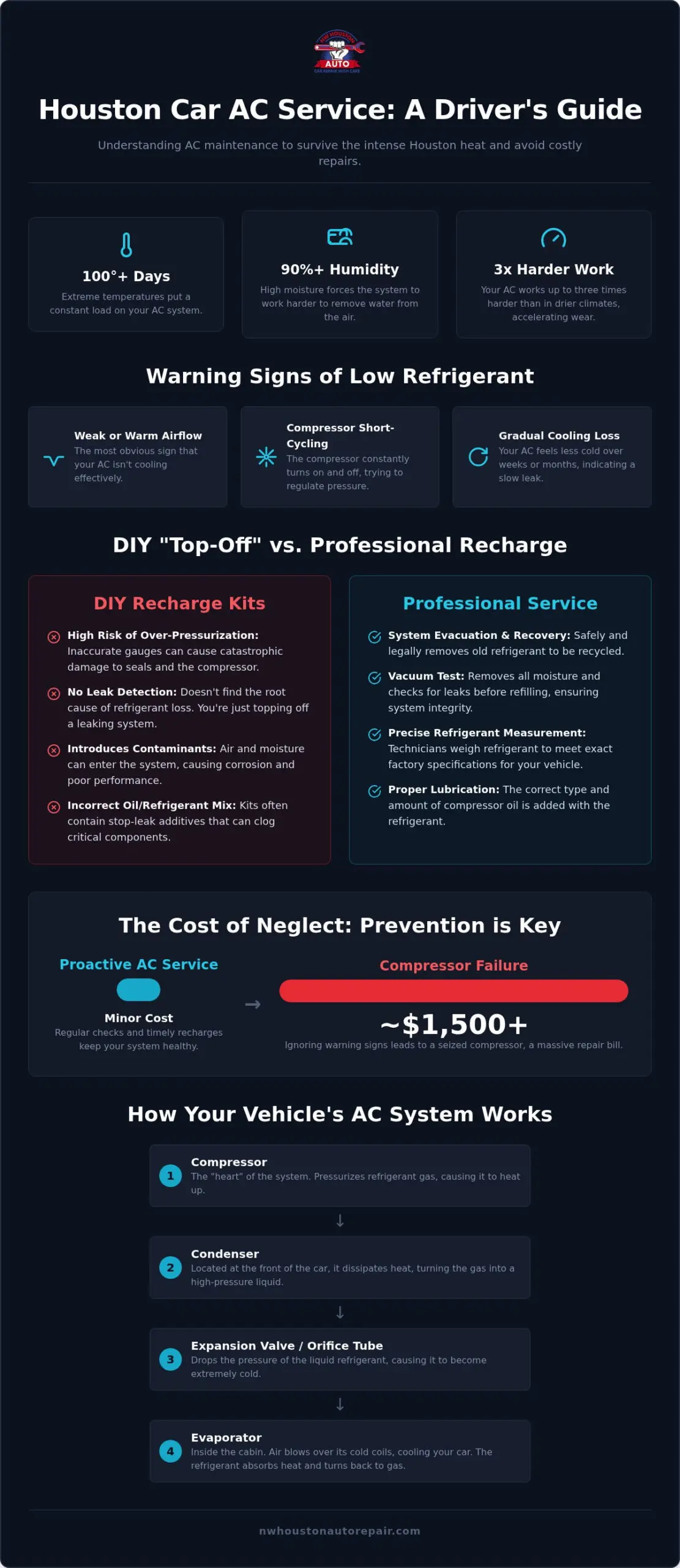
Living in the Bayou City means your vehicle faces a unique set of challenges every time the mercury climbs. A professional car ac recharge service Houston drivers rely on isn’t just a luxury; it’s a specialized maintenance routine designed to combat the “Houston Stress Test.” On days when temperatures soar past 100 degrees and humidity levels hit 90%, your system works three times harder than it would in a drier climate. This constant demand puts immense pressure on your compressor and seals. To keep things running, a professional recharge involves evacuating old refrigerant, performing a vacuum test to find leaks, and refilling the system to exact factory specifications.
Refrigerant levels often drop through natural permeation, where gas molecules slowly escape through rubber hoses over several years. This is a natural process, but it is very different from a mechanical leak caused by a failed seal or a cracked line. Understanding How Your Vehicle’s AC System Works is the first step toward differentiating between routine “air con for car” maintenance and an expensive emergency repair. Catching a low charge early prevents the system from overheating and failing entirely. It’s about being proactive rather than waiting for the vents to blow hot air in the middle of July.
Why Houston Drivers Need Regular AC Inspections
Gulf Coast humidity is a silent killer for automotive components. High moisture levels in the air accelerate corrosion on the condenser, which sits right at the front of your car and takes the brunt of road debris. If you spend your mornings stuck in stop-and-go traffic on the 610 Loop, your AC lacks the natural airflow it needs to dissipate heat efficiently. This forces the cooling fans and compressor to run at maximum capacity for extended periods, accelerating wear. Don’t forget your cabin air filter, either. A clogged filter restricts airflow, making the system work even harder to push cool air into the cabin. Regular auto air conditioning checks ensure these components remain in peak condition before the summer peak hits.
Recharge vs. Top-Off: The Professional Difference
It’s tempting to grab a “recharge kit” from a big-box store, but “topping off” at home is a dangerous gamble. These kits often lack precise gauges, leading to over-pressurization that can blow out your seals or seize your compressor instantly. Professional technicians use specialized recovery equipment to pull out the old refrigerant, which is a legal requirement to protect the environment. We weigh the recovered gas to see exactly how much was lost, giving us a clear picture of your system’s health. A professional AC recharge is a closed-loop recovery and vacuum-testing process that ensures your system is moisture-free and filled to the exact gram.
The Mechanics of Cooling: How Your Vehicle’s AC System Works
Your car’s air conditioning is a closed loop designed to move heat from inside the cabin to the outside air. This process relies on four major players: the compressor, condenser, expansion valve, and evaporator. It starts with the compressor, which pressurizes refrigerant gas. This high-pressure gas travels to the condenser at the front of your car, where it sheds heat and turns into a liquid. From there, it passes through the expansion valve, dropping in pressure and temperature before entering the evaporator behind your dashboard. As cabin air blows over the cold evaporator coils, the refrigerant absorbs the heat, turns back into a gas, and heads back to the compressor to start over.
The refrigerant does more than just carry heat. It also acts as a delivery vehicle for specialized oil that lubricates the internal moving parts of your system. When you have a low charge, the oil can’t circulate properly. This often leads to a condition known as “slugging,” where liquid refrigerant or pockets of oil enter the compressor in ways they shouldn’t. Without consistent lubrication, the compressor will eventually seize. This is why a car ac recharge service Houston drivers schedule regularly is so important. It’s a protective measure that keeps the “heart” of your cooling system beating. Why Professional AC Service is Essential becomes clear when you realize that handling these chemicals requires precision to avoid system contamination or environmental damage.
Refrigerant Types: R134a vs. R1234yf
If your vehicle was built before 2015, it likely uses R134a, which was the industry standard for decades. However, by 2026, most vehicles on the road utilize R1234yf. This newer refrigerant is significantly better for the environment but requires specialized equipment to service correctly. You must never mix these two types. Their chemical compositions are incompatible, and cross-contamination will cause catastrophic failure of your seals and compressor internals. We always verify your vehicle’s specific requirements before beginning any work.
The Role of the AC Compressor
Think of the compressor as the heart of the system. It’s a mechanical pump driven by your engine belt. When it fails, the rest of the components become useless. You might notice grinding noises under the hood or erratic cooling when the compressor starts to struggle. Sometimes the issue is electrical, such as a clutch that refuses to engage. If you suspect your system is failing to kick on, you can Learn more about our auto electrical repair services to see how we diagnose these complex issues. If your vents are blowing warm, reach out to our friendly team so we can catch the problem before it turns into a total system replacement.
Signs Your Car Needs an AC Recharge vs. a Major Repair
The most common indicator that you need a car ac recharge service Houston summers require is a gradual decline in cooling performance. You might notice the air feels crisp in the morning but struggles to keep up once the afternoon humidity peaks. This slow loss of “chill” usually suggests your refrigerant has dipped below the optimal level due to natural permeation. However, if your vents are blowing ambient air regardless of the time of day, you might be facing a mechanical failure rather than a simple low charge. Recognizing these Signs Your Car Needs an AC Recharge can save you from driving in a mobile sauna while preventing further damage to your system.
Listen closely to your engine while the AC is running. If you hear the compressor clicking on and off every few seconds, your system is “short-cycling.” This happens because a safety switch detects low pressure and cuts power to the compressor to prevent it from running dry. It’s a protective measure, but it’s also a clear cry for professional attention. You should also stay alert for odd noises. A faint hissing sound behind the dashboard often points to a refrigerant leak, while a loud squealing from the engine bay usually signals a worn serpentine belt or a failing compressor clutch. These symptoms require more than just a top-off; they demand a thorough diagnostic to identify the root cause.
Don’t ignore the “Damp Carpet” mystery, either. If you notice a musty smell or wet floorboards on the passenger side, your evaporator drain line is likely clogged. While this feels like an AC failure because it affects air quality and humidity removal, it’s actually a drainage issue. Clearing the line is a straightforward fix that restores comfort without the need for a full system overhaul. Check our 2026 Vehicle AC Repair Checklist for more signs to help you decide if your car needs a simple maintenance visit or a more complex repair.
The Warm Air Diagnostic
Pay attention to which vents are blowing warm air. If the driver’s side is cold but the passenger’s side is warm, you might have a failing blend door actuator rather than a refrigerant issue. This is a common electrical or mechanical failure in dual-zone climate control systems. Before you assume the worst, take a look at your condenser through the front grille. Houston’s road debris can easily bend the delicate metal fins or clog them with leaves and dirt. If the condenser can’t breathe, the refrigerant can’t shed heat, leaving you with lukewarm air even if your charge levels are perfect.
Visual Inspections You Can Do at Home
Pop the hood and look for oily residue on the AC hoses and fittings. Since refrigerant carries oil, a greasy spot is a classic “smoking gun” for a slow leak. Check your cabin air filter too. A filter choked with dust and Houston pollen will restrict airflow so severely that the system can’t push cold air into the cabin. Finally, inspect the area around your radiator for blockages. Anything that prevents proper heat exchange will force your system to work harder, eventually leading to the very “air con for car” failures we want to help you avoid.
What to Expect During a Professional AC Recharge Service
A professional car ac recharge service Houston residents trust starts with a baseline performance test. We hook up a manifold gauge set to measure high side and low side pressures while checking the air temperature coming out of your center vents. This initial data tells us if the issue is a simple low charge or something more complex like a failing expansion valve. We don’t guess with your comfort. We use specialized equipment to get a clear picture of your system’s health before we turn a single wrench.
Next comes refrigerant recovery. It’s illegal and irresponsible to vent refrigerant into the atmosphere, so we use a certified recovery machine to pull out the remaining gas and weigh it. This step is vital because it reveals exactly how much refrigerant your system has lost. If your car is supposed to hold 500 grams but we only recover 200, we know there’s a significant leak that needs to be addressed. We then move into the vacuum phase. We run a vacuum pump to remove all air and moisture from the lines. Moisture is the ultimate enemy of your AC. When it mixes with refrigerant, it creates an acidic sludge that destroys your compressor from the inside out.
Finally, we perform a deep pressure test. We monitor the system to ensure it holds that vacuum perfectly. If the gauges move, we know air is getting in, which means refrigerant will get out. We never skip this step. It’s the only way to guarantee that the new refrigerant we add stays where it belongs. If your system is struggling to keep up with the Texas heat, our expert technicians are ready to help with a thorough diagnostic.
The Leak Detection Process
When a system fails the pressure test, we hunt for the source using electronic “sniffers” that detect microscopic gas particles in the air. For those stubborn, slow leaks that only appear under certain temperatures, we inject a specialized UV dye. This dye circulates through the system and glows brightly under a technician’s light, pinpointing failed seals or hairline cracks in the condenser. We believe in doing the job right the first time. Fixing the leak is a mandatory part of our process because simply refilling a leaking system is a temporary band-aid that eventually leads to a seized compressor.
Refilling to Factory Specifications
Once we’ve confirmed the system is airtight, we refill it using precision digital scales. Modern vehicles, especially those built after 2021, have very specific tolerances. Being off by even a few grams can cause the system to underperform or over-pressurize. We also add fresh PAG oil to ensure the internal components of your compressor remain lubricated and cool during the peak of summer. We finish the service by verifying the “delta-T,” which is the temperature difference between the cabin air and the vent output. If your vents aren’t blowing frosty air, reach out to our friendly team today to restore your cabin’s comfort.
Why Professional AC Service is Essential for Houston Commuters
Modern vehicles in 2026 are essentially rolling computers. Your air conditioning is now deeply integrated with your car’s electrical architecture and engine management software. ASE-certified technicians have the specialized training needed to navigate these complex electronics that quick-lube shops often overlook. Since 1999, NW Houston Auto Repair and Collision has combined technical mastery with neighborly warmth to keep our community comfortable on the road. We prioritize trust and transparency in every job. This means we provide honest diagnostics and only recommend the specific repairs your vehicle needs to stay dependable. If a collision has also affected your vehicle’s cooling components or body panels, our auto body northwest Houston collision repair experts can restore your car to its original factory condition with precision and care.
The Value of a Multi-Point Inspection
When you bring your vehicle to a neighborly, family-owned shop, you get much more than a simple refill. Our comprehensive service includes a thorough check of your serpentine belts, cooling fans, and electrical connections. A quick-lube chain might miss a fraying belt that is about to snap in the middle of the 610 Loop, but we look at the big picture. We use specialized diagnostic equipment to find the root cause of your cooling issues. See our full car maintenance services to learn how we keep every system in your vehicle running at peak efficiency.
Preparing Your Vehicle for a Houston Summer
Don’t wait until the first 100-degree day in May to realize your vents are blowing warm air. The best time to schedule an AC check is in the early spring before the intense heatwave hits. Many of our long-term customers choose to combine their AC service with other summer essentials, such as cooling system flushes, to prevent engine overheating during heavy traffic. Proactive care is the best way to avoid the stress of a mid-summer breakdown. Schedule your professional Houston AC recharge today and enjoy a frosty cabin all summer long.
Stay Cool and Protect Your Compressor
Mastering your vehicle’s cooling system doesn’t have to be a source of stress. You’ve learned that a professional car ac recharge service Houston drivers trust is the difference between a minor maintenance visit and a catastrophic compressor failure. Remember that modern systems using R1234yf require the precision of specialized equipment and the expertise of ASE-Certified Technicians. Skipping the hardware store “quick fix” protects your seals and keeps your cabin comfortable throughout the longest commutes on the 610 Loop.
Since 1999, our family-owned and operated shop has been the neighborly authority on both mechanical and collision-related AC damage. We take pride in our technical mastery of both legacy R134a and the latest refrigerant standards. Don’t let the next heatwave catch you off guard. Take control of your comfort and protect your vehicle’s longevity today. Book Your Expert AC Recharge at NW Houston Auto Repair and experience the difference of honest, transparent service. We are ready to help you stay cool on every mile of your journey. You deserve a dependable partner who keeps your car running right.
While seasonal maintenance keeps your car running smoothly, it’s also important to consider the impact of Texas weather on your home. For property owners looking to address potential issues, you can learn more about HCR Roofing Specialist and their professional storm damage repair services.
Frequently Asked Questions
How often should I have my car’s AC recharged in Houston?
You should typically have your system inspected every two to three years to ensure optimal performance. In our local climate, the extreme heat and humidity put extra stress on seals and hoses, making a biennial checkup a smart preventative move. While a well-sealed system doesn’t consume refrigerant, natural vibration and thermal expansion can lead to microscopic leaks over time. Regular car ac recharge service Houston checks help catch these issues before they damage your compressor.
Why is my car AC blowing cold only when I’m driving but warm at red lights?
This symptom usually points to insufficient airflow over the condenser or a failing electric cooling fan. When your vehicle is moving, air is forced through the front grille to cool the refrigerant; at a red light, you rely entirely on the fans. If those fans struggle or the condenser fins are clogged with Houston road debris, the heat exchange process fails. It could also indicate the early stages of a low refrigerant charge that needs professional attention.
Can I just use a DIY AC recharge kit from an auto parts store?
Using a DIY kit is a risky gamble that often leads to overcharging or system contamination. These cans frequently contain stop-leak additives that can gum up internal components and damage professional recovery machines used during future repairs. Without a manifold gauge set to monitor both high and low side pressures, you won’t know if you’re actually fixing the problem or just masking a more serious mechanical failure. Trusting an expert ensures your system remains balanced and safe.
How much does a car AC recharge service typically cost in Houston?
The total investment for a professional recharge depends largely on whether your vehicle uses R134a or the newer R1234yf refrigerant. While newer cars require more expensive materials, a professional service remains a cost-effective way to prevent a total system meltdown. We provide transparent estimates after our initial diagnostic, ensuring you understand exactly what your vehicle needs to stay cool without any hidden surprises or unnecessary upsells. Protecting your compressor now saves you from much larger bills later.
What is the difference between R134a and R1234yf refrigerants?
R1234yf is the modern, environmentally friendly refrigerant that has replaced R134a in most vehicles manufactured after 2021. While both gases perform the same cooling function, R1234yf breaks down much faster in the atmosphere if a leak occurs. Because they operate at different pressures and use different service ports, they require specialized, separate equipment. Our shop is fully equipped to handle both types to serve all generations of Houston drivers with precision and care.
Will an AC recharge fix a loud noise coming from my dashboard?
A recharge rarely fixes noises inside the cabin, as these sounds typically originate from the blower motor or the climate control doors. Hissing might be the only exception, sometimes indicating refrigerant moving through a restricted expansion valve. If you hear grinding or squealing, the problem is likely mechanical or electrical. We use specialized diagnostic equipment to pinpoint the exact source of the noise before suggesting any specific car ac recharge service Houston solution that fits your needs.
Is it safe to drive with a broken car AC system during a Houston summer?
Driving without AC in our humidity is technically possible but can be dangerous due to heat exhaustion and reduced driver focus. Interior temperatures in a parked car can exceed 140 degrees within minutes, and even while driving, the heat island effect on Houston highways is brutal. Beyond your own safety, a failing AC system can sometimes lead to a seized compressor belt. If that belt snaps, it might leave you stranded on the shoulder of a busy freeway.
How long does a professional AC recharge service take?
You can usually expect a thorough recharge service to be completed in about sixty to ninety minutes. This timeframe allows our technicians to perform a full recovery, a deep vacuum pull to remove moisture, and a mandatory leak test before refilling. We believe in being deliberate and careful with your property. Taking this extra time ensures the job is done right the first time so you can get back to your day with total confidence in your comfort.