
What if that subtle drift to the right isn’t just an annoying quirk, but an active threat to your wallet? When an auto shop recommends an adjustment, it is completely natural to wonder: what does a wheel alignment do for my car, and is it genuinely worth the visit? You aren’t alone if you suspect an unnecessary upsell while quietly dreading the cost of replacing prematurely ruined tires.
Every driver deserves transparent answers. Aligning your wheels isn’t just a basic tire service; it’s a precise mechanical calibration of your suspension geometry that protects your tread investment, restores factory safety, and brings back smooth handling. We’ll break down the warning signs of misaligned angles, show how computerized equipment restores true stability, and explain how regular care keeps your vehicle safe on demanding roads.
Key Takeaways
- Suspension calibration adjusts steering geometry rather than the tires themselves to maintain optimal contact with the road.
- Learning what does a wheel alignment do for my car clarifies how precise adjustments prevent rapid, uneven tread wear.
- Mastering the differences between camber, caster, and toe angles helps you understand factory handling specifications.
- Recognizing subtle warning signs like steering pull and off-center wheels ensures you catch suspension misalignment before costly damage occurs.
- Thorough computerized alignment services begin with comprehensive steering inspections to confirm mechanical safety before calibration.
Understanding Wheel Alignment: How Suspension Calibration Protects Your Vehicle
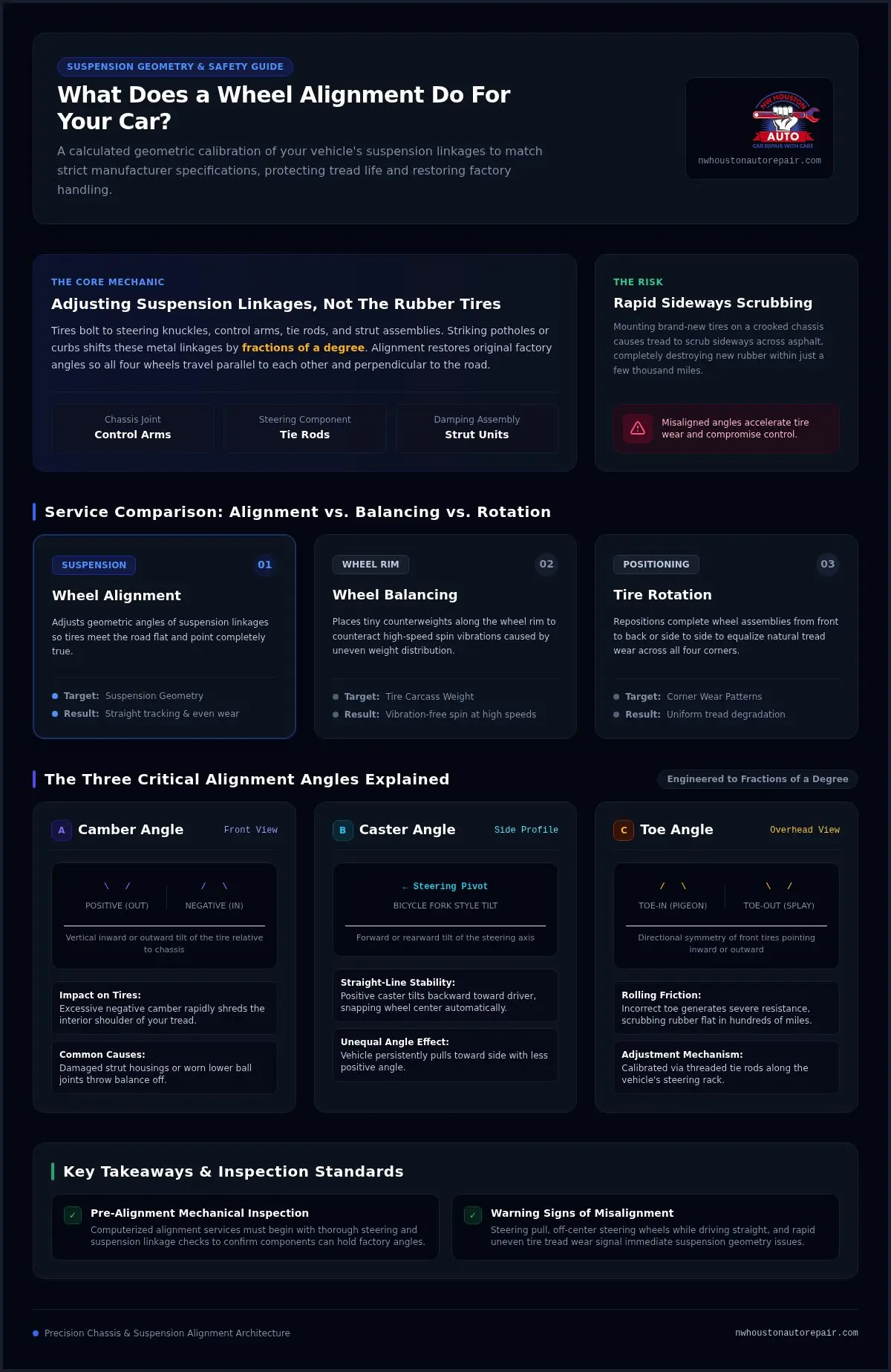
Drivers frequently leave an auto repair shop asking the same practical question: exactly what does a wheel alignment do for my car? A common misconception assumes technicians physically bend or reshape the rubber tires. In reality, a proper wheel alignment is the precise mechanical calibration of your vehicle’s suspension components to restore original factory geometry. Technicians adjust the physical angles of the chassis connections, ensuring all four wheels travel completely parallel to each other and perpendicular to the roadway. Put simply: wheel alignment is the calculated geometric calibration of your suspension system to match strict original equipment manufacturer specifications.
Adjusting Vehicle Suspension Rather Than the Tires Themselves
Tires simply mount onto wheels, which bolt directly to steering knuckles, control arms, tie rods, and strut assemblies. When you strike a harsh pothole or hit a concrete curb, these rigid metal linkages shift by fractions of a degree. Even a microscopic shift in these structural joints alters how your tread contacts the asphalt. If you mount a set of brand-new tires onto a crooked chassis, those expensive treads will scrub sideways and degrade within just a few thousand miles. If worn steering links cannot hold factory angles, dedicated suspension repair is necessary before any calibration can lock into place.
Wheel Alignment vs. Wheel Balancing vs. Tire Rotation
Many vehicle owners confuse standard tire upkeep with chassis alignment. While each service targets smooth travel and tread life, they solve entirely separate mechanical problems:
- Wheel Alignment: Adjusts the geometric angles of the suspension linkages so tires meet the road flat and point true.
- Wheel Balancing: Places tiny counterweights along the wheel rim to counteract high-speed spin vibrations caused by uneven weight distribution across the tire carcass.
- Tire Rotation: Repositions wheels from front to back or side to side to equalize natural tread wear across all positions.
Understanding what does a wheel alignment do for my car makes it easy to see why routine maintenance packages often combine these tasks. Scheduling a precision wheel alignment alongside regular tire rotation pairs mechanical balance with correct chassis geometry, protecting your tires from every angle.
The Three Critical Alignment Angles: Camber, Caster, and Toe Explained
Automotive engineers calculate suspension geometry to fractions of a single degree. When drivers ask what does a wheel alignment do for my car on a mechanical level, the answer comes down to adjusting three spatial angles: camber, caster, and toe. Each parameter controls a distinct axis of movement. If even one angle slips out of factory tolerance, your handling degrades, highway stability falters, and your tires wear out prematurely.
Camber Angle: Inward and Outward Vertical Wheel Tilt
View your vehicle directly from the front bumper. Camber represents the inward or outward vertical tilt of the tire. Positive camber occurs when the top edge of the tire tilts outward away from the chassis; negative camber occurs when it tilts inward. While high-performance cornering setups sometimes utilize subtle negative camber, excessive inward tilt rapidly shreds the interior shoulder of your tread. Damaged strut housings or worn lower ball joints frequently throw camber off balance.
Caster Angle: Steering Pivot Axis and Straight-Line Stability
Look at your wheel assembly from the vehicle’s side profile. Caster measures the forward or rearward tilt of your steering axis, much like the angled front fork on a bicycle. Positive caster tilts the steering pivot backward toward the driver, creating high-speed tracking stability and allowing your steering wheel to snap back center automatically after completing turns. If caster differs between the left and right wheels, your car will pull persistently toward the side with less positive angle.
Toe Angle: Directional Symmetry and Rolling Friction
Imagine looking down at your vehicle from directly overhead. Toe describes whether the leading edges of your front tires point inward toward each other (toe-in) or splay outward (toe-out). Incorrect toe generates severe sideways rolling resistance, physically scrubbing the rubber flat across the pavement within hundreds of miles. Professional technicians resolve this friction by adjusting threaded tie rods along the steering rack. Recognizing the physical signs your car needs an alignment will help you spot these symptoms early.
Evaluating what does a wheel alignment do for my car becomes straightforward once you see how these angles govern driving dynamics:
- Camber: Controls vertical tire surface contact; prevents inner or outer shoulder baldness.
- Caster: Manages straight-line tracking stability; prevents highway wander and erratic steering pull.
- Toe: Governs forward directional tracking; stops severe sideways tread scrubbing.
If you suspect an errant pothole bent an arm or shifted your angles, feel free to contact our team to discuss a quick steering inspection.
Key Benefits of an Alignment: Safety, Handling, and Long-Term Savings
Investing in routine suspension maintenance delivers immediate returns every time you get behind the wheel. When asking what does a wheel alignment do for my car in terms of daily ownership, the answer extends far past simple steering adjustments. Calibrating your vehicle’s steering and suspension geometry directly reduces operating expenses, enhances control during split-second emergency maneuvers, and preserves high-dollar mechanical assemblies against premature failure.
Preventing Premature and Costly Tire Tread Wear
Tires represent a major investment. Correct alignment ensures vehicle weight presses evenly across the complete footprint of the tire rather than grinding down a single shoulder. Common misalignments produce destructive tread wear patterns:
- Feathering: Tread ribs become smooth on one edge and sharp on the other due to erratic toe settings.
- Camber Wear: Inner or outer tire edges wear down to the steel belts while the rest of the tread remains deep.
- Cupping: Scalloped dips form across the tire circumference when loose suspension joints bounce erratically.
Pairing a routine alignment check with scheduled tire rotation maximizes rubber longevity across all four positions.
Restoring Effortless Straight-Line Tracking and Steering Response
Fighting a drifting steering wheel for an hour on the highway creates intense driver fatigue. When caster and camber angles match factory tolerances, your car tracks straight and true with minimal steering effort. This stability proves vital during abrupt braking or evasive swerves in wet conditions. Balanced geometry ensures maximum tire surface area grips the road surface, keeping the vehicle stable rather than unsettled during quick directional changes.
Improving Fuel Economy by Reducing Road Resistance
Misaligned tires do not roll freely forward. Instead, they drag slightly sideways across the asphalt, creating substantial tire rolling resistance. Your engine burns surplus fuel simply to overcome that persistent mechanical drag. For modern electric vehicles, incorrect alignment can reduce real-world battery efficiency by 5% to 10% because electric motors must work significantly harder to overcome that scrubbing resistance. Establishing proper alignment eliminates artificial friction, helping your powertrain operate at peak efficiency.
Knowing what does a wheel alignment do for my car transforms suspension maintenance from an unexpected shop chore into an essential money-saving service. Scheduling a precision wheel alignment restores effortless highway cruising while safeguarding your tires for thousands of miles ahead.
Warning Signs Your Car Needs an Immediate Wheel Alignment
Suspension misalignment rarely announces itself with an engine warning light. Instead, chassis angles deteriorate gradually, silently degrading your vehicle dynamics until severe tire destruction or steering failure forces a costly stop. Learning how to recognize subtle mechanical red flags answers the question of what does a wheel alignment do for my car when immediate intervention prevents catastrophic wear. If your vehicle displays erratic handling cues, inspecting your chassis should become an urgent priority.
Off-Center Steering Wheels and Vehicle Drift on Flat Pavement
Straight-line driving provides the clearest test of steering geometry. If you must hold your steering wheel emblem tilted at an angle just to maintain a straight path on a flat highway, your toe angles are severely distorted. A gentle drift can sometimes result from the engineered drainage slope of the pavement. True mechanical pulling, however, forces you to muscle the wheel persistently to keep the car within its lane. Test your tracking on a flat stretch of open road; if the vehicle actively veers off course within seconds, schedule an alignment check right away.
Road Impacts, Potholes, and Infrastructure Hazards
Sudden collisions with road obstacles cause instant chassis distortion. Striking a deep pothole, bouncing over sunken utility covers, or curbing a rim during parallel parking bends metal control arms and slips tie-rod adjustment sleeves out of place. Commuters navigating expanding highway construction zones face constant impacts that accelerate suspension fatigue. Check our detailed guide on precision wheel alignment in Houston to see how rough regional infrastructure shortens alignment intervals.
Post-Repair Protocols and New Tire Installations
Mechanical repairs invariably alter your vehicle’s baseline geometry. Installing fresh replacement struts, sway bar end links, or tie rods changes the resting height and angle of the wheel assemblies. Never skip calibration after completing suspension repair; leaving your chassis uncalibrated will ruin those fresh components within weeks. Similarly, mounting a brand-new set of tires without verifying alignment invites immediate, asymmetrical tread wear.
Notice any of these red flags during your daily drive? Don’t let misaligned angles ruin expensive tires. Schedule an alignment inspection today to restore your vehicle’s factory stability and safety.
What to Expect During a Professional Computerized Alignment Service
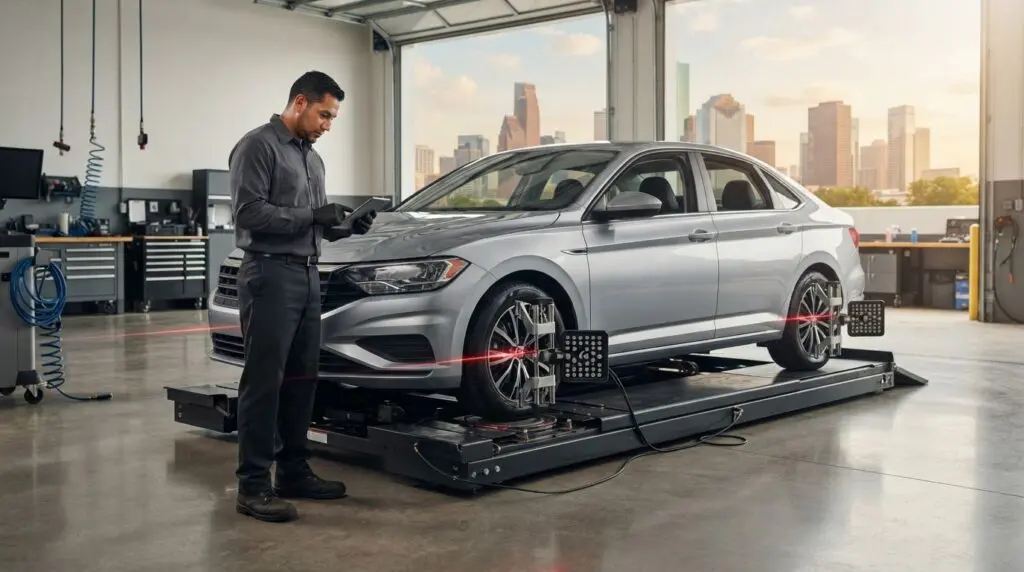
Driving your car onto a diagnostic rack reveals the high-tech reality of modern suspension care. If you are still weighing what does a wheel alignment do for my car in practical terms, observing the workflow demystifies the entire procedure. High-precision alignment bays rely on advanced optical imaging technology and meticulous physical inspections to ensure every steering linkage matches factory parameters to hundredths of a degree.
Pre-Alignment Steering and Suspension Health Inspection
Ethical automotive technicians never touch an adjustment wrench without conducting a thorough mechanical inspection first. The vehicle goes up on the lift so technicians can physically check ball joints, tie-rod ends, control arm bushings, and wheel bearings for unwanted play. Attempting to align a vehicle with damaged or loose chassis parts is impossible; the angles will drift out of true the moment the car rolls off the lift. Technicians also inspect tire condition and set tire pressures to proper placard ratings, ensuring a true foundation for measurement.
Computerized Imaging and Factory Specification Adjustments
Once baseline steering integrity is verified, technicians secure optical targets to all four wheel assemblies. Specialized multi-camera imaging systems read the exact positioning of these targets in 3D space, transmitting geometric measurements directly to the diagnostic console. The system compares live readings against the vehicle manufacturer’s original technical specifications. Guided by live data, technicians methodically loosen and adjust tie-rod sleeves, eccentric cam bolts, and suspension shims to bring camber, caster, and toe angles back into exact alignment.
Test Driving and Diagnostic Printout Verification
Transparency is the hallmark of professional service. After locking down all suspension hardware, the technician provides a clear diagnostic report detailing before-and-after measurements across every angle. These printouts show the out-of-spec readings highlighted alongside the corrected factory numbers, giving you verifiable proof of the work performed. A certified technician then completes a road test to confirm the steering wheel remains centered and tracking stays straight on flat pavement.
Regular maintenance preserves your car’s handling feel. Scheduling a suspension check annually or every 10,000 to 15,000 miles keeps your chassis aligned and prevents expensive tire replacement down the road. Understanding what does a wheel alignment do for my car gives you the confidence to protect your investment with timely care.
Restore Precision Handling and Protect Your Investment
Clear suspension geometry makes all the difference between an exhausting daily commute and a confident, controlled ride. Understanding what does a wheel alignment do for my car cuts through the confusion, proving that this service isn’t an unnecessary upsell. Aligning your wheels safeguards your tire investment against premature wear, reduces unnecessary rolling resistance, and keeps vital safety dynamics locked to factory specifications.
Don’t let rough roads compromise your safety or drain your wallet. Serving the Houston driving community since 1999, our family-owned facility relies on advanced computerized four-wheel alignment and suspension diagnostics to deliver honest, transparent mechanical recommendations. Take the stress out of vehicle care and regain total control on the road. Schedule your precision wheel alignment with NW Houston Auto Repair and Collision today to experience smooth, dependable driving every mile.
Frequently Asked Questions
How often should I have a wheel alignment done on my car?
You should have your alignment checked once a year or every 10,000 to 15,000 miles. Frequent travel across rough Houston roadways, sudden curb impacts, or deep potholes may require more frequent checks. Routine inspections catch minor chassis shifts before they cause severe tread destruction.
Can bad alignment cause vibrations in the steering wheel?
Chassis misalignment rarely creates a noticeable steering vibration on its own. Persistent shaking usually points to tire imbalance, an out-of-round wheel, or warped brake rotors. Bad alignment primarily causes vehicle pulling and crooked tracking, though severe tire cupping resulting from prolonged misalignment can eventually generate highway vibrations.
What is the difference between a two-wheel and a four-wheel alignment?
A two-wheel alignment calibrates only the front steering assembly, which suits older trucks or rear-wheel-drive vehicles featuring a solid rear axle. A four-wheel alignment measures and adjusts all four corners to ensure directional symmetry. Modern sedans, crossovers, and all-wheel-drive cars require complete four-wheel calibration to track true.
Can I perform a wheel alignment at home with basic hand tools?
You shouldn’t attempt a DIY alignment on a modern daily driver with string and tape measures. While basic tools can roughly approximate front-wheel toe, they cannot accurately measure caster, camber, or thrust angles to fractions of a degree. Factory handling demands computerized diagnostic sensors to achieve reliable geometry.
Will a wheel alignment fix a car that pulls to one side?
Yes, an alignment will fix pulling if the issue stems from uneven caster, camber, or toe angles. However, pulling can also result from uneven tire pressure, dragging brake calipers, or internal tire radial pull. A skilled technician inspects your brakes and tires first to confirm the true underlying cause.
Does getting new tires installed automatically include a wheel alignment?
No, mounting new tires does not automatically include chassis calibration. Tire installation covers mounting rubber to the rims and balancing the assembly. If you are asking what does a wheel alignment do for my car after buying rubber, it adjusts the suspension joints so your fresh investment doesn’t scrub away prematurely.
How long does a professional computerized wheel alignment service typically take?
A professional computerized alignment generally takes approximately 45 to 60 minutes to complete. This timeframe covers the initial mechanical inspection of your steering joints, mounting the optical targets, making precision underside adjustments, and performing a final road test to confirm proper center tracking.