
Did you know that since 2025, Texas has eliminated mandatory annual vehicle safety inspections for passenger cars? This legislative shift means that if you’re one of the 60,000 plus drivers involved in a Houston collision this year, the burden of identifying structural danger rests entirely on your shoulders. It’s incredibly stressful to drive away from a wreck wondering if your vehicle is truly safe or if there’s a hidden disaster lurking beneath the bumper. You shouldn’t have to guess when it comes to your family’s safety or your car’s resale value.
We understand that anxiety, and we’re here to act as your authoritative guide. In this 2026 safety checklist, you’ll learn exactly how to tell if car frame is bent after accident by spotting the subtle signs most owners miss. We’ll walk you through visual red flags like uneven panel gaps and explain why your car might feel like it’s “crab-walking” down the Katy Freeway. From identifying unibody ripples to understanding why high-tech 3D laser measurements are now a necessity for modern ADAS systems, this guide provides the clarity you need. Let’s look at the symptoms that separate a simple cosmetic fix from a serious structural repair.
Key Takeaways
- Spot hidden structural issues by checking the alignment of your doors, hood, and trunk in bright daylight. Uneven gaps or doors that require force to close are immediate warning signs of a shifted frame.
- Pay attention to how your vehicle handles on Houston roads. If it pulls to one side or feels like it’s drifting sideways, you’ll learn how to tell if car frame is bent after accident through these specific performance red flags.
- Understand the difference between traditional body-on-frame and modern unibody designs. Knowing how impact forces travel through your car’s skeleton helps you identify why even a minor bump can cause major structural shifts.
- Discover why professional 3D laser diagnostics are essential for modern vehicles equipped with advanced driver assistance systems. A deviation of just a few millimeters can compromise your safety sensors and future crash protection.
- Protect your vehicle’s resale value and longevity by addressing frame damage early. Ignoring these symptoms leads to accelerated tire wear and potentially dangerous failures during emergency maneuvers.
Understanding the ‘Skeleton’: Frame vs. Unibody Damage
Your vehicle’s frame acts as the structural foundation for every other component, from the heavy engine block to the precision door hinges. When this skeleton is compromised, the entire safety profile of your car changes instantly. Many drivers assume that a minor tap in a grocery store parking lot or a low-speed Houston fender bender only results in a few cosmetic scratches. In reality, modern automotive engineering is so precise that even a displacement of a fraction of an inch can be catastrophic. If you are wondering how to tell if car frame is bent after accident, you first need to understand exactly what kind of structure you are driving.
Structural damage is particularly dangerous because it compromises the crumple zones designed to protect you. These areas are engineered to absorb the violent energy of a crash. Once they have been bent or stressed, they lose their ability to protect you in a second collision. A frame that is out of alignment doesn’t just make the car drive poorly; it turns your dependable vehicle into a safety liability. It’s a problem that requires immediate attention to preserve both your safety and your car’s long-term value.
What is a Ladder Frame?
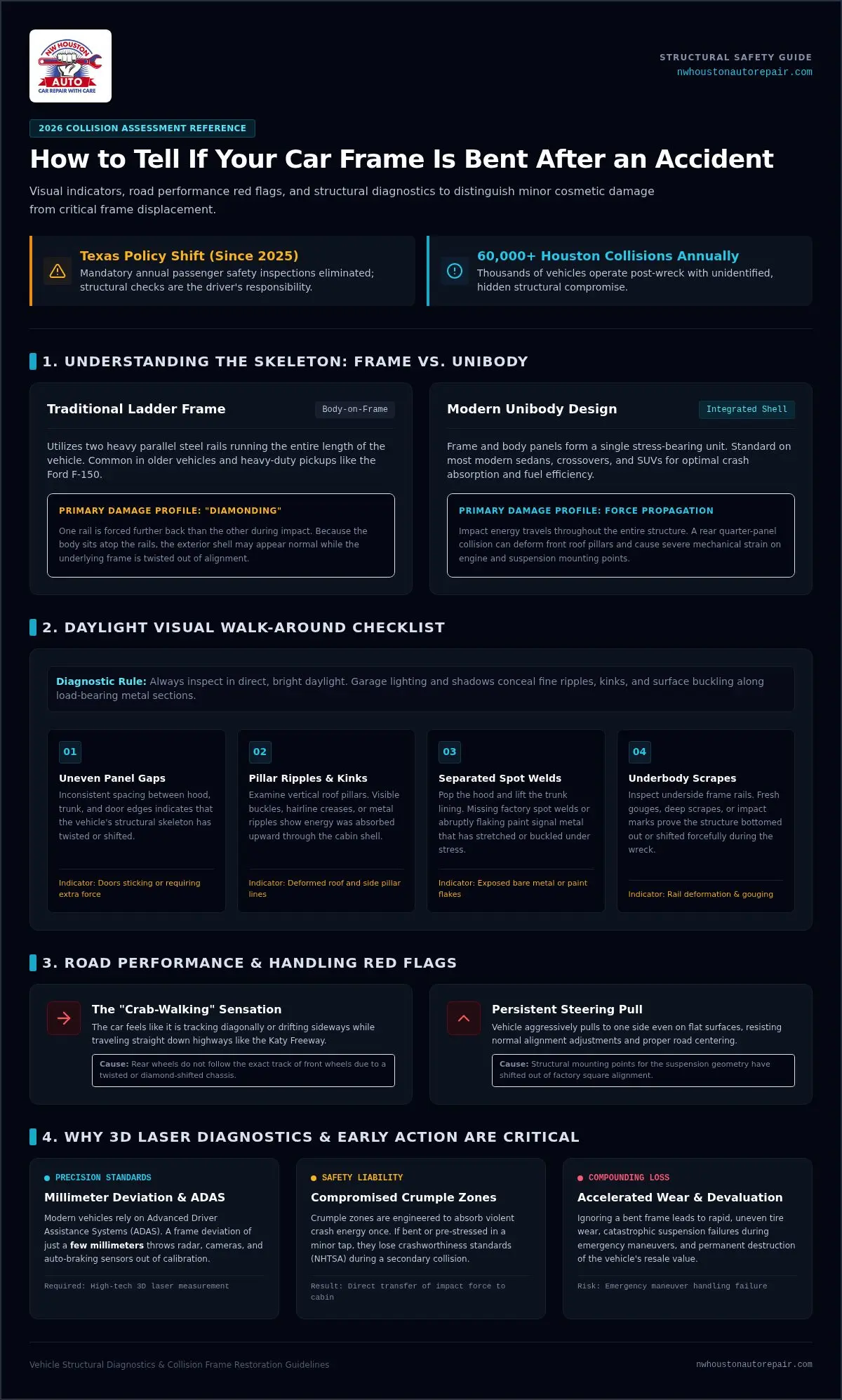
Traditional body-on-frame construction, often called a ladder frame, consists of two heavy steel rails running the length of the vehicle. This design is common in older vehicles and heavy-duty trucks like the Ford F-150. These frames are incredibly durable, but they are prone to specific types of distortion like diamonding, where one rail is pushed further back than the other. Understanding the history of vehicle frame and unibody construction helps identify why these heavy steel structures require different diagnostic techniques compared to modern family sedans. Because the body sits on top of the frame, the car might look fine while the steel rails underneath are dangerously twisted.
The Complexity of Modern Unibody Systems
Most sedans, crossovers, and SUVs on the road today utilize a unibody design. In this system, the frame and the body panels are manufactured as a single, stress-bearing unit. This setup is excellent for fuel efficiency, but it means that impact forces travel through the entire shell of the car. A hit to the rear quarter panel can actually cause a misalignment in the front roof pillars. Restoring these complex systems requires high-precision collision repair to meet factory safety specifications. Learning how to tell if car frame is bent after accident involves looking beyond the point of impact, as the damage is often widespread and invisible to the untrained eye. If the unibody is even slightly out of square, it places immense stress on the engine and suspension, leading to expensive mechanical failures later on.
The Visual Inspection Checklist: What to Look For
Finding structural damage starts with a simple walk-around, but you need the right environment. Take your vehicle out into bright, direct Houston sunlight. Shadows in a garage can hide the subtle ripples that signal a major problem. As you move around the car, look for irregularities that weren’t there before the collision. This is the first step in learning how to tell if car frame is bent after accident without needing specialized tools immediately. Look closely at the pillars, the vertical supports for your roof, for any creases or kinks in the metal. You should also pop the hood and check the trunk floor. If you see missing spot welds or areas where the paint has suddenly flaked off, the metal underneath has likely stretched or buckled.
Don’t forget to look underneath the vehicle. Inspect the frame rails for fresh scrapes or gouges that suggest the car bottomed out or shifted during the impact. These visual cues are vital because structural integrity is governed by strict NHTSA vehicle crashworthiness standards. If these zones are compromised, the car won’t react correctly in a future crash. Understanding how to tell if car frame is bent after accident through these visual cues helps you make an informed decision about your next repair step. If you spot anything suspicious, it’s always best to reach out for a professional opinion to ensure your safety.
Uneven Body Gaps and Door Misalignment
Check your “shut lines.” These are the gaps between your doors, fenders, hood, and trunk lid. In a factory-perfect car, these gaps are uniform. If a door sticks, rubs against the frame, or requires extra force to close, you’re looking at a structural shift. A difference of just 1/8th of an inch in gap width from one side of the car to the other is a definitive indicator of a bent frame. These tiny deviations suggest the entire shell has torqued out of alignment.
Visible Cracks or Buckling Under the Car
Get low and look at the suspension mounting points. Any cracks in the metal or signs that the mounting bolts have shifted are major red flags. You might also notice “diamonding.” This occurs when one side of the frame is pushed further back than the other, making the car’s foundation look more like a parallelogram than a rectangle. Look for flaking paint or fresh rust on the frame rails. When steel bends, the paint loses its grip and flakes off, exposing the bare metal to Houston’s humidity. If the metal looks rippled like a crushed soda can, the frame has reached its yield point and requires expert attention.
Performance Red Flags: How the Car Drives
Performance red flags often scream louder than a visual dent. If your car pulls aggressively to one side on a straight stretch of I-45, don’t just assume it’s a low tire. With Houston recording over 60,000 traffic crashes in 2025, we see this specific symptom frequently after highway collisions. Structural shifts place uneven tension on the suspension. This tension forces the vehicle out of its natural path. You might also feel a persistent shudder through the steering wheel or seat. These aren’t just annoying vibrations. They often indicate that the engine mounts or subframe have shifted, throwing the car’s rotating mass out of balance.
Listen for groans or squeaks when navigating speed bumps or turning into your driveway. When the frame is torqued, the metal components rub against each other in ways the manufacturer never intended. Identifying these warning signs of car frame damage early can prevent a total mechanical failure. Knowing how to tell if car frame is bent after accident means trusting your senses. If the car feels “off,” it usually is. Don’t ignore the way your vehicle communicates its distress.
Tracking and ‘Crab Walking’ Symptoms
This is one of the most serious performance issues. Crab walking, or dog-tracking, happens when the front and rear axles are no longer parallel due to a twisted chassis. To check for this, have a friend follow you in another vehicle while you drive on a flat, straight road. If the rear of your car seems to be “peeking” out to one side while the front stays centered, the frame is definitely bent. This makes the car incredibly unpredictable during emergency maneuvers. A car that drives sideways cannot brake symmetrically. This is a massive risk during a sudden Houston rainstorm when hydroplaning is already a threat.
Unusual Tire Wear and Alignment Issues
Take a close look at your tread. If you notice “feathering,” where the tread blocks feel sharp on one side and smooth on the other, your alignment is failing. While a standard wheel alignment can fix many issues, a bent frame makes a permanent fix impossible. If your technician tells you they’ve adjusted everything but the car still pulls, the mounting points themselves have moved. This is a primary way how to tell if car frame is bent after accident. For more details on maintaining your vehicle’s geometry, see our guide on Precision Wheel Alignment in Houston. Rapid wear on the inside or outside of just one tire is a definitive signal that your car’s skeleton is no longer square.
Why Professional Diagnostics Are Non-Negotiable
While our visual checklist and performance tests provide a strong starting point, human eyes simply cannot detect the minute shifts that compromise a vehicle’s structural integrity. Modern automotive safety is a game of millimeters. OEM specifications for unibody cross-measurements generally permit no more than ±2 mm to ±3 mm of deviation across factory datum points. If your vehicle exceeds these tolerances, its ability to protect you in a future collision is severely diminished. Relying on a “looks fine to me” assessment is a dangerous gamble when you’re trying to figure out how to tell if car frame is bent after accident.
Professional diagnostics take the guesswork out of the equation. By comparing your vehicle’s current state to original factory blueprints, technicians can identify exactly where the metal has moved. This level of precision is essential for ensuring that safety systems, such as airbags and impact sensors, function correctly. If the frame is even slightly out of square, those sensors might not trigger at the right moment during a crash. Trust the data over your intuition to keep your family safe on the road.
The Role of 3D Laser Measurement
We utilize advanced computerized 3D measuring systems to map your vehicle’s geometry with absolute precision. These laser scanners identify deviations as small as a fraction of a millimeter, catching “invisible” damage that manual tools often miss. This technology is essential for modern high-strength steel unibody frames, which are designed to absorb energy by deforming in specific ways. 3D laser mapping is the gold standard for collision safety. Furthermore, these measurements are critical for your Advanced Driver Assistance Systems (ADAS). A structural deviation of just 1 millimeter can displace your forward-facing radar or cameras by dozens of feet at highway distances, leading to erratic braking or lane-keep failures.
Restoring Factory Specifications
Once we identify the displacement, we use heavy-duty frame machines and hydraulic force to pull the metal back into its original alignment. It’s a methodical process that requires technical mastery to ensure the metal isn’t overstressed or weakened. Proper restoration is required to maintain the vehicle’s crumple zone integrity, ensuring the car remains “crashworthy” for years to come. Visit our collision center to see how we handle precision structural work with the care your vehicle deserves. Don’t leave your safety to chance after a wreck. If you suspect your vehicle isn’t tracking correctly, schedule your structural diagnostic today to get the definitive answers you need.
The Risks of Ignoring a Bent Frame in Houston
Driving in Houston requires a vehicle that is 100 percent dependable. Between the high-speed merges on Beltway 8 and the bone-jarring potholes on our local roads, your car’s structure faces extreme stress every single day. Once you understand how to tell if car frame is bent after accident, the most critical step is taking action. Ignoring these signs doesn’t just make for a bumpy ride; it creates a cascade of mechanical failures. A twisted frame forces your engine and transmission to work at awkward angles, leading to accelerated wear that a simple oil change can’t fix. Over time, these mounting long-term costs often exceed the price of the initial structural repair.
There is also the looming threat of insurance complications. If you are involved in a second collision and your insurance carrier discovers unrepaired structural damage from a previous incident, they may deny your claim entirely. They view an unrepaired frame as a pre-existing condition that makes the car unroadworthy. Procrastination doesn’t just risk your safety. It risks your financial recovery when you need it most. We’ve helped Houston drivers navigate these complexities since 1999, and we know that a documented, professional repair is the only way to stay protected.
Safety Risks and Crumple Zone Failure
Your car’s crumple zones are engineered as one-time use safety features. They are designed to sacrifice themselves to save you. Once these areas are bent or even slightly buckled, they lose their structural memory and cannot absorb energy a second time. This means that in another accident, the force of the impact could bypass the safety zones and travel directly into the passenger cabin. A compromised frame also significantly increases the risk of a cabin collapse during a rollover or side impact. Safety is our absolute priority at NW Houston Auto Repair. Don’t take an unnecessary risk on the Beltway with a skeleton that is already broken.
Financial and Insurance Implications
The financial impact of structural damage is immediate and severe. If a bent frame is disclosed or discovered during a pre-purchase inspection, your vehicle’s resale value can plummet. In many cases, a salvage or rebuilt title can reduce a car’s market value by 30 percent to 50 percent. Documented professional repairs are the only way to preserve some of that equity and prove to future buyers that the car is safe to drive. If you’ve spotted the red flags and are ready for a professional look, contact our Houston team for a structural assessment. We’ll provide the transparency and technical mastery you need to get back on the road with total confidence.
Secure Your Safety and Vehicle Longevity
Driving a vehicle with structural damage is a risk you don’t have to take. You now know that uneven panel gaps, sticking doors, and erratic “crab walking” on the freeway are clear signals of a deeper problem. While these visual checks are vital, remember that true safety is found in the details that the human eye misses. Learning how to tell if car frame is bent after accident empowers you to take charge of your vehicle’s health before small issues turn into dangerous failures.
As a family-owned establishment serving the community since 1999, we’re here to provide the technical mastery your car deserves. We use specialized 3D laser frame measurement to ensure your unibody meets factory specs. Plus, we stand behind our work with a lifetime warranty on collision repairs. Don’t leave your safety to chance after a wreck. Our team is ready to restore your car’s integrity with transparency and care.
Schedule Your Precision Frame Inspection at NW Houston Auto Repair today. We’ll help you get back on the road with total peace of mind and a vehicle you can depend on for years to come.
Frequently Asked Questions
Can you drive a car with a bent frame?
No, you shouldn’t drive a car with a bent frame because it’s fundamentally unsafe. While the vehicle might still move, its structural integrity is compromised. This makes the car unpredictable during emergency braking or sharp turns on Houston’s busy highways. Driving a damaged vehicle puts your passengers at risk and can cause rapid wear on your suspension and tires. It’s best to have the car towed to a professional shop for a full assessment.
Is a bent frame always a total loss for insurance?
Not necessarily, but it depends on your vehicle’s value and the extent of the damage. In Texas, insurance companies often consider a car a total loss if repair costs reach 70 to 80 percent of its actual cash value. Since frame repairs require specialized labor and precision equipment, these costs add up quickly. If your car is older, even a minor structural shift might trigger a total loss payout from your insurance provider.
How much does it cost to fix a bent car frame in Houston?
Costs for structural restoration vary based on the severity of the bend and the type of vehicle. Minor straightening might require just a few hours on a frame machine, while severe damage could involve replacing entire sections of the chassis. Since we prioritize transparency, we recommend a professional diagnostic to provide an accurate estimate. Every wreck is unique, and factors like high-strength steel or complex unibody designs will influence the final repair plan for your vehicle.
Can a bent frame be fixed perfectly?
Yes, with the right technology and expertise, a bent frame can be restored to original factory specifications. We use advanced computerized 3D laser measuring systems to ensure every point on your chassis matches the manufacturer’s blueprints exactly. This precision is non-negotiable for modern vehicles. When handled by a team with technical mastery, your car will handle correctly and provide the same level of protection it did before the collision occurred.
Will a bent frame show up on a vehicle history report?
Yes, structural repairs are typically documented and will appear on vehicle history reports like CARFAX or AutoCheck. This documentation is important for transparency and future resale. While it can affect the car’s market value, having proof of a professional repair using 3D laser technology can actually help reassure future buyers. It shows that the vehicle was restored correctly by an authoritative guide rather than patched together with guesswork or outdated tools.
What happens if I don’t fix a minor frame bend?
Ignoring even a minor bend leads to a cascade of mechanical problems. You’ll likely notice rapid, uneven tire wear and persistent pulling to one side. Over time, the uneven stress can damage your transmission and engine mounts. Most importantly, a minor bend compromises your car’s crumple zones. If you’re in another accident, the vehicle won’t protect you as intended. This is why learning how to tell if car frame is bent after accident is a vital safety skill.
Does a bent frame affect my car’s alignment permanently?
Yes, a bent frame makes a standard wheel alignment impossible to maintain. If the structural mounting points for your suspension have shifted, your tires will never sit square on the road. You might pay for multiple alignments only to find the car still pulls or vibrates. This is a primary indicator of how to tell if car frame is bent after accident. Only after the frame is pulled back into factory spec can your alignment be successfully restored.
How long does a professional frame repair take?
The timeline depends on the complexity of the damage and the parts required for the job. A straightforward frame pull might take two to four days on the machine. However, if structural components need to be cut out and replaced, the process can take a week or longer. We understand that being without your vehicle is stressful. Our team works with efficiency and precision to ensure your car is safe and back on the road as quickly as possible.