

Imagine sitting in gridlock on the Sam Houston Tollway in mid-July 2026. The outside temperature is climbing toward triple digits, and suddenly, your vents start blowing air that feels more like a hair dryer than a freezer. You immediately wonder if you just need a quick refrigerant top-off or if you’re facing a total system failure. Understanding the early symptoms of a bad car ac compressor is the only way to protect your wallet and your comfort before the oppressive Houston humidity takes over your cabin.
We understand that vehicle malfunctions are stressful, especially when you’re worried about being overcharged for repairs you might not actually need. You deserve a clear, honest explanation of what’s happening under your hood. In this guide, we’ll show you how to distinguish between minor glitches and a failing compressor unit. You’ll learn to identify telltale noises, cooling inconsistencies, and physical warning signs. By the end of this article, you’ll have the confidence to diagnose the issue accurately and know exactly when to seek a precision solution from a local professional who treats you like a neighbor.
Key Takeaways
- Spot early warning signs like inconsistent cooling and unusual grinding noises to prevent small issues from turning into major repairs.
- Learn to identify the primary symptoms of a bad car ac compressor so you can protect your vehicle’s HVAC system from total failure.
- Discover why delaying a repair can cause “Black Death,” a catastrophic internal breakdown that spreads metallic debris throughout your entire AC unit.
- Differentiate between a simple refrigerant recharge and a mechanical failure to ensure you only pay for the services your car actually requires.
- Gain the knowledge needed to stay cool in the Houston humidity by understanding when to call in a trusted local expert for precision diagnostics.
Understanding the Role of the AC Compressor in Your Vehicle
The compressor is the heart of your vehicle’s cooling system. It’s a heavy-duty pump that circulates refrigerant, keeping you comfortable while you drive through the Texas sun. Without a healthy compressor, the rest of the system is essentially useless. It takes low-pressure gaseous refrigerant and squeezes it into a high-pressure, high-temperature gas. This transformation is vital for effective heat exchange. If the compressor fails, you’ll quickly notice the symptoms of a bad car ac compressor as the cabin starts to feel like a sauna.
Internal lubrication is another critical factor. The compressor relies on specialized oil mixed with the refrigerant to keep its internal metal parts moving smoothly. Without this oil, metal-on-metal friction causes instant, catastrophic failure. This is why we emphasize precision in every auto air conditioning repair we perform. We’ve seen how even a minor oil leak can lead to a total system meltdown in a matter of days.
How a Compressor Functions Under Pressure
The operation follows a specific cycle: suction, compression, and discharge. It pulls in cool refrigerant gas, compresses it, and sends it toward the condenser. A key part of this process is the compressor clutch. This component allows the pulley to engage or disengage the compressor from the engine’s power. It’s the most hard-working component in your HVAC assembly because it constantly cycles on and off to maintain your desired temperature. To understand the broader context of how automotive air conditioning systems work, it helps to view the compressor as the engine of the cooling loop.
Why Houston Heat is a Compressor Killer
Houston drivers face unique challenges in 2026. On days when the humidity hits 90% or higher, your AC system works overtime. High ambient temperatures in NW Houston force the compressor to run at maximum duty cycles for hours. Humidity adds a massive latent load. The system isn’t just cooling the air; it’s working to pull gallons of water out of the cabin atmosphere to keep you dry and cool.
Extended idling in Houston traffic makes things even worse. Without the natural airflow from driving at highway speeds, the system struggles to shed heat. This increases the compressor’s head pressure, putting immense strain on the internal seals and bearings. This constant stress is a leading cause for the early onset of symptoms of a bad car ac compressor in our local community. Don’t ignore the first signs of trouble, as the heat won’t wait for a convenient time to break your system.
7 Critical Symptoms of a Bad Car AC Compressor
Recognizing the symptoms of a bad car ac compressor early can save you from a complete system overhaul. The most frequent sign is a rise in cabin temperature. You might notice the air is cool but never reaches that crisp, bone-chilling cold required to combat a 2026 Houston afternoon. This often indicates the compressor isn’t effectively pressurized, leaving you to sweat through your commute despite having the dial turned to the max.
Look for oily residue around the compressor shaft seal or hose connections. Refrigerant often carries lubricating oil with it. If you see wet spots that aren’t just water condensation, you likely have a leak. Additionally, the compressor clutch should engage with a distinct click when you turn on the AC. If it’s permanently stuck or fails to move, the compressor can’t pump refrigerant, rendering the entire system useless. These physical signs are your first line of defense against a sweltering drive.
Identifying Unusual Diagnostic Noises
Your car shouldn’t sound like a rock tumbler when you turn on the AC. Grinding sounds usually indicate that internal bearings are failing. Squealing often points to a seized pulley or a clutch assembly that’s on its last legs. If you hear frequent clicking, it suggests a cycling issue or a potential auto electrical repair need. These noises are the compressor’s way of telling you that mechanical parts are rubbing where they shouldn’t be, creating heat and friction that will eventually lead to a total seizure.
Performance Red Flags You Shouldnt Ignore
Watch for air that starts cold but turns warm after 10 minutes of driving. This often happens when a failing compressor overheats or a worn clutch begins to slip under the load of Houston humidity. Burning smells under the hood are a major warning sign; this usually means the drive belt is dragging over a seized compressor pulley, which is a fire hazard. You might also notice a drop in engine power or an erratic idle when the AC kicks in. This shows the compressor is creating excessive mechanical drag, forcing your engine to work much harder than it should.
If these signs sound familiar, it’s time for a professional car diagnostics check. Catching these symptoms of a bad car ac compressor now is much better than being stranded in the heat later this summer. You can always reach out to our team to discuss the specific noises or cooling issues you’re experiencing.
Is It the Compressor or Something Else? (Differential Diagnosis)
Misdiagnosing an automotive cooling issue is one of the most expensive mistakes a vehicle owner can make. Many symptoms of a bad car ac compressor overlap with simpler, cheaper failures like a faulty pressure switch or a clogged cabin filter. We often see drivers come in after spending money on “DIY recharge kits” from a big-box store, only to realize they’ve ignored a mechanical fault. A recharge is just a temporary band-aid if your compressor shaft seal is leaking. Without a professional pressure test, you’re literally throwing money into the wind. Precision is the only way to avoid unnecessary expenses.
Compressor Failure vs. Low Refrigerant
It’s vital to distinguish between a lack of fluid and a mechanical breakdown. Low refrigerant usually results in a slow, steady decline in cooling performance over several weeks or months as the gas escapes. In contrast, a compressor failure is often sudden or accompanied by the grinding noises we mentioned earlier. Sometimes, a blocked expansion valve can “trick” a technician into thinking the compressor is dead because the pressures look abnormal on the high side. Our master technicians verify these differences to ensure we aren’t replacing a major component when a simple valve or seal is the true culprit.
The Role of Specialized Auto Electrical Repair
In 2026, car AC systems are highly integrated. Many modern vehicles use variable-displacement compressors controlled by the Engine Control Unit (ECU). A blown fuse, frayed wire, or faulty sensor can mimic a seized unit. We’ve seen clients fear a $1,000 bill when a $50 relay was the only issue. Specialized auto electrical repair ensures we find the real fault before you spend money on parts you don’t need.
Because these systems are so complex, we use advanced scanners to communicate with your car’s computer. This verifies that the command to start the AC is actually reaching the compressor clutch. This methodical approach protects your property and your wallet. If you’re seeing the symptoms of a bad car ac compressor, don’t jump to the most expensive conclusion. Let an expert verify the electrical, mechanical, and chemical health of your system first. We take pride in finding the most efficient and honest solution for every neighbor who walks through our doors.
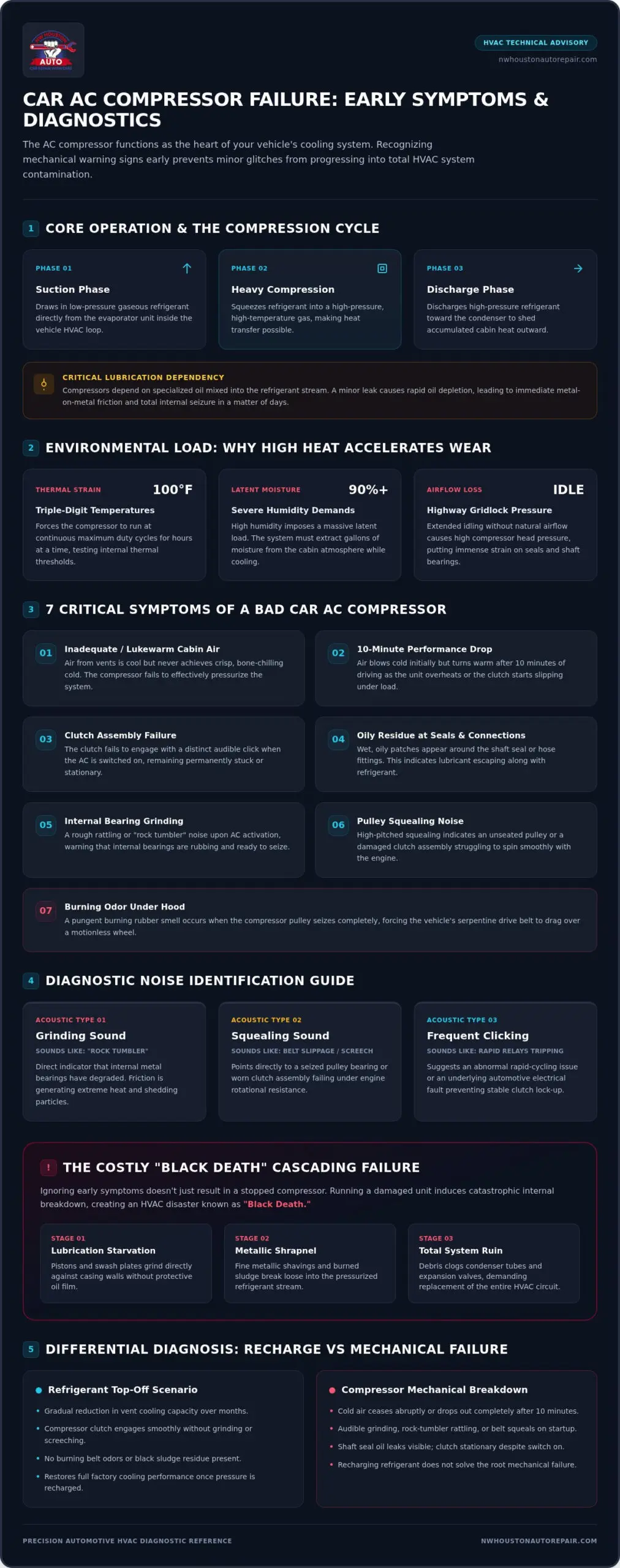
The “Black Death”: Why Ignoring AC Symptoms Is a Costly Mistake
Ignoring the early symptoms of a bad car ac compressor doesn’t just mean a hot drive; it can lead to a catastrophic event known in the industry as “Black Death.” This occurs when the internal components of the compressor, such as the pistons or bearings, begin to disintegrate. As these metal parts grind together, they shed microscopic shavings into the refrigerant lines. This debris mixes with the system’s lubricating oil to create a thick, abrasive, black sludge that travels through every inch of your HVAC assembly.
Once this sludge is present, it clogs the condenser, the expansion valve, and the evaporator. The most expensive mistake we see is when a shop replaces only the failed compressor without addressing the contamination. The new compressor will pull in those leftover metal shavings and fail within days, sometimes even hours. Early detection allows us to perform a “clean” replacement of just the compressor and receiver-drier, saving you from the massive expense of a total system flush and multi-component replacement.
The Escalating Cost of Neglect
A simple clutch repair is a manageable fix, but waiting too long turns it into a full system replacement. In the 2026 Houston climate, delay is your enemy. If your system has a leak, the high humidity allows moisture to enter the lines. This moisture reacts with the refrigerant to create acid, which eats your system from the inside out. If you’re trying to plan for these repairs, refer to our car ac repair cost guide for detailed budget planning. Addressing a small noise now prevents a four-figure bill later.
Protecting Your Vehicles HVAC Longevity
Precision matters when handling modern high-pressure R134a or R1234yf systems. We recommend regular AC inspections as part of your routine maintenance schedule. A synthetic oil change visit is the perfect time for our technicians to perform a quick visual check of your AC hoses and compressor clutch. We look for the subtle symptoms of a bad car ac compressor, such as faint oil staining or belt wear, before they leave you stranded. Our goal is to keep your property dependable and your family cool through every Texas summer. If you’ve noticed a change in how your car cools, schedule a precision inspection today to catch the problem before it spreads.
Professional AC Diagnostics and Repair in NW Houston
Resolving the symptoms of a bad car ac compressor requires much more than a simple part swap. At NW Houston Auto Repair and Collision, we utilize precision equipment to recover refrigerant safely and legally, adhering to all environmental standards. This isn’t a task for a backyard mechanic; the complexity of modern automotive cooling in 2026 demands professional mastery. Our team has served the NW Houston community since 1999, providing a unique balance of technical expertise and neighborly warmth. We verify the chemical, mechanical, and electrical health of your entire HVAC assembly to ensure your vehicle remains dependable.
We don’t just treat the symptoms; we identify the root cause. If a compressor has failed, we investigate why. Was it a lack of lubrication, an electrical fault, or a cooling fan failure? By fixing the underlying issue, we ensure the new part doesn’t suffer the same fate. This commitment to precision is why our neighbors trust us with everything from routine maintenance to complex mechanical restorations.
Our Precision Diagnostic Process
We don’t guess when it comes to your comfort. Our process begins with digital manifold gauge testing to analyze high and low-side pressures in real-time. This critical data tells us if the compressor is internally failing or if a blockage exists elsewhere in the lines. We also utilize electronic leak detection and UV dye tracing for pinpoint accuracy. If your car has a microscopic leak at a seal or hose, we’ll find it. Our comprehensive car diagnostics rule out sensor malfunctions or computer errors that might mimic a seized unit. This thorough approach protects your wallet by preventing the replacement of functional parts.
Schedule Your Houston AC Performance Test
Don’t wait for a total breakdown in the middle of a Houston heatwave. When the humidity peaks and the sun is relentless, a weak AC system is more than just an inconvenience; it’s a safety concern for your family. NW Houston Auto Repair and Collision is a family-owned and operated shop that takes pride in transparency. We provide clear, honest estimates and explain every step of the restoration process so you feel confident in the work being performed.
If you’ve noticed the symptoms of a bad car ac compressor, let our master technicians handle the complex auto electrical troubleshooting and mechanical repairs. We’ve built our reputation on precision and safety for over two decades. Schedule your professional AC inspection today! We are ready to help you stay cool and keep your vehicle in peak condition throughout the sweltering Texas summer.
Stay Cool and Protect Your Investment in the Houston Heat
Identifying the symptoms of a bad car ac compressor is your first line of defense against the sweltering 2026 humidity. You’ve learned that unusual noises and inconsistent cooling aren’t just minor annoyances; they’re urgent warning signs that can prevent catastrophic “Black Death” system contamination. By choosing a professional diagnosis over a temporary DIY fix, you save money and ensure your vehicle remains dependable for years to come.
Our team at NW Houston Auto Repair and Collision has been a family-owned Houston staple since 1999. We bring technical mastery to every service, specializing in both collision and mechanical repairs. Whether you need expert auto electrical troubleshooting or a precision system restoration, we’re your dependable partners. Don’t let a failing compressor turn your commute into a sauna. Contact NW Houston Auto Repair and Collision for Precision AC Diagnostics today. We take pride in keeping our neighbors safe and comfortable. We look forward to seeing you and getting your AC back to peak performance.
Frequently Asked Questions
Can I drive my car with a bad AC compressor?
You can usually continue driving with a failing compressor, but it depends on how the component has failed. If the internal seals are simply leaking refrigerant, your car will remain drivable but uncomfortable. However, if the compressor pulley has seized, it can cause your serpentine belt to snap or slip. This will disable your power steering and alternator, leaving you stranded on a Houston highway. We recommend a quick check to ensure your vehicle remains safe.
How much does it typically cost to replace a car AC compressor in Houston?
The cost of replacing a compressor varies significantly based on your vehicle’s make, model, and whether the system has suffered internal contamination. A basic replacement involves the part and labor, but if Black Death sludge has spread, you’ll need a more comprehensive system flush and additional components like the condenser. Because every situation is unique, we provide transparent, line-item estimates after our master technicians perform a precision diagnostic test at our NW Houston facility.
Will a bad AC compressor affect my cars engine performance?
A failing compressor can definitely impact your engine’s performance. When internal bearings begin to fail, they create excessive mechanical drag that forces your engine to work much harder to turn the pulley. You might notice a drop in fuel efficiency, a rougher idle when the AC is engaged, or even a slight loss of power during acceleration. Addressing these symptoms of a bad car ac compressor early helps protect your engine from unnecessary strain.
How long do car AC compressors usually last in high-heat climates?
In high-heat environments like Houston, most car AC compressors typically last between 8 and 12 years. However, our local 90% humidity levels and extreme summer temperatures force these units to run at maximum capacity for extended periods. This high duty cycle can lead to premature wear of the internal seals and clutch assembly. Regular maintenance, such as checking refrigerant levels, can help extend the lifespan of your cooling system components and prevent early failure.
Is it possible to repair just the compressor clutch instead of the whole unit?
It is technically possible to replace only the compressor clutch if the internal pump and bearings are still in good condition. This can save you money on parts if the failure is strictly electrical or mechanical within the clutch itself. However, because the labor involved in accessing the compressor is often the same, many Houston drivers choose to replace the entire unit to ensure long-term reliability and avoid paying for the same labor twice in the near future.
What happens if I dont fix my car AC compressor immediately?
Delaying a repair often leads to much higher costs down the road. When a compressor begins to fail internally, it can shed metallic debris into your refrigerant lines, causing the Black Death contamination we discussed earlier. This sludge ruins your condenser and evaporator, turning a single-part replacement into a total system overhaul. Recognizing the symptoms of a bad car ac compressor now prevents a much larger headache and a significantly higher bill later this summer.
Why does my car AC smell like something is burning when I turn it on?
A burning smell usually indicates that your compressor pulley has seized or the clutch is slipping severely. When the pulley stops spinning but your engine’s serpentine belt continues to move over it, the resulting friction generates intense heat and smells like burning rubber. This is a serious mechanical issue that can lead to a snapped belt or even an engine bay fire. You should turn off your AC immediately and seek a professional inspection to prevent further damage.
Does my car insurance cover AC compressor failure after an accident?
Car insurance typically covers AC compressor failure if the damage is a direct result of a covered collision. For example, if a front-end impact crushed your condenser and damaged the compressor lines, the repair should be part of your claim. As specialists in collision repair since 1999, we work directly with insurance companies to ensure all mechanical damages are documented and restored. We’ll help you navigate the process to ensure your cooling system is returned to factory standards.