

Could a delayed shift or strange transmission noise mean the whole unit needs replacing? Not necessarily. A symptom is a warning sign, not a diagnosis, and the transmission repair Houston drivers need depends on what’s causing the change in how the vehicle drives.
It’s understandable to worry when your car shifts differently, makes an unfamiliar sound, or feels unreliable on a Houston commute. Those signs alone can’t tell you what work is needed. A professional diagnosis can help identify the concern and clarify the next step without assuming the most extensive repair is necessary.
This guide covers common transmission warning signs, what diagnosis can establish, and when to seek help instead of trying to identify the fault yourself. You’ll also learn what details to share with a local repair shop. NW Houston Auto Repair and Collision provides transmission repair for Houston-area drivers, alongside services including synthetic oil changes, state inspections, and auto electrical repair.
Key Takeaways
- Notice changes in shifting, response, or sound, but treat them as warning signs rather than a diagnosis.
- Vehicle history, observed symptoms, and relevant evidence help guide a professional assessment.
- Transmission repair Houston drivers need can involve different options. Symptoms alone can’t determine whether repair or replacement is appropriate.
- Prepare useful details before an assessment by noting when the issue occurs and what has changed.
- Document the symptoms, arrange a local assessment, and discuss options based on the findings.
Transmission Repair in Houston: Which Warning Signs Deserve Attention?
A vehicle that shifts differently, hesitates when you press the accelerator, or makes a new noise can make every trip feel uncertain. Houston traffic leaves little room for surprises, so it’s natural to wonder whether the transmission is failing. But a symptom can have several possible causes. A change in how the car behaves is a reason to pay attention, not proof of what has failed.
Warning signs deserve assessment, but they don’t prove transmission failure. Noticing a change helps you describe the problem; diagnosis is needed to understand its source. If you’re considering transmission repair Houston, focus first on what you’ve observed rather than trying to identify the failed part yourself.
What changes in shifting, sound, or response can signal
Delayed engagement may feel like a pause after selecting a gear before the vehicle begins to move. An inconsistent shift can feel abrupt or happen unexpectedly. A slipping sensation may seem like the engine is working harder without the vehicle responding as expected. These experiences can point to a concern, but they don’t identify its cause on their own. An automatic transmission is a complex system, and similar driving changes can have more than one explanation.
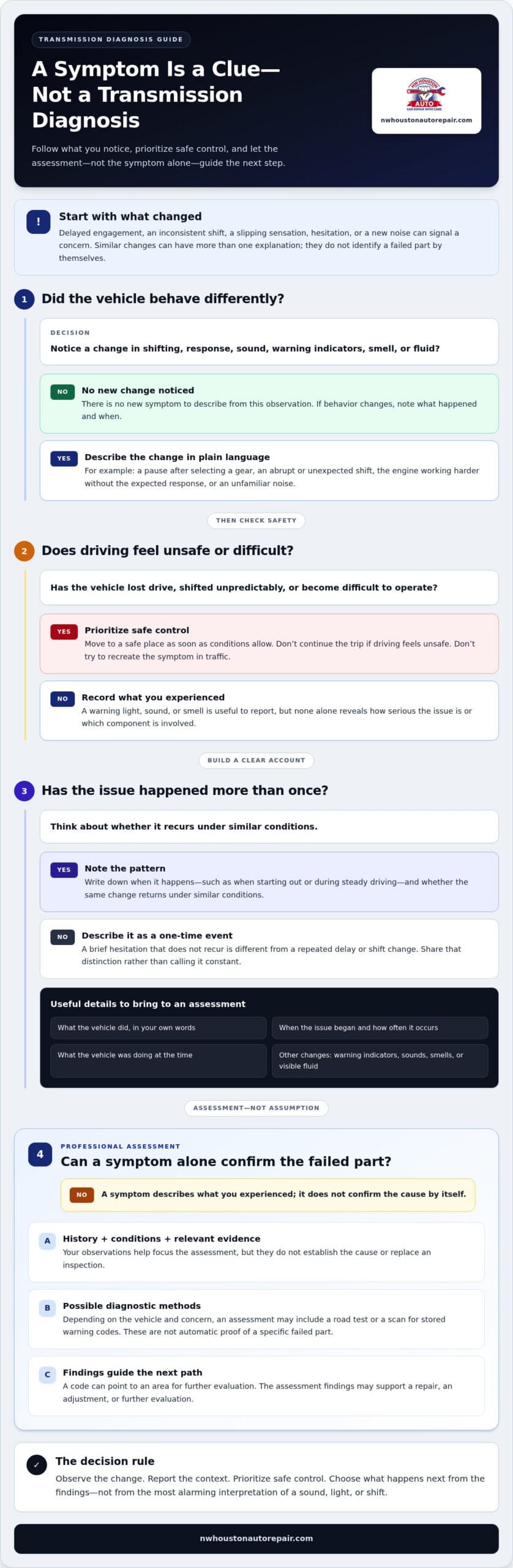
Notice whether the issue is new, happens repeatedly under similar conditions, or occurred only once. A brief hesitation that doesn’t recur is different from a repeated delay or shift change. Record when it happens, such as when starting out or during steady driving. Note any unusual noise or fluid beneath the vehicle, too. You don’t need to interpret these signs; clear observations are useful during an assessment.
- Write down what the vehicle did, using plain language.
- Note when it happened and whether it has happened again.
- Record other changes, such as noise or fluid on the ground.
When should a Houston driver stop and seek help?
Prioritize safe control. If the vehicle loses drive, shifts unpredictably, or becomes difficult to operate, move to a safe place as soon as conditions allow. Don’t continue the trip if driving feels unsafe. A warning light, sound, or smell is useful to report, but none of these signs alone reveals how serious the problem is or which component is involved.
Don’t try to recreate a concerning symptom in traffic to gather more information. Note what happened and arrange an assessment instead. A local transmission repair appointment can be a practical next step when your vehicle’s behavior changes. Share your observations clearly, even if you’re unsure what they mean. The aim is to understand the concern before deciding what work is appropriate.
How Transmission Problems Are Diagnosed Before Repair
Diagnosis is more than assigning a label to a noise or warning light. It involves gathering the vehicle’s history, understanding the conditions in which the concern appears, and evaluating relevant evidence before determining what may be causing it. Your description is an important starting point, but it doesn’t replace an assessment of the vehicle.
A reported symptom describes what you experienced; a confirmed finding identifies what the assessment supports. That distinction helps prevent a guess from becoming an assumed repair. A dashboard warning or a description such as “it hesitates” can point toward an area to examine, but neither identifies every failed component by itself.
What information helps narrow down a transmission concern?
Bring practical details, even if you’re not sure they’re significant. Note when the issue began, whether it happens repeatedly, and what the vehicle was doing at the time. For example, mention whether you noticed a change while pulling away, during steady driving, or after the vehicle had been parked. Include warning indicators, unusual sounds or smells, visible fluid, and changes in how the vehicle responds.
- Describe what you noticed in your own words.
- Record when it began and how often it occurs.
- Note the driving conditions and any other changes you observed.
Specific observations can help a technician interpret what the vehicle shows during an assessment. They don’t establish the cause on their own or replace an inspection. If the symptom is intermittent, say so rather than describing it as constant. That context can help distinguish a one-time event from a concern that returns under similar conditions.
Why diagnosis matters before choosing a repair
Similar driving complaints can have different underlying explanations, so the same repair shouldn’t be assumed from a symptom alone. Depending on the vehicle and concern, diagnostic methods may include a road test or a scan for stored warning codes. These may be parts of an assessment, but they aren’t automatic proof of a specific failed part. A code can point to an area for further evaluation, while the full findings guide what should happen next. This diagnostic approach applies across vehicle categories; commercial fleet specialists like IQ Truck Center follow similar systematic evaluations to pinpoint drivetrain issues before recommending major repairs.
Those findings may support a repair, an adjustment, or further evaluation. The right path depends on what the assessment establishes, not on the most alarming interpretation of a light or sound. For transmission repair Houston drivers can approach with confidence, ask for the concern and findings to be explained in clear terms before deciding on work. Avoid naming a failed component based only on a symptom; let the evidence lead.
Keep your notes handy to make the conversation more focused. If your vehicle needs an assessment, contact NW Houston Auto Repair and Collision to discuss the transmission concern and next steps.
Transmission Repair or Replacement? Understand the Possible Paths
A transmission symptom doesn’t automatically mean the entire unit needs replacing. The right scope of work depends on the assessment findings, the type of issue, and the vehicle’s overall condition. A focused repair, an adjustment, replacement, or further evaluation may be considered, but none should be selected from a symptom alone.
Think of these options as outcomes guided by findings, not a fixed ladder every vehicle must climb. The table offers a general comparison. It isn’t a diagnosis or a recommendation for a particular vehicle.
| Possible path | What it may involve | What remains vehicle-specific |
|---|---|---|
| Adjustment | A change intended to address an issue identified during assessment. | Whether an adjustment is suitable and what it should address. |
| Focused repair | Work directed at a limited concern identified through inspection. | The cause, repair scope, and whether the rest of the transmission is in suitable condition. |
| Replacement | Replacing the transmission may be discussed when findings support that path. | The vehicle’s condition and the evidence behind the recommendation. |
When a focused repair may be considered
A focused repair may be appropriate if inspection identifies a limited issue and the findings support addressing it without replacing the whole unit. The phrase “focused repair” describes the scope, not a promise that a particular repair will solve a reported symptom. A delay or shift change alone can’t establish whether the issue is limited or whether other concerns are present.
Ask which finding supports the proposed work and how it relates to the concern you reported. A clear explanation connects the observed problem to the suggested scope without relying on a guess about a specific component. When component repairs or replacements are necessary, choosing reliable replacement hardware is essential; specialized automotive parts providers like VolvoXperts demonstrate how obtaining genuine and OEM parts ensures compatibility and long-term vehicle reliability.
When replacement may enter the discussion
Replacement is one possible path, not the automatic response to a warning sign. It may enter the discussion if the assessment and the vehicle’s condition support considering broader work. The recommendation should be tied to what was found, rather than based only on a light, sound, or change in driving response.
Before authorizing work, make sure you understand the diagnosed concern, why replacement is being considered, and what the proposed work includes. You can also ask whether repair or adjustment was considered and how the findings shaped the recommendation. Straight answers help you make an informed decision.
For transmission repair Houston drivers can approach with confidence, understand the reasoning behind the proposed path. A clear explanation can establish what is known, what the assessment supports, and why a particular scope is being discussed. Let the findings guide the decision.
Before Transmission Repair in Houston: Prepare for a Clear Diagnosis
A little preparation can make a service conversation more focused. You don’t need to identify the cause or know the right repair before you arrive. Write down what the vehicle has been doing, review any warning indicators, and arrange a local assessment. The details you share can help the technician understand the concern and evaluate it in context.
- Document the symptoms. Note what changed, how often it happens, and the conditions around it.
- Review warning indicators. Record dashboard lights or messages, along with any other changes you’ve noticed.
- Arrange an assessment. Share your notes and discuss the next step for the vehicle.
What to record before arranging service
Keep your notes factual. Include when the issue began, whether it repeats, and what the vehicle was doing at the time. Record dashboard messages, unusual sounds or smells, visible fluid, and changes in how the vehicle responds. If something else changed recently, mention it, but don’t assume the changes have the same cause.
Avoid clearing warnings or attempting repairs before the assessment, since that may remove useful context or change what the technician can observe. You don’t need a perfect account. A clear description in everyday language is a helpful starting point.
What to expect from a service conversation
Describe what you noticed and when it happens. Then ask for the findings in plain language: What condition was identified? How does it relate to your concern? What work is being proposed? These questions help you understand the reasoning and discuss the scope before authorizing repairs.
The time needed and appropriate repair scope depend on the vehicle and diagnostic findings. Avoid relying on an assumed completion date before the assessment. The conversation should clarify what is known and what the proposed work addresses, without treating your first description as a confirmed diagnosis.
For transmission repair service, bring your notes and discuss the concern with NW Houston Auto Repair and Collision. If you’re ready to take the next step, contact the team to arrange a conversation about your vehicle. A clear account of what changed can make that first discussion more useful, while the assessment guides decisions about the work itself.
Transmission Repair in Houston: A Local Next Step You Can Take
A change in how your vehicle shifts or responds can make everyday plans harder, especially when you rely on it to commute, run errands, or get around Houston. You don’t have to know what caused the change to take a useful next step. Notice what’s different, keep a record, and use a professional assessment to understand what options the findings support.
That sequence separates observation from decision. Your notes give the repair team context about the concern, while assessment helps clarify what may be happening and what scope of work is appropriate. A symptom alone doesn’t decide whether the vehicle needs a focused repair, an adjustment, replacement, or another step.
For transmission repair Houston drivers can approach with greater confidence, focus on a clear conversation about the vehicle’s behavior and the findings behind any proposed work. NW Houston Auto Repair and Collision is a family-owned and operated business serving Houston-area drivers. Its local focus gives you a place to discuss the concern and understand the assessment before deciding what comes next.
How local experience supports a more confident next step
Local service gives Houston-area drivers a practical place to discuss a transmission concern without arriving with a diagnosis in hand. Share what you’ve noticed and what matters most for your daily transportation. A clear conversation can help you understand how the concern will be considered and what the assessment establishes before you make decisions about next steps.
Keep the discussion centered on your vehicle, not assumptions about what a particular symptom must mean. The goal is to connect the concern you reported with the findings and proposed scope.
Arrange transmission repair when symptoms need attention
If your vehicle’s behavior has changed and you’re ready to discuss service, explain the concern in your own words and ask about the next step. NW Houston Auto Repair and Collision provides transmission repair for drivers bringing in a transmission concern. The appropriate work depends on the vehicle and assessment, so don’t assume a repair outcome or timing in advance.
Vehicle trouble can disrupt a routine. Take the next step calmly, with the information you have, and let the assessment guide the conversation about what comes next.
Contact NW Houston Auto Repair and Collision in Houston to discuss your transmission concern and arrange a next step.
Take the Next Step Toward a Clearer Plan
Uncertainty can be the hardest part of a vehicle problem. You don’t need to arrive with a repair decision already made. Use the first conversation to explain what’s changed and understand what the assessment can establish. Ask how the findings relate to the work being considered, then make sure you understand the proposed scope before moving forward.
That approach gives you a grounded starting point for transmission repair Houston drivers may need, keeping the decision focused on your vehicle rather than assumptions about what a symptom means. If shifting or response changes are disrupting your routine, reaching out is a practical way to begin discussing the concern.
Start a conversation about your transmission concern with NW Houston Auto Repair and Collision. A clear next step can make the situation feel more manageable, and you can move forward with greater confidence once you understand what the findings support.
Frequently Asked Questions
Can I keep driving if my transmission is slipping?
If slipping makes the vehicle’s movement unpredictable or difficult to control, stop driving as soon as it’s safe and arrange help. A vehicle that hesitates or doesn’t respond as expected can be especially concerning when merging or crossing an intersection. Don’t keep testing it in traffic. If the sensation is mild but repeats, note when it occurs and arrange an assessment before relying on the vehicle for regular trips.
Can a transmission problem turn on the check-engine light?
Yes, some transmission-related concerns can trigger the check-engine light, but the light can also point to other vehicle systems. It doesn’t confirm that the transmission is at fault or show which part needs attention. Note when the light appeared and whether the vehicle’s behavior changed at the same time. For transmission repair Houston drivers can approach with confidence, the warning should be considered alongside the vehicle’s symptoms and assessment findings.
Does a transmission fluid leak always mean the transmission needs replacement?
No, a fluid leak doesn’t automatically mean the transmission needs replacement. The source and extent of the leak need to be assessed before anyone can determine what work may be appropriate. If you notice a fresh spot where the vehicle was parked, note its location and appearance without touching it or getting beneath the vehicle. Don’t assume the cause from its appearance alone; arrange an assessment rather than ignoring a recurring leak.
How long does transmission repair take?
There isn’t one reliable timeframe for every transmission repair. The time involved depends on what the assessment finds and the scope of work appropriate for that vehicle. A concern that calls for limited work differs from one requiring a broader repair. Ask the shop to explain the expected steps and timing after reviewing the vehicle. Until then, avoid planning around an assumed completion time, since the cause and repair needs haven’t yet been established.
Can a transmission warning light identify the exact part that has failed?
No, a warning light by itself can’t identify the exact failed part. A vehicle may store a code that points toward a system or area needing attention, but that information doesn’t necessarily confirm the component or cause. Further evaluation may be needed before a specific repair is chosen. Treat the light as useful information to report, not as a parts diagnosis or a reason to authorize a particular repair without supporting findings.
Can transmission trouble affect a vehicle’s fuel economy?
It can. If a vehicle isn’t shifting or responding normally, it may use fuel less efficiently, though fuel economy can change for reasons unrelated to the transmission as well. Notice whether the change began alongside a shift or response issue, and share both observations during an assessment. A change in fuel use alone can’t identify the cause, so don’t treat it as proof of transmission trouble or choose a repair based on that sign alone.
Why does my transmission behave differently when the car is cold?
Some vehicles may feel or shift differently shortly after a cold start, but a recurring delay, harsh shift, or other noticeable change deserves attention, especially if it continues after the vehicle warms up. Record how long the behavior lasts and whether it happens after every cold start or only occasionally. Don’t assume temperature explains it. Sharing that pattern with the technician can help distinguish a brief cold-start change from a persistent concern that needs assessment.