

What if a weak battery isn’t the real reason your car won’t start? A failing battery, starter, or alternator can create similar symptoms, so replacing the first suspect may leave the underlying fault untouched. The right way to fix auto electrical problems starts with recognizing the signs and testing the system before choosing a repair.
Flickering lights, repeated starting trouble, or a battery that keeps losing charge can make every trip feel uncertain. Careful diagnosis helps narrow down the cause and avoid swapping parts without answers. In this guide, you’ll learn which symptoms deserve prompt attention, what electrical troubleshooting can involve, and how to prepare for a repair visit in NW Houston. NW Houston Auto Repair and Collision is a family-owned Houston-area shop established in 1999, with auto electrical repair among its services. Use these practical steps to describe the problem and understand the next step toward dependable driving.
Key Takeaways
- Starting trouble, flickering lights, and accessories losing power offer useful clues, but one symptom can have several causes.
- To fix auto electrical problems accurately, diagnosis traces the issue through relevant components and circuits before a repair is chosen.
- Symptom timing, dashboard indicators, and recent changes can help focus the investigation.
- Record when the problem occurs. Don’t probe wiring, bypass fuses, or drive if the vehicle seems unsafe to operate.
- NW Houston Auto Repair and Collision provides auto electrical repair in Houston.
Auto Electrical Problems in Houston: Symptoms That Deserve Attention
You turn the key in your Houston driveway and the car won’t start. On another trip, the headlights flicker or the radio cuts out while other accessories act unpredictably. These changes can be frustrating, especially when the vehicle seems fine one moment and unreliable the next.
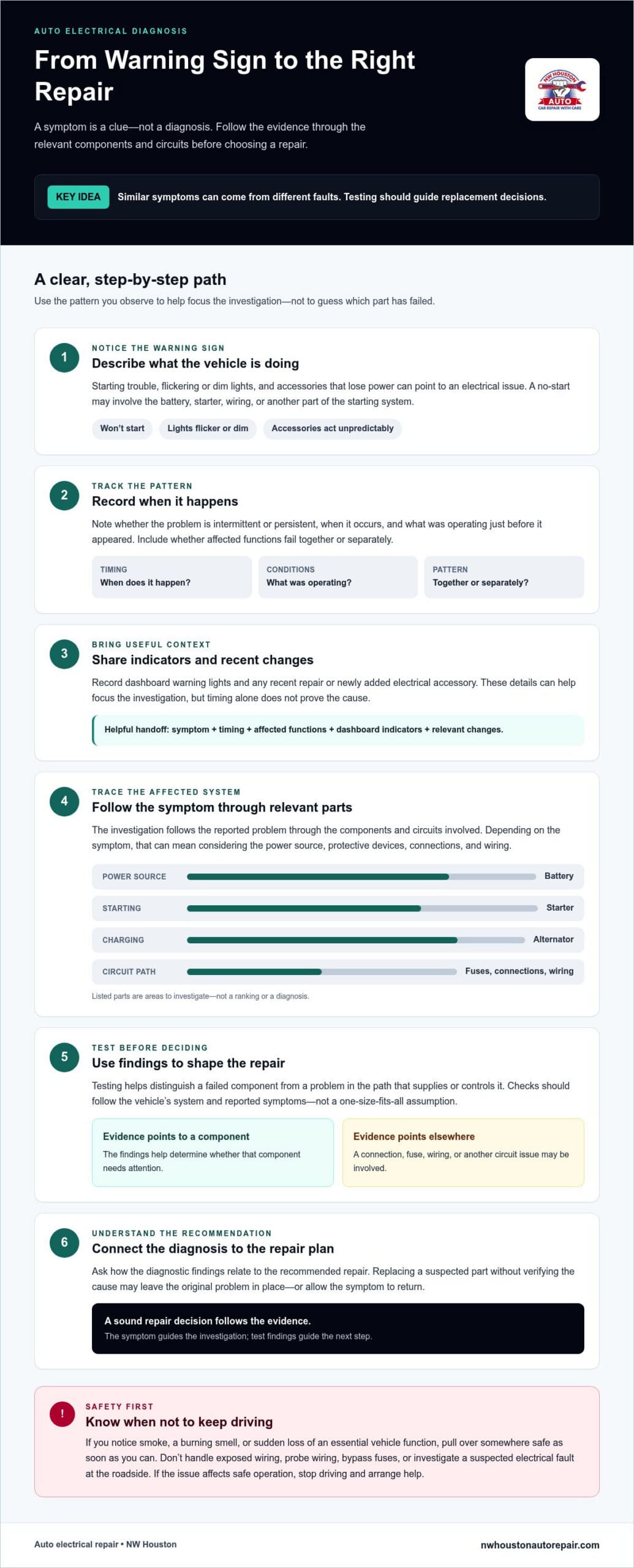
An auto electrical problem is a fault affecting a vehicle’s power, starting, charging, or electrical circuits. Treat what you notice as a clue, not a diagnosis. A no-start, for example, may involve the battery, starter, wiring, or another part of the starting system. Replacing the first suspected component can miss the underlying issue.
Notice whether the problem is intermittent or persistent. Does it appear during a particular trip or when you use a certain accessory, or does it happen every time you start the car or switch on a system? Write down when it occurs, what was operating, and whether the symptom changes. That pattern is more useful than a guess about which part has failed.
Which warning signs can point to an electrical fault?
A car that clicks, cranks inconsistently, or does nothing when you try to start it needs attention, but those signs don’t prove the battery is at fault. The starter is one part of the starting system; Starter (engine) explains its role in turning the engine over.
Watch for headlights or interior lights that dim, flicker, or behave differently than usual. Accessories such as power windows, the radio, or dashboard displays that stop working or act unpredictably can also point to an electrical issue. Make a note of which functions are affected and whether they fail together or separately. For example, several functions changing at once is useful context, but it still doesn’t identify the cause.
When should you stop driving and seek help?
Take urgent warning signs seriously. If you notice smoke, a burning smell, or a sudden loss of an essential vehicle function, pull over somewhere safe as soon as you can and prioritize safe operation. Don’t handle exposed wiring or investigate a possible electrical fault at the roadside.
An occasional flicker or an accessory that works inconsistently still deserves diagnosis, even if the vehicle continues to run. Don’t assume it’s safe to keep driving simply because the symptom goes away. If the issue affects your ability to operate the car safely, stop driving and arrange help. For symptoms that don’t immediately compromise safe operation, record what happened and arrange auto electrical repair in NW Houston. Clear observations help explain what needs attention without turning a warning sign into an unsupported conclusion.
How Auto Electrical Diagnosis Finds the Source of the Problem
Diagnosis isn’t simply naming the part that might be responsible. It means tracing a reported symptom through the relevant components and circuits, then using the findings to decide what needs attention. A starting complaint, for example, could involve a component, a poor connection, a fuse, or wiring. The symptom points the investigation in a direction; it doesn’t settle the answer.
Similar electrical symptoms can come from different faults, so testing should guide replacement decisions. Replacing a suspected part without verifying the cause may leave the original problem in place. A sound approach to fixing auto electrical issues looks for evidence before settling on a repair.
What information helps narrow down an electrical issue?
Start with the timeline. Note when the issue began, whether it happens every time or only intermittently, and what was happening just before it appeared. Record dashboard warning lights and which vehicle functions fail together. If the starting system acts up only after the car has been parked, for example, that timing is useful context, not proof of a particular failed part.
Share relevant changes, too. A recent repair or newly added electrical accessory may help focus the investigation, but its timing alone doesn’t establish the cause. Clear observations give the technician a more useful starting point than a guess based on one symptom.
Why testing matters before replacing parts
Testing helps distinguish a failed component from a problem in the path that supplies or controls it. Depending on the symptom, diagnosis may involve considering the power source, protective devices such as fuses, connections, and wiring along the affected circuit. The checks should follow the vehicle’s system and the reported problem rather than rely on a one-size-fits-all assumption.
If a replacement doesn’t address the actual fault, the symptom may remain or return. Findings should shape the repair plan, whether they point to a component or another issue in the circuit. Automotive engineering is a broad field; SAE International’s scholarly journals offer technical publications for readers interested in that wider context, while a vehicle-specific diagnosis must focus on the car’s own symptoms and findings.
Before the appointment, share your notes about when the problem happens, dashboard indicators, and any recent changes. Ask how the diagnostic findings relate to the recommended repair so you can understand why that work is being considered. For electrical symptoms disrupting your routine in NW Houston, contact NW Houston Auto Repair and Collision to discuss the issue.
Battery, Alternator, Starter, or Wiring: What Could Be Behind the Symptoms?
A slow crank, dimming lights, or power that cuts in and out can point toward different parts of the electrical system. The battery supplies power, the starter motor helps turn the engine over, and the alternator supports the vehicle’s charging system while it runs. Fuses and wiring connect and protect circuits. Because these parts work together, symptoms can overlap rather than identify one failed component.
| Component | Possible symptom pattern | Why testing is still needed |
|---|---|---|
| Battery | Slow or unsuccessful starting, or other power concerns | A charging issue or poor connection may create similar signs. |
| Alternator | Possible charging concerns or changes in electrical function | The related circuits and connections may also be involved. |
| Starter motor | The engine may crank slowly or fail to crank consistently | Battery power and the starter’s connections also matter. |
| Fuse | A particular electrical function may stop working | A blown fuse is a clue to investigate, not proof of why it happened. |
| Wiring or connections | Intermittent power or a function that cuts in and out | The issue may depend on the affected circuit and connection. |
How battery and starting-system issues may appear
If the engine turns over slowly or starting is inconsistent, the battery and starting system deserve attention, but the symptom alone doesn’t establish the cause. A battery concern can overlap with a charging-system problem or a loose or faulty connection. Replacing the battery without checking the wider picture may not resolve the complaint. A battery replacement may be appropriate when diagnosis points to the battery, but starting trouble alone isn’t enough to make that decision.
The starter motor is another part of the starting process. If the engine doesn’t crank as expected, a technician may need to consider the starter alongside the power supply and its connections. Don’t assume that a new battery is the answer simply because the vehicle struggles to start.
When charging, fuses, or wiring may be involved
Charging concerns may involve the alternator or connected circuits, and changes in lights or electrical functions can have more than one explanation. A fuse that has blown is worth noting, but repeatedly replacing it without investigating the circuit can leave the underlying concern unresolved. Avoid bypassing a fuse or probing wiring yourself.
What to Do Before Your Auto Electrical Repair Appointment
A little preparation can make it easier to explain an electrical issue clearly. You don’t need to identify the faulty part or recreate a symptom. Capture what you observed and share it with the repair team. Good notes can focus the diagnosis, but they can’t determine the cause in advance.
A simple symptom log for intermittent electrical problems
Use your phone or a notepad to record each occurrence while the details are fresh. Include the time, driving conditions, affected functions, warning lights, and whether the problem changed after restarting. Don’t repeat an action that feels unsafe.
- Note the conditions. Record whether the vehicle was starting, idling, or being driven, and whether you had just used a particular accessory.
- Describe what changed. Identify which functions stopped working or behaved differently, and whether they failed together.
- Record dashboard indicators. Write down any warning lights or messages you noticed. If you can safely do so, note their appearance without trying to troubleshoot while driving.
- Share relevant changes. Mention recent repairs or the installation of an electrical accessory. This is useful context, not proof that the change caused the issue.
Even a brief log can help distinguish a repeatable pattern from a one-time event. Bring it to your appointment along with any questions you want answered.
What not to do while waiting for diagnosis
Put safety first. Don’t touch damaged, exposed, or hot electrical components, probe wiring, or bypass a fuse. If a fuse fails again after replacement, don’t keep replacing it. Arrange for the circuit to be diagnosed instead of trying to work around the fault.
If you notice smoke or a burning smell, move to a safe place and don’t continue driving. Use the same caution if an electrical symptom suddenly affects an essential vehicle function or makes the car feel unsafe to operate. Don’t risk a trip just to see whether the issue clears. Arrange help and explain what happened.
Before the appointment, review your notes and make sure they include the conditions when the issue occurs, warning-light observations, and relevant recent changes. Clear information helps the technician understand what you experienced, while testing determines the next step. You don’t have to diagnose the vehicle yourself to help move the process forward.
If you’re ready to arrange auto electrical diagnosis in NW Houston, contact NW Houston Auto Repair and Collision and share the symptoms you’ve recorded. A clear account is a practical first step toward finding the right way to fix auto electrical trouble.
Get Auto Electrical Repair in NW Houston with a Clear Next Step
If electrical symptoms are disrupting your routine, you don’t have to identify the faulty part before seeking help. NW Houston Auto Repair and Collision provides auto electrical repair for Houston drivers. The shop is family-owned and operated, with auto electrical repair among its services.
Start with what you know: what the vehicle did, when it happened, which systems were affected, and whether the issue has returned. Notes about warning lights, starting behavior, or changes in charging-related symptoms can give the team useful context. These details help explain the concern, but they don’t replace diagnosis or determine the repair in advance.
What to expect when describing an electrical concern
Describe the symptom in everyday terms. Did the car fail to start, did a light behave differently, or did an accessory stop working? Share whether the problem is constant or intermittent and what was happening when you noticed it. Bring your notes along if you’ve written down the conditions.
The repair approach depends on the diagnostic findings and the vehicle’s specific issue. Similar symptoms can arise from different faults, so the concern needs to be understood before deciding what work is appropriate. Discuss the observed problem and the next steps without assuming that a particular part must be replaced.
Arrange your next step in NW Houston
Electrical concerns can overlap with battery, starting, and charging-system issues. If your notes point to a possible charging concern, include when it appears and what changes you observe. That context may help focus the discussion. The symptom alone doesn’t establish that the alternator is at fault, and the appropriate repair depends on what diagnosis reveals.
For local drivers, auto electrical troubleshooting is part of the repair services at NW Houston Auto Repair and Collision. Share what you’ve noticed and discuss the next step based on the vehicle’s symptoms and diagnostic findings. Bring your symptom notes and ask questions so you can understand what the investigation indicates and what work is being recommended. Careful diagnosis is the foundation for deciding how to fix auto electrical problems without relying on guesswork.
Make a Confident Move Toward Reliable Driving
Electrical trouble can make every plan feel uncertain, but the next move doesn’t have to be a guess. Give the concern the attention it deserves, then use a professional assessment to make an informed decision about how to fix auto electrical issues. When discussing recommended work, ask what the findings indicate, which repair addresses the concern, and whether there are options to consider. A useful conversation should leave you understanding what was found, what remains uncertain, and what choices you have before work begins. That clarity helps you decide what makes sense for your vehicle without relying on part-swapping based on a hunch.
NW Houston Auto Repair and Collision provides auto electrical repair for Houston drivers. If electrical symptoms are affecting your confidence behind the wheel, contact NW Houston Auto Repair and Collision to discuss your vehicle’s electrical concern and take the next step toward understanding the problem.
Frequently Asked Questions
Is it safe to drive with an electrical problem?
It depends on the symptom and the system affected. If you notice smoke, a burning smell, loss of an essential function, or unpredictable vehicle behavior, pull over safely and don’t continue driving. A description alone can’t establish whether the vehicle is safe. A minor-seeming or intermittent issue still needs professional assessment, especially if it returns or changes how the car operates.
Can a weak battery cause electrical problems in a car?
Yes, battery trouble can be associated with starting difficulty or inconsistent electrical behavior, but those signs can also involve the charging system, connections, or other circuits. A slow start, for instance, doesn’t prove the battery is the cause. Describe what happens, including whether other functions change at the same time, and have the cause diagnosed before replacing a component.
How can I tell whether the alternator or battery is causing the problem?
You usually can’t identify the failed part reliably from symptoms alone. Starting trouble, warning indicators, or changing electrical behavior may involve the battery, alternator, or connected circuits. Record when the issue occurs and what you notice, then use diagnostic testing to guide the repair decision. For more context on charging-system concerns, see the car alternator repair article.
What happens if a car keeps blowing the same fuse?
A fuse that fails repeatedly is a reason to investigate the circuit, not keep replacing the fuse. Don’t bypass it or install one with a different rating. Repeated failure may indicate an underlying electrical concern that needs proper diagnosis. If you notice heat, smoke, or visible damage, stop attempting repairs and prioritize safety while arranging an assessment.
Can a wiring problem make a car start intermittently?
It can, but intermittent starting has several possible causes, and the symptom alone doesn’t identify wiring as the fault. Note when the car struggles to start, whether dashboard indicators appear, and if other functions change at the same time. Share those observations with the repair team. Testing is needed to determine whether wiring, a connection, or another part of the starting system needs attention.
How much does auto electrical repair cost?
The cost depends on the cause of the problem, the vehicle, the parts involved, and the work required. A symptom by itself isn’t enough to give a reliable estimate because similar complaints can call for different repairs. Diagnosis helps clarify what the vehicle needs before a repair plan is chosen. Ask for an explanation of the findings and proposed work so you can understand the next step.
What should I do if my car’s electrical issue only happens sometimes?
Keep a brief record of when the symptom appears, which systems are affected, and any warning indicators you notice. Those observations can help guide diagnosis, but they don’t replace testing, since intermittent faults can be difficult to identify from a short description. Don’t try to recreate the problem if it feels unsafe. If smoke or a burning smell appears, move to safety and stop driving.