

You’re merging onto I-10 during the evening rush when that sudden, rhythmic thudding starts under your floorboards. You pull over to find a jagged screw in your tread, and the fear of a high-speed blowout on the Beltway immediately sets in. Finding a dependable tire plug repair Houston specialist is your first step toward getting back on the road without overspending on a replacement you might not need.
We’ve all been there, standing on the shoulder of a hot highway, wondering if a quick fix is enough to keep our families safe. With 17,106 pieces of debris cleared from local toll roads between 2020 and 2023, road hazards are a daily reality for every driver in the city. It’s frustrating to feel like you’re at the mercy of a shop that might overcharge you for a simple problem. This guide will show you exactly when a tire plug repair is safe, how the brutal Houston heat affects your rubber, and when it is time to visit a professional shop for a permanent fix. We are going to walk through the difference between a temporary plug and a highway-rated repair so you can get back to work with total confidence.
Key Takeaways
- Identify the “No-Go Zones” where punctures are unrepairable to avoid the risk of a high-speed blowout on the Beltway.
- Understand how the intense Houston heat compromises your tire’s rubber, requiring specialized inspection techniques to ensure your safety.
- Differentiate between temporary emergency plugs and the professional tire plug repair Houston drivers need for a permanent, highway-safe seal.
- Learn the proper way to assess a flat on the shoulder of I-10 without removing the puncture object and causing a total loss of pressure.
- Discover why our family-owned shop prioritizes your safety over a quick sale by following strict RMA standards for every inspection.
Understanding Tire Damage: The Houston Commuter’s Reality
Driving in Houston is a contact sport for your tires. Whether you are navigating the constant expansion on Highway 290 or dodging deep potholes on local side streets, your rubber is under constant assault. A road hazard is any external object that compromises tire casing. While many drivers think they can handle a small puncture with a store-bought tire mobility kit, the reality of local conditions often demands a more robust tire repair solution. Check your pressure today. Don’t wait for a warning light to tell you there’s a problem.
The Impact of Construction Zones on NW Houston Roads
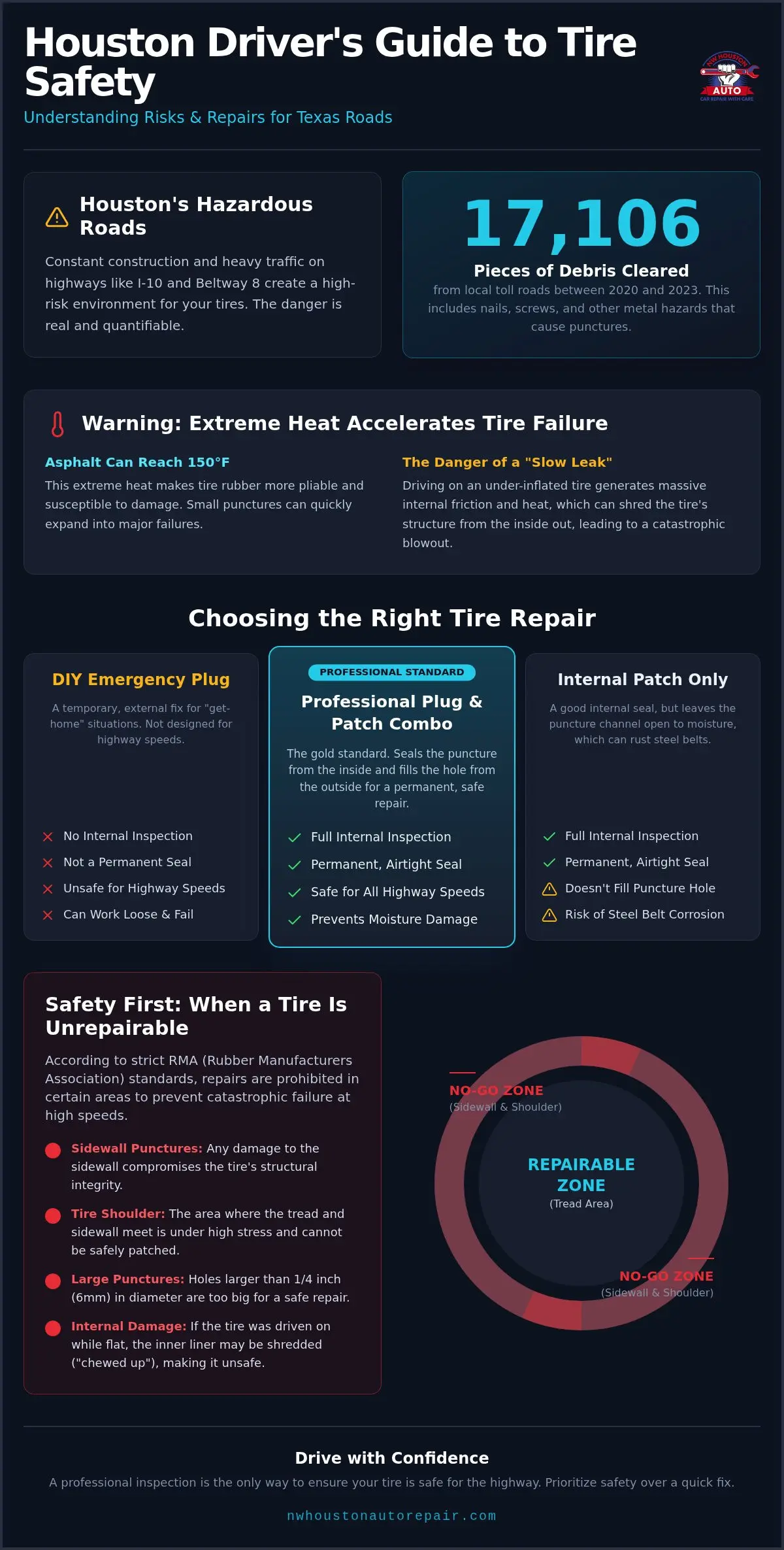
Nails and screws are incredibly common near our expanding neighborhoods because of high construction activity. Commercial trucks on the Beltway frequently drop debris that leads to “unlucky” punctures in the worst possible locations. Since 2020, Houston has seen a 3% yearly increase in roadway debris, meaning the risk to your vehicle is higher than ever. In fact, the Harris County Toll Road Authority’s Incident Response Team picked up 17,106 pieces of debris between 2020 and 2023. This volume of metal on the road makes a professional tire plug repair Houston service a necessity rather than an option.
How Texas Heat Accelerates Tire Failure
Our extreme summer heat changes the physical properties of your tires. When the asphalt surface hits 150 degrees, the rubber becomes more pliable and susceptible to damage. This heat accelerates the vulcanization process, making the rubber brittle over time. A small puncture that might hold air in cooler climates can expand rapidly in the Texas sun. Heat cycling on an under-inflated tire is especially dangerous. As the tire flexes, the internal temperature skyrockets, leading to a catastrophic blowout. If you’ve noticed a drop in pressure, seeking a tire plug repair Houston expert immediately can save the tire before the heat destroys it.
Driving on a “slow leak” is actually more dangerous than a sudden flat. When a tire is low on air, the sidewalls experience excessive friction and heat. This can cause the internal structure to disintegrate before you even realize there is a problem. A professional inspection is the only way to identify this hidden internal damage. We don’t just look at the hole; we check the entire casing to ensure the tire is still safe for the highway. Our expert technicians follow RMA standards to ensure every fix meets safety requirements for high-speed travel.
Tire Plug vs. Patch: Which Repair is Right for You?
When you find a nail in your tread, you have a choice. You can grab a DIY kit from a gas station, or you can opt for a professional tire repair that actually lasts. A tire plug is a temporary external fix designed for emergency situations. It stops the immediate leak but does not address the structural integrity of the tire. Conversely, a tire patch is an internal seal. It requires removing the tire from the rim to provide a permanent solution. For drivers needing a reliable tire plug repair Houston, the “plug-and-patch” combo is the gold standard. This method seals the puncture from the inside and fills the hole from the outside, creating a dual-layer defense against the road.
The Mechanics of a Professional Tire Plug
A professional plug serves a critical purpose. It fills the physical void left by a nail or screw to prevent moisture from reaching the internal steel belts. If water reaches those belts, they can rust and cause the tread to separate. While a plug is effective at stopping leaks, it can work loose under the extreme stress of Houston freeway speeds. The constant flexing of the rubber on I-10 can cause a simple plug to fail. Our technicians ensure the plug is trimmed perfectly flush to the tread surface to prevent it from catching and pulling out during your commute. Don’t risk a blowout.
Why Internal Patching is Non-Negotiable
You cannot truly fix a tire without looking inside it. The patching process involves buffing the inner liner to create a clean surface for a chemical bond. This bond ensures the patch becomes part of the tire itself, preventing air from seeping into the various layers of the rubber. Only an internal inspection can reveal if the sidewall is “chewed up” from running flat. If you drove even a short distance on low pressure, the internal structure might be shredded. If you are unsure about the safety of your current tire, reach out to our team for a thorough assessment.
DIY kits are popular, but they have serious limitations. These kits are often intended as a “get home” fix rather than a permanent solution for high-speed driving. A tire plug repair Houston drivers can trust must include that internal seal to handle the heat and velocity of our local highways. We prioritize your safety by following Rubber Manufacturer’s Association (RMA) standards, which mandate an internal patch for any permanent repair. Don’t settle for a five-minute fix for a twenty-thousand-mile problem. It’s your safety on the line.
Safety First: When a Tire Repair is Not an Option
Every driver wants to save money, but your safety on I-10 or Beltway 8 is worth more than the cost of a new tire. We strictly follow the Rubber Manufacturer’s Association (RMA) standards to determine if a tire is a candidate for a professional tire repair. These guidelines aren’t just suggestions; they are engineering limits designed to prevent catastrophic failure at highway speeds. A tire that is improperly fixed can fail without warning, putting you and your passengers at significant risk.
The 1/4 Inch Rule and Tread Boundaries
Structural integrity depends on the size and location of the puncture. If a hole is larger than 1/4 inch, which is roughly the diameter of a standard pencil, it cannot be safely plugged or patched. The damage to the internal steel belts is simply too extensive to guarantee a permanent bond. Additionally, we look at the “Shoulder Rule.” Repairs too close to the edge of the tire will always fail because the shoulder experiences the most flex and heat during cornering. If the puncture is in this “No-Go Zone,” a tire plug repair Houston shops provide won’t be safe for long-term use. We also check the tread depth; the Texas legal minimum is 2/32 of an inch. If your tread is at that limit, the tire is already junk.
Identifying Irreparable Sidewall Damage
Sidewall damage is a deal-breaker. If you see “scuffing” or dark “heat rings” on the outside of the tire, it is a sign that the tire has been driven while flat. This destroys the internal structure, making the tire a ticking time bomb. A “bubble” or “bulge” in the sidewall is another critical warning. These indicate that the internal layers have separated, and a blowout is imminent. Never ignore these signs. If air and moisture reach the internal steel cords through an unrepairable cut, the cords will rust and eventually fail. This is why a tire plug repair Houston drivers rely on must always begin with a full internal inspection.
We understand the stress of vehicle malfunctions. That is why our family-owned shop focuses on transparency and mastery. We will never guarantee a fix without a physical inspection because hidden internal damage is often invisible from the outside. If your tire is unsafe, we will explain exactly why and help you find a dependable replacement. We take pride in being a bold problem-solver for our neighbors, ensuring every car that leaves our shop is ready for the road.
What to Do When You Get a Flat in Houston
Finding yourself with a flat tire on a major artery like I-10 or the Beltway is a high-stress event. Your first priority is safety. Pull as far onto the right shoulder as possible to create a buffer between your vehicle and passing traffic. Avoid the left shoulder at all costs; it is the most dangerous place to be on a Houston highway. Turn on your hazard lights immediately. If you feel unsafe or the traffic is too heavy, stay inside your vehicle and call for roadside assistance. Don’t risk your life for a piece of rubber.
Safe Roadside Assessment
Once you are in a secure location, perform a quick visual check of the damage. If you spot a nail or screw, leave it exactly where it is. Pulling the object out can turn a slow leak into a “gusher,” leaving you stranded much faster. Use your smartphone to take a clear photo of the puncture location. This documentation helps your technician identify the leak quickly when you arrive for a tire plug repair Houston service. If you don’t have a spare tire ready, do not attempt to “limp” the vehicle to the next exit. Driving on a completely flat tire will shred the internal sidewall and ruin your rim within a few hundred yards.
The Problem with Emergency Sealants
Many drivers keep aerosol sealants in the trunk for emergencies. While these products can get you moving again, they are not a permanent solution. These chemicals often gum up your Tire Pressure Monitoring System (TPMS) sensors, which are expensive to replace. Most professional shops have to charge for the extra labor required to clean that sticky residue out of the tire and off the wheel before a real repair can happen. Learn more about our tire repair services to understand why we recommend a mechanical fix over a chemical one. Emergency sealants should only be a last resort to get you to the nearest exit.
Getting your vehicle to a professional shop is the only way to ensure a permanent, highway-safe fix. We’ve been a dependable partner for the Houston community since 1999, and we understand the urgency of getting back to your family or your job. We follow strict RMA standards to ensure your safety isn’t compromised by a “quick fix” that won’t hold up in the Texas heat. If you are currently dealing with a road hazard, contact our team now to schedule an expert inspection.
Expert Tire Solutions at NW Houston Auto Repair
NW Houston Auto Repair and Collision has been a staple of the local community since 1999. We aren’t just a service provider; we’re your neighbors who understand exactly what it takes to keep a car dependable in the Texas climate. A flat tire isn’t just an inconvenience. It’s a stressor that disrupts your commute and your family’s schedule. Our team combines deep technical mastery with the approachability of a family-run establishment to provide the reassurance you need during a vehicle malfunction. We take pride in our heritage and our ability to handle everything from routine maintenance to complex restorations with unwavering reliability, a commitment to excellence also demonstrated by specialists like Speedy Roo Motorsports & Repair Inc for Japanese brands.
When you bring your vehicle in for a tire plug repair Houston service, we don’t just shove a plug into the tread and send you back onto the highway. We always remove the tire from the wheel for a 360-degree safety check. This allows our technicians to inspect the inner liner for the internal “heat rings” or structural degradation that we discussed in previous sections. These signs of damage are often invisible from the outside but can lead to a blowout if ignored. We also ensure your TPMS sensors are functioning correctly and calibrated after the fix. Our commitment is to get you back on the road quickly, but we’ll never sacrifice your safety for the sake of speed.
Beyond the Patch: Total Wheel Care
A puncture is often a wake-up call for your vehicle’s overall health. While we have the tire off, we perform a comprehensive inspection of the rim. Driving even a short distance on a flat can bend or crack a wheel, leading to vibrations and future leaks. A flat tire also provides the perfect opportunity for a tire rotation to ensure your remaining tread wears evenly across all four corners. This simple step can add thousands of miles to the life of your rubber.
If you hit a significant pothole or curb that caused the flat, your wheel alignment may be compromised. Misalignment can scrub away your tread in a matter of weeks, turning a simple repair into a total replacement. We offer these integrated services to extend the life of your tires and keep your handling precise on the highway. Our goal is to be your protective guide through every mechanical challenge. Schedule your tire inspection today to keep your property dependable and your family safe.
Drive with Confidence on Every Houston Highway
Navigating the construction zones and intense heat of our city requires more than just a quick fix from a gas station kit. You now know that a true tire plug repair Houston involves a meticulous internal inspection and a permanent patch that meets strict RMA safety standards. Whether you are worried about a slow leak or assessing a recent puncture, prioritizing a professional fix prevents the risk of a high-speed blowout on I-10. Our family-owned and operated shop has served the local community since 1999. We provide transparent, neighborly service with no hidden fees, ensuring your vehicle remains a dependable asset for your daily commute. Our expert technicians are ready to perform a 360-degree safety check to see if your flat is fixable. Don’t Gamble with Your Safety—Schedule a Professional Tire Repair Today. It’s our mission to keep you safe through every road hazard.
Frequently Asked Questions
Is a tire plug a permanent fix for my car?
A standalone plug is considered a temporary emergency fix, but a professional plug-and-patch combination is a permanent solution. This dual-method repair seals the internal liner and fills the puncture path to keep out moisture. We always follow RMA standards to ensure the repair lasts for the remaining life of the tread. However, we never guarantee a permanent fix until our technicians perform a full internal inspection of the tire casing.
How much does a professional tire repair cost in Houston?
The cost of a professional repair varies based on the extent of the damage and whether the tire requires a specialized plug-and-patch service. While some local shops might offer quick fixes, a thorough inspection and internal seal are necessary for highway safety. We focus on transparent, neighborly service with no hidden fees. You should contact us directly for an assessment, as we prioritize a safe, dependable repair over a quick sale.
Can a sidewall puncture be plugged safely?
No, a sidewall puncture can never be plugged or patched safely because the sidewall experiences the most flex and heat while driving. Any repair in this area will likely fail, leading to a dangerous blowout. If you have damage on the shoulder or sidewall, the tire is unrepairable and must be replaced immediately. We follow strict safety protocols to keep you and your property dependable on busy Houston roads.
How long can I drive on a plugged tire before it fails?
An emergency roadside plug is only intended to get you to the nearest service station. It’s not designed for long-term use or high speeds on the Beltway. If you have a professional tire plug repair Houston technicians have performed with an internal patch, it should last for the remaining life of the tire. Driving on a temporary plug for too long increases the risk of the plug working loose or moisture rusting the steel belts.
Will a tire plug affect my cars wheel alignment?
A tire plug itself doesn’t change your wheel alignment, but the road hazard that caused the flat might have. Hitting a deep pothole or a curb hard enough to puncture a tire often knocks the suspension out of spec. We recommend checking your alignment and tire rotation during any flat repair. This proactive approach ensures your vehicle handles safely and prevents your tread from wearing down prematurely after the fix.
What happens if I drive on a flat tire for too long?
Driving on a flat tire for even a short distance can cause irreparable internal damage to the sidewall. The friction generates extreme heat that shreds the rubber and compromises the steel structure. This often leaves “heat rings” or “scuffing” that make the tire a total loss. Beyond the tire, you risk bending your rim or damaging your suspension components, which leads to much more expensive repairs than a simple patch.
Do I need to replace my tire if it has a nail in the tread?
Not necessarily, as many punctures in the central tread area are fixable with a professional tire plug repair Houston service. If the hole is 1/4 inch or smaller and located away from the shoulder, a permanent patch can save the tire. We perform a 360-degree safety check to see if the internal structure is still sound. If the casing is healthy, we can get you back on the road safely without the cost of a full replacement.
Is it safe to drive on Houston highways with a plugged tire?
It’s only safe if the tire was repaired using a professional plug-and-patch method that meets RMA standards. Store-bought emergency plugs are not rated for the high speeds and extreme heat found on I-10 or Highway 290. Our technicians ensure every repair is highway-ready by sealing the tire from the inside out. Don’t gamble with your safety; a professional inspection is the only way to ensure your tire can handle the commute.