

What if that minor vibration in your steering wheel after hitting a pothole on I-45 is actually a ticking clock for a highway blowout? Houston drivers face more car accidents than any other major city in Texas, and many incidents stem from neglected tire damage. Since mandatory safety inspections ended in 2025, the responsibility for roadworthiness sits squarely on your shoulders. When you’re searching for reliable flat tire repair Houston, you aren’t just looking for a quick fix. You’re looking for the peace of mind that your vehicle can handle the city’s intense heat and unpredictable road debris.
We understand the frustration of feeling like a shop is trying to pressure you into a new set when a simple repair might do. At NW Houston Auto Repair and Collision, we’ve spent over 25 years helping our neighbors distinguish between a safe fix and a dangerous risk. This guide will teach you exactly when your tire can be saved, why certain temporary plugs are a gamble, and how to find a repair that lasts. We’ll break down the technical standards for repairability so you can make an informed, affordable decision that keeps your property dependable and your family safe.
Key Takeaways
- Understand why professional tire repair requires a multi-step process to restore both the airtight seal and the structural integrity of your vehicle’s tires.
- Learn the “No-Go” zones of tire damage, specifically why punctures located in the sidewall or shoulder are non-repairable safety risks.
- Compare the hidden dangers of temporary DIY string plugs against the permanent “off-the-rim” plug-and-patch method used by experts.
- Discover how Houston’s 140°F road temperatures and highway construction debris influence the best approach for reliable flat tire repair Houston.
- Gain the confidence to choose a local partner that prioritizes transparent safety evaluations and neighborly service over aggressive sales tactics.
Understanding Flat Tire Repair in Houston: Safety and Standards
Professional tire repair is a precision restoration of your vehicle’s most critical contact point with the road. It isn’t just about stopping a leak; it’s about returning the tire’s airtight seal and structural integrity to a safe operating state. When you experience a puncture, your vehicle’s braking distance and handling capabilities change immediately. A compromised tire can lead to unpredictable steering response during a sudden maneuver on a busy feeder road. At NW Houston Auto Repair and Collision, we treat every flat tire repair Houston as a safety-first mission. Our team uses a neighborly approach to explain the “Repairable Zone,” which is the area of the tread where a permanent fix is actually possible without risking a blowout.
The Mechanics of a Flat: Why Tires Lose Pressure
Tires lose pressure for several reasons, and Understanding Flat Tires starts with identifying the source of the failure. Common culprits include sharp road debris like nails or screws, failing valve stems, or “bead leaks” where the tire meets the metal rim. In Houston, our extreme climate plays a major role. When asphalt temperatures soar above 140°F, the air inside your tires expands, putting immense stress on any existing weak spots. Heat kills tires. A small puncture that causes a slow leak during a cool morning can quickly turn into a sudden blowout under the midday sun. We’ve seen how high speeds combined with high heat turn a minor inconvenience into a major roadside emergency.
Tire Industry Standards for Safe Repair
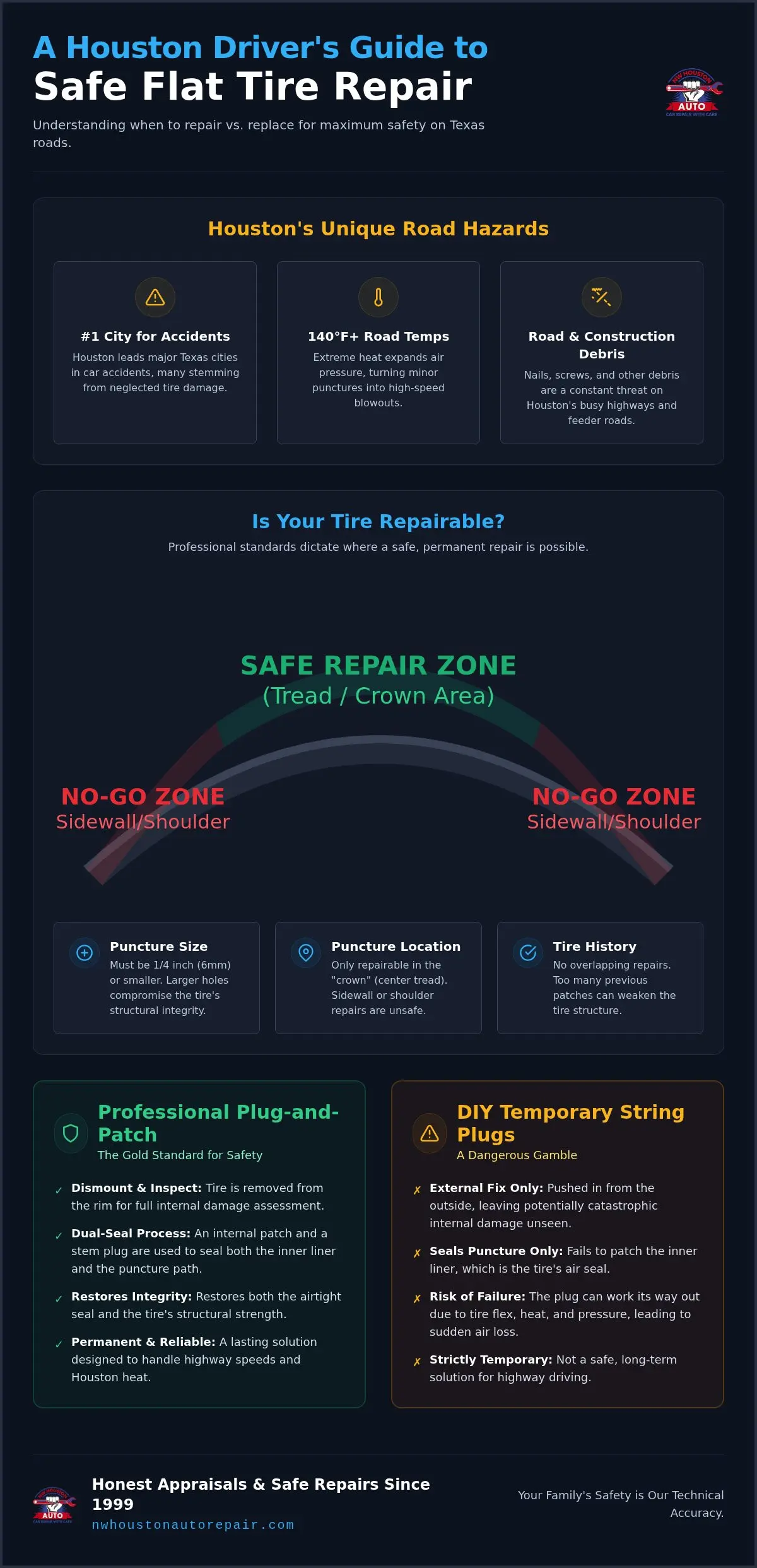
We strictly follow the U.S. Tire Manufacturers Association (USTMA) guidelines to ensure your safety. These industry standards dictate that a permanent repair can only be performed if the puncture is located within the “crown” or center of the tread. If a nail is too close to the shoulder or sidewall, the flex of the tire will eventually cause the repair to fail. There are three non-negotiable rules we live by:
- The Quarter-Inch Rule: Punctures must be 1/4 inch (6mm) or smaller in diameter.
- The Crown Limit: Repairs are restricted to the tread area between the outer grooves.
- No Overlapping Repairs: We won’t repair a tire that has an existing patch in the same area or too many previous repairs.
By adhering to these rigorous standards, we ensure that your flat tire repair Houston isn’t just a temporary patch but a reliable restoration. We’ve been a staple of the community since 1999; we know that your family’s safety depends on our technical accuracy. If a tire doesn’t meet these criteria, we’ll be honest with you about why a replacement is the only safe path forward.
Is Your Tire Repairable? The Professional Evaluation
Determining if a tire can be salvaged requires more than a quick glance at the tread. A professional evaluation is a meticulous process that begins with a full exterior visual check for punctures, cuts, or bulges. However, the most critical step is dismounting the tire from the rim. Without seeing the interior, a technician cannot identify the “marbling” or heat discoloration that occurs when a tire is driven while under-inflated. This internal damage compromises the liner and makes the tire a prime candidate for a blowout. At NW Houston Auto Repair and Collision, we prioritize this deep dive because a surface-level fix isn’t worth the risk on a high-speed freeway.
The Safe Repair Zone vs. The Sidewall
The tread area is the only part of the tire reinforced with steel belts, providing the stability needed for a patch to bond effectively. The shoulder and sidewall are designed to flex constantly to absorb road shock. Because of this movement, any plug or patch applied to these “No-Go” zones will eventually peel away or leak. Visualizing the shoulder as a critical transition zone helps drivers understand why we can’t compromise on placement. If you are unsure if your puncture is in a safe spot, you can reach out to our team for a quick, honest assessment. Adhering to NHTSA Tire Safety Standards ensures that we never compromise on these boundaries for the sake of a quick sale.
When Replacement is the Only Safe Option
Sometimes, even a tread puncture is too severe for a safe flat tire repair Houston. If a puncture is larger than one-quarter of an inch, the structural cables are likely too damaged to support the vehicle’s weight under load. Similarly, if two punctures are too close together or located in the same quadrant, the repair will overlap and weaken the rubber. We also look for signs of tire aging, such as dry rot or brittle tread, which prevents a patch from sealing properly. If you’ve driven even a short distance on a completely flat tire, the internal friction often causes tread separation. In these cases, we will always recommend a replacement to keep your vehicle dependable and your family safe on Houston roads.
Professional Plug-and-Patch vs. DIY Temporary Fixes
When you’re stranded on a shoulder, a DIY kit from a convenience store looks like a lifesaver. However, there’s a massive technical gap between an emergency stopgap and a professional flat tire repair Houston. A “string plug” is an on-the-rim repair where a sticky cord is forced into the puncture from the outside. While this might hold air long enough to get you home, it’s never intended as a final solution. These kits are for emergency use only. Without removing the tire from the wheel, there’s no way to see if the internal structure is compromised or if moisture has already begun to rust the steel belts. For situations where a DIY fix is insufficient and you need a professional tow, you can visit Bernabe Towing & Recovery for expert assistance in the Portland area.
Similarly, for readers who might need assistance in the London area, you can check out Instant Recovery to learn more about professional breakdown and vehicle recovery standards.
Canned sealants are another common “quick fix” that often causes more harm than good. The pressurized chemicals inside these cans can ruin your Tire Pressure Monitoring System (TPMS) sensors, which are expensive to replace. Furthermore, string plugs frequently fail when subjected to Houston’s intense road conditions. When local asphalt temperatures climb toward 140°F, the adhesives in temporary plugs can soften and pull away. According to industry experts in Tire Care and Safety, an unsealed inner liner allows air and moisture to seep into the tire’s casing. This leads to internal rot that eventually causes the tread to separate while you’re driving at highway speeds.
The NW Houston Auto Repair Standard: The Two-Piece Fix
At NW Houston Auto Repair and Collision, we’ve spent over 25 years perfecting a repair process that prioritizes your safety. We never perform “on-the-rim” repairs. Our technicians remove the tire from the wheel every single time to perform a full internal inspection. We utilize a two-piece “plug-and-patch” method that is the gold standard for the industry. This involves a rubber stem that fills the puncture path (the plug) and a lead-wire patch that vulcanizes to the inner liner. This creates a permanent, airtight bond that restores the tire’s integrity.
Because we take the tire off the rim to do the job right, we also perform a precision tire-balancing before the wheel goes back on your car. This prevents the annoying vibrations and uneven wear that often follow a sloppy repair. We take pride in our technical mastery and neighborly approach, ensuring that when you leave our shop, your vehicle is truly dependable. We don’t just patch a hole; we restore your peace of mind.
Houston Road Hazards: Protecting Your Tires from Local Stress
Driving in Southeast Texas is a unique challenge for any set of tires. Between the constant construction debris on I-45 and the deep potholes found throughout the Inner Loop, your vehicle’s rubber is under constant assault. These physical hazards are only half the battle. Our extreme climate adds another layer of stress. On a typical summer afternoon, Houston asphalt temperatures frequently soar above 140°F. This intense heat makes tire rubber more pliable and susceptible to damage from sharp objects that might otherwise bounce off. It also accelerates the chemical breakdown of the tire’s compound, leading to faster tread degradation and a higher likelihood of needing a flat tire repair Houston.
Temperature fluctuations also play havoc with your tire pressure. For every 10-degree change in ambient temperature, your tire pressure can shift by about one PSI. In a city where a morning rainstorm can drop temperatures by 20 degrees in an hour, your tires are constantly expanding and contracting. This cycle weakens the internal structure over time. If you suspect a leak while navigating heavy traffic, stay calm. Avoid sudden braking or sharp turns, which put additional load on a compromised sidewall. Instead, signal early and move toward the nearest safe exit or parking lot to assess the damage.
Maintenance as Prevention: Beyond the Patch
Preventing a roadside emergency starts long before you see a nail in your tread. We recommend a regular tire rotation every 5,000 to 7,500 miles. This practice ensures even wear across all four tires and allows our technicians to spot slow leaks or embedded debris before they cause a failure. Proper wheel alignment is equally critical. If your vehicle is misaligned, specific areas of the tread will thin out prematurely, making them easy targets for road hazards. For a deeper look at how we handle these technical adjustments, read our Precision Wheel Alignment in Houston driver’s guide.
TPMS: Your First Line of Defense
Your Tire Pressure Monitoring System (TPMS) is a sophisticated safety tool, not just a nuisance light on your dashboard. If that yellow icon appears while you’re on the Westpark Tollway, don’t ignore it. Even if the tire looks fine to the naked eye, it could be down several pounds of pressure, which significantly increases heat buildup. Our team specializes in calibrating and repairing sensitive TPMS sensors. We ensure they provide accurate data so you aren’t left guessing about your vehicle’s safety. If your warning light is stubborn or you’ve recently hit a major pothole, schedule a safety check with us today to keep your property dependable and your commute stress-free.
Why Choose NW Houston Auto Repair for Your Tire Needs?
Since 1999, NW Houston Auto Repair and Collision has served as a cornerstone of the local driving community. We aren’t just a volume-based tire center. We’re a family-owned establishment that treats your vehicle with the same care we’d give our own. Our “safety first” philosophy means we prioritize your well-being over a quick sale. If we determine that a tire cannot be safely repaired based on the industry standards we discussed earlier, we’ll explain the technical reasons behind that decision. We believe in transparency, not pressure. When you come to us for flat tire repair Houston, you’re getting the expertise of a team that’s kept neighbors safe on the road for over 25 years.
The Family-Owned Advantage
Choosing a local shop gives you direct access to the technicians working on your car. You won’t find high-pressure sales tactics here. Instead, you’ll find professional guidance and honest assessments. We understand that a vehicle malfunction is stressful. Our goal is to alleviate that anxiety through clear communication and technical mastery. Whether you need a quick pressure check or a complex restoration, we approach every task with the same methodical precision. We take pride in our heritage and our ability to handle a wide variety of mechanical challenges with unwavering reliability.
Comprehensive Care Under One Roof
One of the greatest benefits of visiting a full-service facility is the holistic approach to vehicle health. While your tire is off for repair, our technicians perform a courtesy check of your surrounding components. We look at your suspension and provide a thorough brake-service evaluation to ensure every safety system is functioning correctly. Unlike specialized tire chains, we have the capabilities to handle everything from routine oil changes to major collision repair.
This comprehensive oversight means we spot potential issues before they become expensive breakdowns. We invite you to stop by our shop for a tire inspection or a simple pressure adjustment. Don’t let a small leak turn into a highway emergency. Our team is equipped to handle everything from routine maintenance to highly complex restorations. Visit us in NW Houston for expert flat tire repair Houston and experience the dependable, neighborly care that’s defined our business since 1999. Get back on the road with the confidence that your property is dependable and your family is protected.
Secure Your Safety on Houston Roads
Your tires are the only thing between your vehicle and the unpredictable Houston pavement. We’ve explored why a professional plug-and-patch is the only way to restore a tire’s structural integrity. You now know that skipping an internal inspection is a gamble you don’t need to take. At NW Houston Auto Repair and Collision, we’ve been family-owned and operated since 1999. Our expert technicians combine technical mastery with a neighborly touch to keep your property dependable. As a full-service mechanical and collision facility, we look at the big picture of your vehicle’s health every time you pull into our bay.
Don’t let a small puncture turn into a dangerous highway blowout. Whether you’re dealing with a stubborn TPMS light or a visible nail, getting a reliable flat tire repair Houston is the smartest move you can make today. We’re here to provide the transparency and precision you deserve. Schedule Your Safe Tire Repair in NW Houston Today and drive with peace of mind. We look forward to seeing you at the shop and keeping your family safe on the road.
Frequently Asked Questions
How much does a flat tire repair cost in Houston?
Pricing for a professional restoration depends on the puncture’s severity and its specific location on the tread. While some national chains might offer different rates, a family-owned shop focuses on a thorough plug-and-patch process. This involves dismounting the tire to check for internal heat damage. We recommend calling us for a transparent estimate based on your tire size and the extent of the road debris damage found during our inspection.
How long does it take to repair a flat tire at your shop?
A professional repair typically takes 30 to 45 minutes to complete correctly. It isn’t just a quick plug. We have to take the tire off the rim, buff the inner liner, apply the patch, and re-mount the wheel. This meticulous approach ensures the repair holds up against Houston’s high road temperatures. We work efficiently to get you back on the road while prioritizing technical accuracy over speed.
Can a tire be repaired if the nail is in the sidewall?
No, a puncture in the sidewall is non-repairable because that area undergoes constant flex and stress as you drive. A patch or plug cannot maintain a secure bond in this zone. Attempting a flat tire repair Houston on a sidewall is a major safety risk that could lead to a sudden blowout. We always prioritize your safety and will explain why a replacement is the only safe path forward.
Is it safe to drive on a patched tire at highway speeds?
Yes, provided the repair was done using the professional plug-and-patch method. A correctly installed internal patch seals the liner and restores the tire’s structural integrity. This allows it to handle the speeds and heat typical of Houston highways. However, temporary string plugs or canned sealants aren’t rated for high-speed driving. Always ensure a technician has inspected the interior before you hit the freeway.
How many times can a single tire be patched safely?
Most industry standards allow for up to two or three repairs on a single tire. These punctures must be at least 90 degrees apart and located within the tread’s safe zone. If punctures are too close together, the patches can overlap and weaken the rubber. We evaluate each case individually to ensure the tire remains dependable. If the structure is too compromised, we’ll recommend a safe replacement for your vehicle.
Do I need to re-balance my wheels after a tire repair?
Yes, re-balancing is a critical step in the repair process. Adding a patch and plug to the inside of the tire changes its weight distribution. Even a tiny weight imbalance can cause noticeable vibrations in your steering wheel at higher speeds. At NW Houston Auto Repair and Collision, we re-balance your wheel after every repair. This prevents uneven wear and keeps your vehicle’s handling smooth and predictable on the road.
What happens if my tire cannot be repaired?
If a tire is deemed unsafe for repair, our technicians will explain exactly why. This usually happens with sidewall damage, large punctures, or tires showing signs of dry rot. Since we’re a full-service facility, we can help you select a replacement tire that matches your vehicle’s specifications. We aim to get you back on the road affordably without compromising the safety of your property or your family’s well-being.
Does a tire patch last as long as the tire itself?
A professional flat tire repair Houston is designed to be a permanent fix for your vehicle. When the patch is vulcanized to the inner liner, it becomes a structural part of the tire. If the repair is performed correctly and you maintain proper air pressure, the patch should last for the remaining life of the tread. Regular rotations help ensure the repaired area stays secure through Houston’s extreme heat.