

A window that won’t move doesn’t automatically mean the motor has failed. Power window motor repair cost in Houston depends on the faulty component, the vehicle’s door design, and whether an electrical issue is involved. Slow or weak movement can point to motor trouble, while a motor that runs without moving the glass may indicate a regulator problem.
A window that sticks, works intermittently, or stops responding can be frustrating, especially when the cause isn’t clear. This guide explains how symptoms can help distinguish motor trouble from regulator failure and what factors affect the repair estimate.
You’ll also learn how replacement parts, wiring or switch problems, and Houston’s heat and humidity can affect diagnosis and repair durability. Knowing what to look for can help you understand the recommended repair before work begins.
Key Takeaways
- Notice whether the motor is silent, weak, or running while the glass stays still; those clues can help distinguish motor trouble from regulator failure.
- Have the window system diagnosed before replacing parts, since switches, wiring, motors, and regulators can produce similar symptoms.
- Door design and the parts needed for the repair can affect labor, cost, and how long the fix lasts.
- Heat, humidity, dust, and pollen can contribute to window-system wear, so consider the conditions your vehicle faces in Houston.
- If you smell burning while using a window switch, stop operating it and arrange an inspection for a possible electrical or motor problem.
Distinguishing motor problems from regulator problems
A slow, silent, or crooked window can point to different faults inside the door. Note how the glass moves and whether you hear the motor before deciding which component might need attention.
Motor and Regulator Symptoms
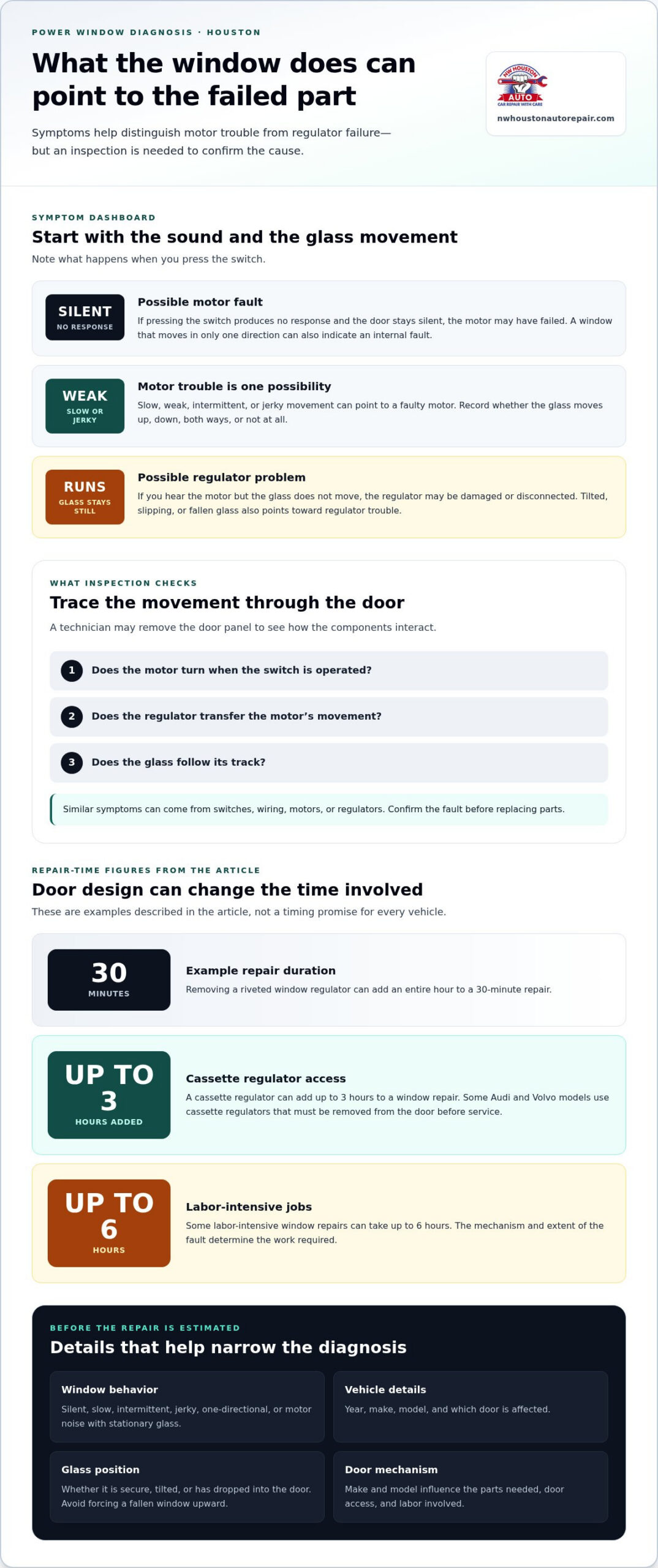
A faulty motor may move the glass slowly, weakly, intermittently, or in jerks. If pressing the switch produces no response and the door stays silent, the motor may have failed. A window that moves in only one direction can also indicate an internal fault. Note whether it moves up, down, both ways, or not at all.
Listen closely while pressing the switch. If you hear the motor running but the glass doesn’t move, the regulator may be damaged or disconnected. A window that tilts, slips down, or falls inside the door also points to regulator trouble. These clues can help narrow the cause, but they don’t replace an inspection.
Diagnosis may require removing the door panel to see how the motor, regulator, and glass interact. A technician can operate the switch and check whether the motor turns, the regulator transfers that movement, and the glass follows its track. This matters because a silent window and a fallen window can seem like the same problem from the driver’s seat but involve different parts.
Window Regulator Repair
The regulator guides and supports the glass as it moves through the door. Repair may involve correcting a damaged or misaligned regulator, or replacing it if it can no longer raise and lower the window properly. The glass position, motor operation, and regulator condition all help determine the work needed.
Once the door panel is removed, an inspection can show whether the motor works but the regulator has failed. For example, motor noise with stationary glass suggests the drive isn’t transferring movement. Repair should address the cause instead of treating every unresponsive window as a motor failure.
Some regulators are riveted to the door, which can add labor during removal. Removing a riveted window regulator can add an entire hour to a 30-minute repair. That extra time reflects the regulator’s attachment method, not necessarily a motor fault. Door construction therefore affects the work involved, even when the symptom looks familiar.
Spring-loaded regulators need careful handling during removal. Their stored tension can release abruptly and seriously injure a technician’s hands. That’s another reason not to force a tilted or fallen window back into place. A controlled inspection can show whether the regulator is holding the glass safely and whether the motor also needs attention.
Before approving a repair, ask which observed symptom supports the diagnosis: silence at the switch, motor noise without glass movement, or crooked travel. These distinctions help explain why regulator repair differs from motor replacement, even when either problem leaves the window stuck.
Power window service for domestic and foreign vehicles
Vehicle make and model affect repair cost through door design, replacement parts, and labor access. Houston shops that diagnose power-window and auto-electrical faults are relevant; customer reviews are most useful when they describe clear explanations, accurate diagnosis, and how the window worked after repair.
Domestic and import vehicles can use different window mechanisms, so the same symptom may require different parts or labor. For example, some Audi and Volvo models use cassette regulators that must be removed from the door before service. The door layout and regulator design can shape the repair process more than the badge alone.
Make and model influence the estimate because the technician must identify the correct motor or regulator and determine how the door assembly comes apart. Vehicle age, required parts, and door design also affect the total. A model with a hard-to-access regulator may require more labor than one with a simpler assembly, even when the symptoms are similar.
Repair time varies with that access. A cassette regulator can add up to 3 hours to a window repair, while some labor-intensive jobs can take up to 6 hours. These figures describe repair time, not a promise for every vehicle. The specific mechanism and extent of the fault determine the steps required.
Mobile repair depends on whether the vehicle can be diagnosed and repaired safely at its location. Window work may require door-panel removal, space to handle the glass and regulator, and access to tools and replacement parts. If the window has dropped into the door, don’t force it upward before service. Describe its position when arranging an inspection.
If your vehicle is stuck with a window open or closed in Houston, explain the situation when arranging service. Share your neighborhood, vehicle make and model, and whether the glass is secure. These details help determine the practical next step for accessing the door and installing parts.
Before arranging service, note what happens when you press the switch and whether the window moves. Include the vehicle’s year, make, model, and affected door. When reading feedback, look for specific comments about diagnosis, communication, and completed window repairs rather than relying only on a star rating. A clear description helps narrow the likely labor and parts involved.
Replacement parts and repair durability
A lasting repair starts with matching the failed component to the actual fault. The motor, gears, regulator, switch, wiring, or glass can each affect window movement and the parts the job requires.
Motor Replacement Needs and Options
Motor replacement may be necessary when an inspection shows that the motor can’t operate the window reliably. If it still works, the regulator or another component may be the actual cause. Some shops replace the motor and regulator as one assembly, even when only the regulator has broken.
Compare the diagnosis with the proposed parts. Replacing an assembly may require less labor than removing an old motor from a broken regulator, but the right option depends on the vehicle’s design and the damaged components.
Parts and Labor Costs
For power window motor replacement in Houston, the cost depends on the vehicle and the work required. Vehicle age, necessary parts, and door design affect the estimate. Ask for a breakdown of parts and labor, and confirm whether the work covers the motor alone or a motor-and-regulator assembly.
A difficult door layout can add removal and installation work, while a straightforward assembly may require fewer steps. The parts decision matters, too: replacing the motor and regulator together may take less labor than transferring a working motor from a broken regulator.
Insurance or warranty coverage depends on the policy or warranty terms and the cause of the failure. Review the relevant coverage language for the motor, regulator, and any stated exclusions before assuming the repair is covered.
DIY replacement may suit someone with repair experience, the correct vehicle-specific parts, and tools such as trim-removal tools and hand sockets. The job involves removing the door panel and supporting the glass and regulator during access. Spring-loaded regulators can collapse abruptly and seriously injure a technician’s hands, so don’t handle one without the right knowledge and precautions.
Replacement window glass is a separate need from motor replacement. If the glass is cracked or shattered, it may need to be replaced; motor or regulator repair addresses movement, not broken glass. Have the glass and lift mechanism assessed together, especially if the window has slipped inside the door.
Parts quality can also affect durability. A low-cost regulator may fail again within a few months, so the cheapest part may lead to another repair. Ask which component failed, whether the proposed replacement includes the regulator, and how the completed assembly will be checked using the switch. Clear answers help you understand what the repair is intended to fix.
Common causes of power window failure
A power window can stop working because of motor failure, misalignment, or an electrical problem. Since these faults can produce similar symptoms, note what happens at the switch and how the glass moves before arranging an inspection.
Motor wear often appears as slower movement. A window that rises with noticeable effort may indicate a weakening motor, while intermittent or jerky movement can also point to motor trouble. Note whether one window or several are affected, and whether movement changes between opening and closing. Those details can help distinguish a local fault from a broader electrical issue.
Direction matters, too. If a window moves down but not up, or up but not down, an internal motor failure may be involved. The switch sends the command, but the motor may not respond consistently in both directions. Record the exact pattern instead of describing the window simply as “broken.” That gives a technician a clearer starting point.
Misalignment can make the glass bind as it travels. For example, the window may tilt or move unevenly instead of following a smooth path. That can make the motor seem weak because it has to move glass that isn’t tracking correctly. A technician can inspect the movement and related components to distinguish alignment trouble from motor failure.
Electrical issues can interrupt power to the window system. A faulty connection or switch may keep the motor from receiving a consistent command, while a motor problem can produce similar behavior. Mention it if multiple windows act up. If only one fails, describe how it responds to the switch, including pauses or changes in speed.
Houston’s climate can also contribute to wear. Heat, humidity, dust, and pollen may affect power window motor performance over time. For example, a window used regularly in a dusty vehicle may move differently as the system wears. These conditions don’t identify a failed part by themselves, but they provide useful context when describing a recurring problem.
Track the symptoms with a simple sequence:
- Note whether the glass moves slowly, weakly, intermittently, or jerkily.
- Record whether it operates in one direction or both.
- Observe whether the glass stays aligned as it travels.
- Describe whether one window or several respond inconsistently.
These observations help focus diagnosis on the motor, alignment, or electrical components. Describing the window’s behavior is more useful than guessing which part is faulty.
Electrical-system issues affecting window motors
A power window depends on more than its motor. The switch, wiring, and connections must carry the command to the motor, so an electrical fault can imitate a mechanical failure. Diagnosis should distinguish a power supply or control problem from a motor that has stopped working.
Start by noting which controls work. If the driver’s switch operates a window but its door switch doesn’t, that difference gives the technician a useful diagnostic clue. Mention it if several windows stop responding together. Compare the affected window with another one, and note whether the fault changes when the vehicle is running.
Most power windows don’t operate after the vehicle stops running, although some have a time delay that allows brief operation after the engine stops. Test the switch with the vehicle running, then note the result. This comparison can help distinguish normal system behavior from a fault without repeatedly pressing a switch that produces unusual sounds or smells.
A technician can trace the control path from the switch to the motor, inspecting connections and wiring before recommending parts. For example, if the switch command doesn’t reach the motor, the issue may be electrical. If the motor receives power but doesn’t operate, the motor may be at fault. Testing matters because replacing the motor alone won’t fix a faulty connection.
Pay attention to changes in behavior and describe them clearly:
- State whether one window or several have stopped responding.
- Describe which switch you used and whether the vehicle was running.
- Note any intermittent operation, unusual sound, or burning smell.
These observations help focus diagnosis on the relevant part of the system. They also help prevent a convenient switch test from becoming a reason to keep operating a window that may have an overheating motor.
Stop using the switch if you smell burning from the door panel while operating the window. The smell may signal an overheating or short-circuiting motor. Arrange an inspection and replacement. Continued operation can keep stressing the affected electrical components, so treat a burning odor differently from a window that simply moves slowly.
Share the switch behavior, vehicle state, and any odor with the technician. If a burning smell or recurring electrical symptom needs attention, arrange an inspection rather than continuing to test the window.
NW Houston Auto Repair and Collision: Synthetic Oil Change
If a stuck window follows a vehicle impact, NW Houston Auto Repair and Collision’s Collision Repair service addresses collision-related damage. If a crash affected the glass or door, describe what happened and how the window behaves now so the damage can be assessed in context. A motor or regulator problem without collision damage calls for diagnosis of the window system itself.
NW Houston Auto Repair and Collision also provides Auto Air Conditioning Repair, Tire Repair & Flat Repair, and Synthetic Oil Change. Choose the service that matches the problem rather than treating unrelated maintenance as a window fix. To discuss collision damage or another of these services, contact NW Houston Auto Repair and Collision.
Take the Next Step Toward a Dependable Window
A power window problem can affect more than convenience. A window that won’t close may leave the vehicle exposed, while one that won’t open can make everyday use frustrating. Base your next decision on what the car is doing, not an assumption about which part failed. A clear estimate of power window motor repair cost in Houston starts with identifying the repair and parts required.
If the symptoms point to an electrical fault, NW Houston Auto Repair and Collision provides Auto Electrical Repair. Describe what you’ve noticed and ask about the appropriate next step for your vehicle. A direct conversation can help you explain the problem and understand the service being discussed before proceeding.
Contact NW Houston Auto Repair and Collision to discuss your vehicle’s electrical repair needs. A clear path forward starts with the right conversation.
Frequently Asked Questions
Is it the Motor or the Regulator?
Listen for the motor, then watch how the glass responds. Motor noise without glass movement points toward a regulator or a connection between the parts; silence may involve the motor, switch, or electrical supply. For example, if the driver’s control works but the door switch doesn’t, that difference is a useful diagnostic clue. A door-panel inspection can confirm the faulty component.
When is Motor Replacement Necessary?
Motor replacement is appropriate when testing shows the motor has failed and can’t operate the window. A window that moves in only one direction, responds inconsistently, or stops despite a working switch may need motor testing. Diagnosis should establish whether the fault is inside the motor or elsewhere in the system. Replacing the motor won’t resolve a faulty switch or damaged regulator.
What is the average cost to repair a power window motor in Houston?
Power window motor repair cost in Houston depends on the vehicle, required parts, and door design. A single average may not reflect whether the repair involves a motor, regulator assembly, or electrical fault. The estimate depends on the specific case and is provided after a quote request. When reviewing it, check which parts and labor it covers and whether diagnosis is included.
What is the cost to repair versus replace a power window motor?
Repair versus replacement cost depends on whether the motor can be repaired separately and how the regulator is assembled. If a working motor is attached to a broken regulator, transferring it may take more labor than replacing the motor and regulator assembly together. Compare the proposed parts and labor, not just the part name. Ask whether the estimate addresses the cause of failure and includes the necessary components.
What symptoms indicate a bad power window motor versus a faulty switch or regulator?
A motor may be failing if the window moves weakly, intermittently, or in only one direction. A faulty switch is more likely when one control fails but another operates the same window. Regulator trouble may leave the glass tilted or stationary despite motor noise. Compare the driver’s switch with the door switch and note whether other windows work. These observations help focus electrical and mechanical testing.
How much do Houston auto repair shops charge for power window diagnosis?
A diagnostic charge depends on the testing and inspection required, and the amount is provided after a quote request. Checking switch response may be straightforward, while tracing an intermittent electrical fault or inspecting components behind a door panel can require more diagnostic work. Ask what the diagnostic covers and whether it is included in the repair estimate. This helps clarify the proposed work before you authorize repairs.
How long does power window motor replacement take?
Replacement time depends on the regulator design and door access. Removing a riveted regulator can add an entire hour to a 30-minute repair. A cassette regulator can add up to 3 hours, and labor-intensive repairs can take up to 6 hours. These examples show why the same motor issue can involve different work times across vehicles. The specific door mechanism determines the steps involved.