

What if your car’s weak airflow isn’t a sign that it simply needs more refrigerant? In Houston heat, an underperforming AC can make every drive uncomfortable, and guessing at the fix may leave you unsure what’s actually wrong. Car air conditioner repair starts with understanding the symptoms and finding the cause, not assuming a recharge is the answer.
If the cabin won’t cool down, you want a clear explanation, a sensible next step, and confidence that recommended work addresses the problem. This guide explains what can affect cooling performance, what to expect during diagnosis and repair, and how to discuss your concern without getting lost in technical jargon. NW Houston Auto Repair and Collision is a family-owned shop serving Houston since 1999, with a location in Houston Heights and a focus on Practical Service. Clear Communication. Before arranging service, note when the AC’s performance changed, what you notice at the vents, and whether the issue comes and goes. Those details give the team a useful starting point.
Key Takeaways
- Learn how the AC system moves heat out of your cabin and which components can affect cooling.
- Understand why car air conditioner repair should begin with diagnosing the cause, rather than assuming a recharge is the fix.
- Notice the symptoms and details that can help you describe your cooling concern clearly.
- Get a better sense of what to expect when discussing findings and possible next steps for your vehicle.
- See how plain-language recommendations can help you make an informed decision about AC service.
What car air conditioner repair addresses when cabin cooling fades
When the air from your vents no longer feels cool, the change is easy to notice, but it doesn’t identify the cause. Car air conditioner repair means evaluating and addressing a fault that affects the vehicle’s air-conditioning system. The goal is to understand why cooling has weakened or become inconsistent, then determine an appropriate next step rather than assume one repair fits every vehicle.
That distinction matters in Houston. Heat can make a drive uncomfortable quickly, especially when the cabin stays warm after the AC is turned on or cooling varies during an ordinary trip. A symptom is useful information, but it isn’t a diagnosis. Describe what changed, how long you’ve noticed it, and whether it happens consistently or intermittently. Those observations help a technician investigate without treating a guess as a confirmed fault.
How the AC system supports cabin comfort
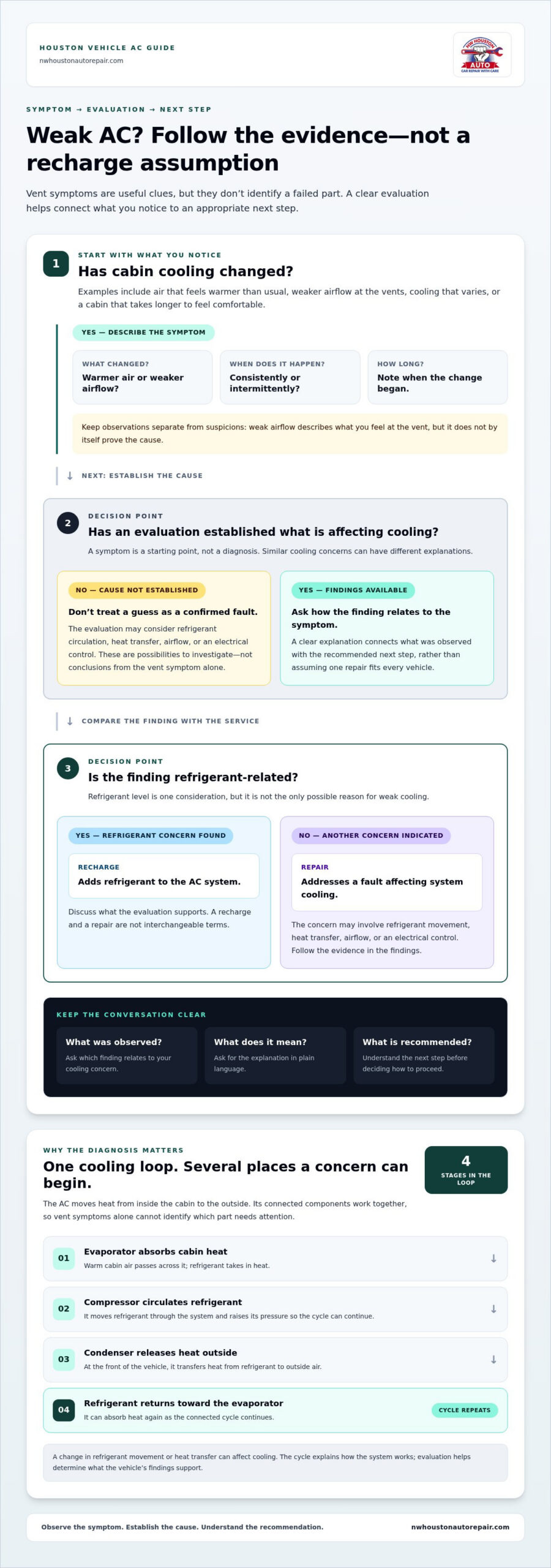
Your vehicle’s AC doesn’t create cold air from nothing. It moves heat from inside the cabin to the outside. Refrigerant circulates through the system, carrying heat as it changes condition along the way. The compressor circulates and pressurizes the refrigerant, the condenser releases heat outside the vehicle, and the evaporator absorbs heat from cabin air as that air passes through the system.
These components work together, so a cooling concern can’t be assigned to one part based only on how the vents feel. For a broader overview of the components and refrigerants involved, see Automotive Air Conditioning Systems.
When a cooling concern calls for repair attention
Reduced cooling is a good reason to arrange a professional evaluation, particularly if the AC seems to work inconsistently or the cabin takes longer than expected to feel comfortable. When you describe the issue, separate what you observe from what you suspect. For example, say whether the air feels warmer than usual, whether the airflow itself seems weaker, and when the change occurs. That gives the technician a starting point without presuming which part has failed.
Weak airflow describes what you feel at the vent; it doesn’t by itself prove why the system is underperforming. The next step depends on the findings, so clear explanations matter as much as identifying the concern. NW Houston Auto Repair and Collision provides auto air conditioning repair with practical service and plain-language recommendations, helping Houston drivers understand what the evaluation shows before deciding how to proceed.
How a car AC system works, and where cooling problems can begin
The AC cycle is easier to understand as a loop. Refrigerant travels through connected components, absorbing heat inside the cabin and releasing it outside. A problem anywhere along that path can affect the result at the vents, which is why the same symptom doesn’t always point to the same repair.
Refrigerant carries heat through an automotive AC system, absorbing it from cabin air and releasing it outside the vehicle.
- The evaporator absorbs cabin heat. Warm air passes across the evaporator, and refrigerant inside it takes in heat.
- The compressor circulates refrigerant. It moves refrigerant through the system and raises its pressure so the cycle can continue.
- The condenser releases heat. At the front of the vehicle, the condenser transfers heat from the refrigerant to the outside air.
- The cycle returns to the cabin. As refrigerant circulates back toward the evaporator, it can absorb heat again.
Each stage depends on the others. A change in how refrigerant moves or how heat transfers can reduce cooling, but the cycle alone can’t tell you which part, if any, needs attention.
What the compressor, condenser, and evaporator do
The compressor keeps refrigerant moving through the loop. The condenser helps release heat outside the passenger cabin, while the evaporator absorbs heat from air entering the cabin. These parts have distinct jobs, but their work is connected. If heat isn’t absorbed or released as expected, vent temperature may change. That observation points to a concern, not a confirmed component failure.
Why a system fault needs diagnosis
Similar cooling symptoms can have different explanations. Refrigerant level is one consideration, but it isn’t the only possible reason for weak cooling. A concern could involve refrigerant circulation, heat transfer, airflow, or an electrical control. Those are possibilities to evaluate, not conclusions to draw from a driver’s description alone.
A careful evaluation checks what the evidence supports. That helps distinguish an issue affecting refrigerant movement from one involving airflow or system controls, and gives the technician a basis for explaining a recommended next step. The point isn’t to replace one guess with a list of possible repairs. It’s to connect the vehicle’s observed behavior with a finding before discussing the work.
For Houston drivers, a clear explanation matters. Ask what was observed, how it relates to the cooling concern, and what action is being recommended. NW Houston Auto Repair and Collision provides auto air conditioning repair with plain-language communication, so the conversation can focus on findings rather than assumptions. If you’re ready to describe what your AC is doing, get in touch with the shop.
AC recharge or car air conditioner repair: why the difference matters
A recharge and a repair aren’t interchangeable terms. A recharge refers to adding refrigerant to an AC system; car air conditioner repair means addressing a fault that affects how the system cools. A refrigerant-related concern may be part of the evaluation, but adding refrigerant alone doesn’t explain why cooling changed or establish whether another issue needs attention.
Diagnosing the cause before choosing an AC repair helps match the recommended work to the vehicle’s actual condition instead of relying on a guess. That’s the difference between responding to a symptom and understanding what the system needs.
What an AC evaluation helps clarify
You know what you’ve noticed: perhaps the cabin doesn’t cool as well as before, or the temperature seems inconsistent. That’s valuable information, but it’s an observation rather than a confirmed cause. An evaluation helps narrow down what may be affecting performance and gives a technician a basis for explaining the findings and possible next step.
There’s no single conclusion to draw from weak cooling alone. The system has several connected components, and the right recommendation depends on what an inspection establishes for that vehicle. A clear conversation should distinguish the reported concern, the technician’s finding, and the action being proposed. If the cause hasn’t been identified, a specific repair recommendation would be premature.
| Concern you notice | What diagnosis clarifies | Possible next step |
|---|---|---|
| Air from the vents feels warmer than expected | Whether a system fault is affecting cooling, and what evidence points to it | Discuss the finding and the relevant repair or service recommendation |
| Cooling seems to change during a drive | Whether the concern relates to a system component or another factor affecting performance | Review the evaluation before deciding what work is appropriate |
| You suspect low refrigerant | Whether refrigerant is part of the issue and whether another fault may also be involved | Address the identified cause rather than assume a recharge is sufficient |
Why a refrigerant-only assumption can miss the issue
Cooling depends on more than refrigerant alone. The compressor moves refrigerant, the condenser releases heat, and the evaporator absorbs heat from cabin air. A fault affecting any part of that process may influence what you feel at the vents. A recharge by itself doesn’t confirm that the underlying concern has been found or that cooling will return to normal.
For practical planning, focus on what the evaluation establishes and how the recommendation relates to your vehicle. NW Houston Auto Repair and Collision emphasizes plain-language findings as part of its auto air conditioning repair. If your AC isn’t cooling as expected, share what you’re experiencing and discuss a sensible next step before deciding on work.
What to expect when arranging car AC repair in Houston
Starting a repair conversation doesn’t require technical terms or a guess about what’s broken. Share what you’ve noticed, then discuss the findings and possible next steps with the shop. This keeps the focus on your concern and helps you understand the recommendation before deciding how to proceed.
How to describe the cooling concern
Use everyday language. You might say the cabin takes longer to feel comfortable, the air doesn’t seem as cool as it used to, or the cooling changes during a drive. If you’ve noticed a pattern, mention when it happens, such as after the vehicle has been parked or during a particular part of your trip. You can also describe whether the airflow seems normal or weaker than usual. These details help explain the concern, but they don’t prove that a specific component has failed.
At NW Houston Auto Repair and Collision, the customer process is straightforward:
- Tell Us What You’re Experiencing.
- Discuss the Next Step.
- Make an Informed Decision.
Each step has a clear purpose. First, your description gives the team context. Next, you can discuss what the evaluation shows and what action is being recommended. Then you decide how to proceed with a better understanding of the concern and proposed work. You don’t need to arrive with a diagnosis; explaining the change you’ve noticed is a useful place to begin.
How clear recommendations support an informed decision
A recommendation should connect the finding to the proposed next step in language you can follow. If something isn’t clear, ask what the evaluation showed, how it relates to the cooling concern, and what the suggested work is intended to address. That conversation helps separate confirmed findings from possibilities, without promising a particular result before the vehicle has been evaluated.
That’s the approach behind Practical Service. Clear Communication. Car air conditioner repair can feel less uncertain when the conversation stays focused on your vehicle, the observed concern, and the recommendation rather than unexplained technical terms. You should have room to understand the information and make your own informed decision.
Whether your AC concern is new or has been changing over time, start with a clear description and talk through what happens next. Talk with the team about your car AC concern.
Find dependable car air conditioner repair in Houston Heights
Houston drivers looking for car air conditioner repair can turn to NW Houston Auto Repair and Collision, a family-owned shop serving Houston since 1999. Located in Houston Heights, TX 77008, the shop serves Houston and surrounding communities. Its local roots offer a nearby place to start when cabin cooling needs attention, with communication focused on helping you understand the concern and the recommendation.
What local drivers can expect from the shop
The shop has in-house capability to service any make and model, domestic or import. Because every vehicle and AC concern is different, a useful repair conversation begins with your description and continues with an explanation of the findings. The team emphasizes plain-language recommendations so you can understand what’s being proposed and make an informed decision, rather than feeling expected to interpret technical terms on your own.
NW Houston Auto Repair and Collision has a displayed 5-star (★★★★★) rating with 250+ Google reviews. Reviews can offer a sense of other customers’ experiences, while clear communication helps you understand the conversation about your own vehicle. The shop’s guiding phrase is Your local partner for dependable vehicle care. It reflects a neighborly approach: listen to the concern, explain the next step, and treat your decision with respect.
For drivers in Houston Heights and nearby communities, having a local shop means you can discuss the issue with a team serving the area, whether your vehicle is a domestic model or an import. You don’t need to arrive with a technical diagnosis. Bring the concern as you’ve experienced it, and let the conversation begin there.
How to take the next step
Make the first conversation simple. Describe what has changed with your AC and share any details that may help the team understand the concern. From there, discuss the next step and take time to understand the recommendation. The aim is clarity, not pressure: you should know what the shop found and what work is being proposed before you decide how to proceed.
Call the shop at (281) 607-0753, email info@nwhoustonautorepair.com, or use the contact page to share your concern and connect with the team.
Take the next step with a local team that values straightforward explanations. Contact NW Houston Auto Repair and Collision about car AC repair.
Make your next drive more comfortable
Cabin comfort is part of feeling at ease behind the wheel, especially during Houston’s hot weather. If your AC isn’t keeping up, you don’t have to figure out the cause on your own or arrive with a technical explanation. A simple description of what you’ve noticed is enough to begin a useful conversation about car air conditioner repair.
Give yourself a clear path forward: share the concern, hear what the evaluation shows, and consider the recommendation with the information in hand. That way, the next decision is based on your vehicle’s needs rather than an assumption. You’re in control of what happens next.
Reach out to discuss your car AC concern and take the first step toward understanding your options. A straightforward conversation can make the repair process feel more manageable, and you can move forward with greater confidence.
Frequently Asked Questions
Is it safe to keep driving when my car AC is not cooling?
Weak cooling alone doesn’t identify its cause or establish what condition the AC system is in. It does mean the cabin may stay uncomfortable, especially during a hot Houston drive. If you’re deciding whether to continue a trip, consider whether the cabin temperature is manageable for you and your passengers. A professional evaluation can help clarify what’s affecting the AC and what to do next.
Can a car AC recharge fix the problem by itself?
Not necessarily. A recharge may not address every reason cooling has changed, because AC performance depends on multiple connected components. Adding refrigerant without understanding the concern may leave the underlying issue unresolved. Diagnosis helps distinguish the driver’s observation from the technician’s finding, so the next step can be based on the vehicle’s condition. Discuss the evaluation and recommendation before deciding what work to approve.
How does a car air conditioner cool the cabin?
Refrigerant circulates through the AC system, carrying heat away from cabin air. The evaporator absorbs heat as air passes through it, helping cool the air that enters the passenger compartment. The refrigerant then travels through the system to the condenser, which releases heat outside the cabin. This repeated heat-transfer process is what makes the air feel cooler, rather than the AC creating cold from nothing.
What are common reasons a car AC stops cooling?
There can be more than one possible cause, and a change in vent temperature doesn’t identify a specific fault. The concern could involve refrigerant circulation, heat transfer at components such as the condenser or evaporator, or another part of the system. These are general possibilities, not a remote diagnosis. An evaluation helps determine which findings apply to your vehicle and whether they relate to the cooling change you noticed.
Does NW Houston Auto Repair work on domestic and imported vehicles?
Yes. NW Houston Auto Repair and Collision has in-house capability to service any make and model, domestic or import. Houston drivers can describe their vehicle’s AC concern without needing to identify a likely failed part first. Sharing the make and model along with what you’ve noticed gives the team useful context for discussing the concern and the appropriate next step.
Where can I get car air conditioner repair in Houston Heights?
NW Houston Auto Repair and Collision is located in Houston Heights, TX 77008, and serves Houston and surrounding communities. To discuss car air conditioner repair, describe what your vehicle’s AC is doing through the contact page or call (281) 607-0753.