

Imagine you’re cruising down the Sam Houston Tollway at 65 miles per hour when a sudden, nagging vibration starts rattling your steering wheel. It’s a stressful experience that usually points to one of two common maintenance needs: an alignment and tire rotation. You might feel like your vehicle is fighting you, and you’re right to be concerned. Premature tire wear can cost you hundreds of dollars in unnecessary replacements if left unchecked. We understand that automotive jargon is often confusing, leaving you unsure which service actually solves the problem.
You deserve a smooth, predictable commute without the fear of a shaky ride or uneven tread. This guide explains the critical differences between these two services and how they work together to protect your investment and your family. We’ll show you exactly how to maximize your tire lifespan and why regular maintenance is more important than ever now that Texas has abolished mandatory safety inspections. By the end, you’ll have the clarity needed to keep your car dependable on every Houston highway.
Key Takeaways
- Distinguish between the physical repositioning of your tires and the precise mechanical calibration of your vehicle’s suspension system.
- Recognize specific warning signs like steering wheel tilt or “cupping” tread patterns to catch issues before they require expensive replacements.
- Implement a proactive alignment and tire rotation schedule to protect your vehicle from the unique stressors of Houston’s potholes and construction zones.
- Master the ideal maintenance interval, typically every 5,000 to 7,500 miles, to significantly extend the lifespan of your tire tread.
- Discover how partnering with a trusted, family-owned local specialist ensures your car remains dependable for every trip across the Sam Houston Tollway.
Understanding Tire Rotation vs. Wheel Alignment
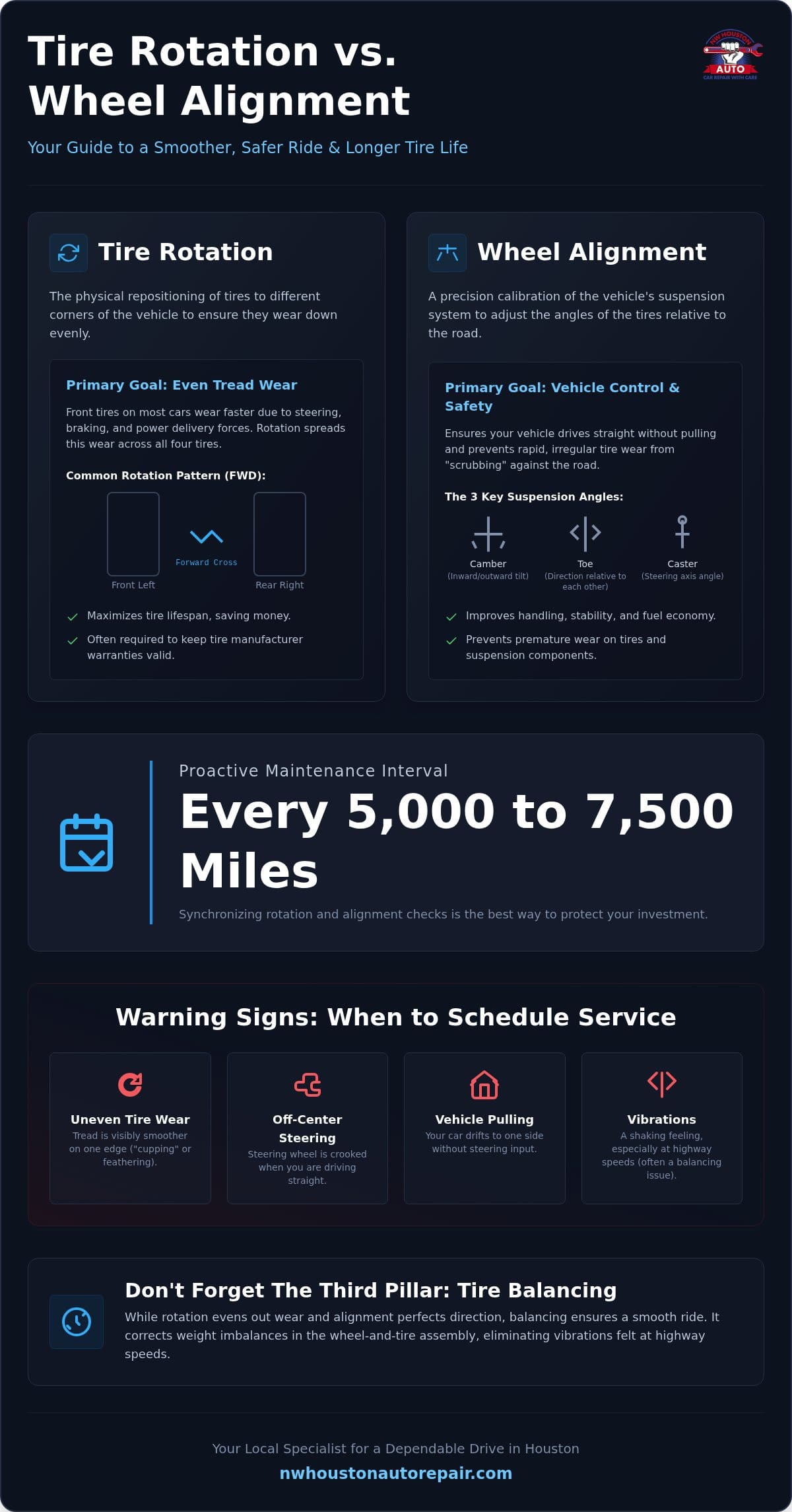
Your vehicle is a complex machine, and keeping it running safely requires understanding how its parts interact. Many people use the terms interchangeably, but an alignment and tire rotation are two distinct services that protect your car in different ways. Think of tire rotation as a way to spread out the wear on your rubber, while alignment is a precision calibration of your suspension system. Although they involve different mechanical steps, they both share a critical mission: keeping you safe and extending the life of your tires. Alignment is the geometric relationship between the wheels and the road.
The Mechanics of Tire Rotation
Tire rotation involves physically moving your wheels to different positions on the vehicle. Front-wheel-drive cars are incredibly common in Houston, and these vehicles put a heavy burden on the front tires. They handle the steering, the majority of the braking, and the power delivery all at once. This causes the front tread to disappear much faster than the rear. By moving them around, we ensure each tire wears down at the same rate. We use specific patterns like the Forward Cross, X-Pattern, or Rearward Cross depending on your vehicle’s drive type and tire design. Performing a regular tire rotation is also a requirement for most manufacturer warranties. If you don’t have proof of these services, the tire maker might not honor your tread-life guarantee if the tires fail early.
The Geometry of Wheel Alignment
While rotation deals with the tires themselves, Wheel alignment is all about the suspension. Our technicians use specialized sensors to measure and adjust three primary angles. First is Camber, which is the inward or outward tilt of the tire when viewed from the front. Second is Caster, the angle of your steering axis that helps with balance and stability. Finally, there is Toe, the direction the tires point relative to each other. Even a tiny deviation in these angles can scrub the tread off a brand-new tire in just a few hundred miles. When your car is properly aligned, it tracks straight and resists the urge to pull toward the shoulder. You can learn more about the technical precision involved on our wheel alignment service page. Keeping your alignment and tire rotation synchronized is the best way to avoid the stress of premature tire failure.
The Mechanics of Precision: How These Services Work
Professional tire maintenance is more than just swapping rubber. It’s a methodical process that starts the moment your car enters our shop. Performing a regular alignment and tire rotation keeps your commute smooth and prevents the hidden damage caused by Houston’s rougher roads. First, we lift your vehicle to inspect the overall health of the tread. We look for hidden punctures or uneven wear patterns before moving the wheels to their new positions. This step ensures your tires wear down as a team, which significantly extends their life. While the wheels are off, we perform a quick check for suspension repair needs. If your bushings or tie rods are worn out, a standard alignment won’t hold. We take pride in this thoroughness because your safety is our priority.
The Alignment Process
Modern alignment requires high-tech precision. We mount your vehicle on a specialized alignment rack and attach sensitive optical sensors to each wheel. These sensors beam data to a computer that compares your current angles against the factory specifications. Our technicians then manually adjust the tie rods and control arms to bring everything back into balance. This level of accuracy is vital for your vehicle’s handling. We always finish with a test drive to confirm the steering wheel is centered and the car tracks perfectly straight. According to NHTSA TireWise safety information, maintaining these components is essential for optimal fuel economy and vehicle control.
Why Balancing is the Third Pillar
Drivers often confuse rotation with tire balancing, but they serve different roles. While rotation changes the position of the tire on the car, balancing ensures the weight of the wheel and tire assembly is distributed evenly. We use a high-speed balancer to identify heavy spots and attach small lead weights to the rim to compensate. Without this, you’ll feel annoying vibrations at highway speeds, especially on the Sam Houston Tollway or I-10. Unbalanced tires don’t just feel bad; they cause uneven wear and put unnecessary stress on your suspension. If you’ve noticed a shimmy in your seat lately, it’s time for a professional check. You can schedule an inspection with our team to ensure your alignment and tire rotation are handled correctly.
Diagnostic Signs: When to Schedule Service
Identifying whether you need an alignment and tire rotation before you visit the shop can save you significant time and stress. While both services address tire health, the symptoms they fix are quite distinct. The most common indicator of misalignment is a persistent “pull” to one side while driving on a flat road. If you have to grip the wheel tightly just to stay in your lane, your suspension angles are likely off. However, you should be observant of when this happens. If that pulling only occurs when you step on the pedal, you might actually need brake repair instead of an alignment. A stuck caliper or worn pad can mimic the feeling of a bad alignment by dragging the car to one side during deceleration.
Visual Inspection of Your Tires
Perform a quick visual check of your rubber once a month to catch issues early. Use the “penny test” by sticking a penny into the tread with Lincoln’s head facing down. If you can see the top of his head, your tread is dangerously low and requires immediate attention. Look for “cupping,” which appears as scooped-out dips or scalloped wavy patterns in the rubber. This is a classic sign that you’ve missed your rotation interval or have worn suspension parts. You might also notice “feathering,” where the tread blocks feel smooth when rubbed in one direction but sharp in the other. This usually points to a “toe” setting issue in your alignment. In our Houston climate, the heat and humidity cause tire pressure to fluctuate wildly. Always check your PSI when the tires are cold to ensure your readings are accurate and your tires aren’t wearing prematurely due to under-inflation.
The Driving Experience Checklist
Pay close attention to your steering wheel’s position while traveling on a straight, level road. If the logo in the center is tilted to the left or right while the car moves straight, your alignment is definitely out of factory specifications. Vibrations provide another vital clue for your diagnostic checklist. Shaking felt specifically in the steering wheel often points to front-end balance or alignment issues. Conversely, a vibration felt through your seat usually suggests the rear tires are out of balance or need a rotation. Poor alignment also creates “rolling resistance,” which forces your engine to work much harder to maintain highway speeds. This extra strain can degrade your motor oil faster than usual, potentially shortening the effective life of your oil change and increasing your long-term maintenance costs. Keeping these systems in check ensures your vehicle remains a dependable, safe partner for every mile of your commute.
The Houston Driver’s Maintenance Strategy
Houston roads are notoriously tough on vehicles. Constant construction, deep potholes, and frequent curb impacts create a hostile environment for your suspension. Maintaining a consistent alignment and tire rotation schedule is your best defense against these local stressors. We’ve seen how the combination of high heat and uneven pavement accelerates tread wear for local drivers. To keep your vehicle dependable, you should follow a comprehensive car maintenance plan tailored to our city’s unique conditions. It’s about being proactive rather than reactive.
Potholes and the Houston Commute
One deep pothole on the I-10 or the 610 Loop can instantly knock your wheels out of factory specifications. This isn’t just a minor nuisance; it creates immediate safety risks. When your wheels fight each other, your fuel efficiency plummets. This is especially noticeable during the stop-and-go traffic that defines the Houston commute. Your engine works harder to overcome the resistance of misaligned tires, burning more gas every mile. For those of us with long daily drives, this adds up to significant costs at the pump. Regular checks ensure your car tracks straight and stays efficient, even when the roads are at their worst.
The Synergy of Combined Service
We recommend a rotation interval of every 5,000 to 7,500 miles. This usually aligns with every other oil change, making it easy to remember. While your car is on the lift for rotation, it’s the perfect time to inspect the alignment. Bundling your alignment and tire rotation into a single visit is the most efficient way to maintain your vehicle. Combining these services prevents the uneven tread wear that leads to loss of control. In extreme cases, poor handling can result in accidents requiring extensive collision repair. A proactive approach keeps you out of the body shop and on the road. You should have your alignment checked at least once a year or immediately after any major impact with a curb or pothole.
Think of this as a “set it and forget it” strategy for your safety. By bundling these tasks, you ensure every component of your wheel assembly works in harmony. It’s a simple way to protect your investment and your family. If you’ve hit a rough patch of road recently, don’t wait for the symptoms to worsen. You can contact our team to schedule your alignment check and keep your vehicle in peak condition.
Why NW Houston Auto Repair is Your Local Specialist
Since 1999, NW Houston Auto Repair and Collision has served as a protective partner for drivers across our community. We aren’t just another corporate service center; we’re a family-run establishment with deep roots in the Houston area. When you bring your vehicle to us for an alignment and tire rotation, you aren’t just a ticket number. You’re a neighbor. Our team combines the technical mastery of a seasoned expert with the approachability of a local shop. We handle everything from a simple tire repair to the most complex mechanical restorations. This versatility ensures that no matter what Houston roads throw at your car, we have the tools and the transparency to fix it right the first time.
Mastery and Precision in NW Houston
We use industry-standard diagnostic equipment to ensure every adjustment meets factory specifications. Our facility is a full-service hub, meaning we don’t just look at your tires in isolation. We evaluate your entire vehicle’s health. Because we’re family-owned, we treat your car like our own. We take pride in our heritage as a bold problem-solver in the auto repair industry. Whether it’s routine maintenance or a complex electrical issue, our commitment to quality and precision never wavers. We aim to alleviate the stress of vehicle malfunctions by being the dependable partner you can trust. You’ll find that our approach to service explanations is calm and transparent, ensuring you understand exactly what your car needs to stay safe.
Your Next Steps for a Smoother Ride
Don’t let a small vibration turn into an expensive repair that costs you hundreds of dollars. Stop by our shop today for a comprehensive tire health assessment. Our experts will examine your tread depth and suspension components to ensure your commute remains safe and predictable. Call us now for a consultation. If you want to dive deeper into the technical side of things, check out our Precision Wheel Alignment in Houston guide. It’s time to ensure your vehicle is as dependable as you need it to be. Let us help you maximize your tire lifespan and keep your property safe. Your safety is our priority, and we’re ready to get you back on the road with confidence.
Secure Your Smooth Commute Today
Navigating the unique stressors of Houston traffic requires a vehicle that tracks straight and handles predictably. By staying ahead of your alignment and tire rotation schedule, you protect your investment from the damage caused by hidden potholes and active construction zones. You’ve learned how these distinct services work together to maximize tread life and ensure your safety on every highway. Don’t wait for nagging vibrations or steering pull to become a costly repair that sidelines your vehicle.
Our master-level automotive technicians have been a protective partner for local drivers since 1999. As a family-owned and operated business, we provide the technical mastery and neighborly warmth you deserve. We take pride in keeping your car dependable so you can focus on what matters most. Schedule your alignment and tire rotation at NW Houston Auto Repair today! We look forward to seeing you at the shop and helping you drive with total confidence for miles to come.
Frequently Asked Questions
Is an alignment necessary after a tire rotation?
An alignment check isn’t strictly mandatory after every rotation, but it’s the smartest time to perform one. While rotating the tires ensures even wear across all four wheels, the alignment ensures those wheels are pointing in the correct direction. Performing an alignment and tire rotation together provides a comprehensive safety check. It allows technicians to spot suspension issues that might be hidden when the wheels are mounted.
How much does an alignment and tire rotation cost in Houston?
Service costs in the Houston area fluctuate depending on your vehicle’s make and model. A standard four-wheel alignment generally costs more than a front-end adjustment, and luxury vehicles with advanced driver assistance systems may require specialized calibration. Tire rotation is often more affordable as a standalone service. You should check with your local shop for a transparent quote that includes both labor and any necessary balancing weights for your specific rims.
Can bad alignment cause tires to wear out in a few months?
Severe misalignment can absolutely destroy a set of tires in just a few months or even weeks. When your wheels aren’t parallel, they essentially drag across the pavement instead of rolling smoothly. This creates intense friction and heat that burns through the rubber compound. You might start with a brand-new set of tires and find the inner edges worn down to the metal wires much sooner than the manufacturer’s mileage guarantee predicts.
How long does a typical alignment and rotation service take?
You can typically expect a combined alignment and rotation service to take between 60 and 90 minutes. This timeframe allows our master technicians to lift the vehicle, swap the wheel positions, and mount the car on the precision alignment rack. We also include a thorough inspection of your suspension bushings and a final test drive to confirm the steering is perfectly centered. Scheduling an appointment helps ensure your wait time stays as short as possible.
What happens if I ignore my car’s alignment issues?
Neglecting your vehicle’s alignment leads to a cascade of expensive mechanical failures. Beyond the immediate cost of replacing tires that wore out early, you’re putting extra stress on your steering rack, ball joints, and wheel bearings. Over time, this makes your car less predictable during emergency maneuvers or heavy rain. It’s much safer and more affordable to address a minor pull now than to replace entire suspension components later because of long-term neglect.
Will new tires fix my car’s pulling problem?
New tires won’t fix a pulling problem caused by a crooked suspension. While fresh tread might provide more grip and slightly reduce the sensation of pulling, the misaligned angles will immediately begin wearing down your new tires unevenly. You’ll likely notice the pull returning within a few hundred miles. It’s essential to have a technician verify your alignment whenever you invest in new tires to ensure you get the full lifespan from your purchase. To explore different ways to purchase and install your next set, visit Partner Tires for a guide on mobile installation versus corporate shops.
City driving is actually one of the primary reasons vehicles lose their alignment. Frequent encounters with curbs, deep gutters, and uneven utility covers put constant stress on your tie rods and control arms. Even if you never hit a highway, these small, repetitive impacts add up over time. Low-speed driving doesn’t protect your suspension from the physical jolts of urban roads, so an annual check remains a critical part of your maintenance routine.
Can I rotate my own tires at home safely?
You can safely rotate your tires at home if you have the proper jack stands, a reliable torque wrench, and a flat workspace. However, home rotations lack the precision balancing and professional suspension inspection that a full-service shop provides. Without a professional alignment rack, you won’t be able to detect the subtle angle shifts that lead to premature wear. Most drivers find that the peace of mind from a professional service outweighs the DIY effort.
For business owners managing a fleet or individuals seeking specialized log book servicing to maintain their vehicle’s value, you can find out more about professional automotive management programs.