

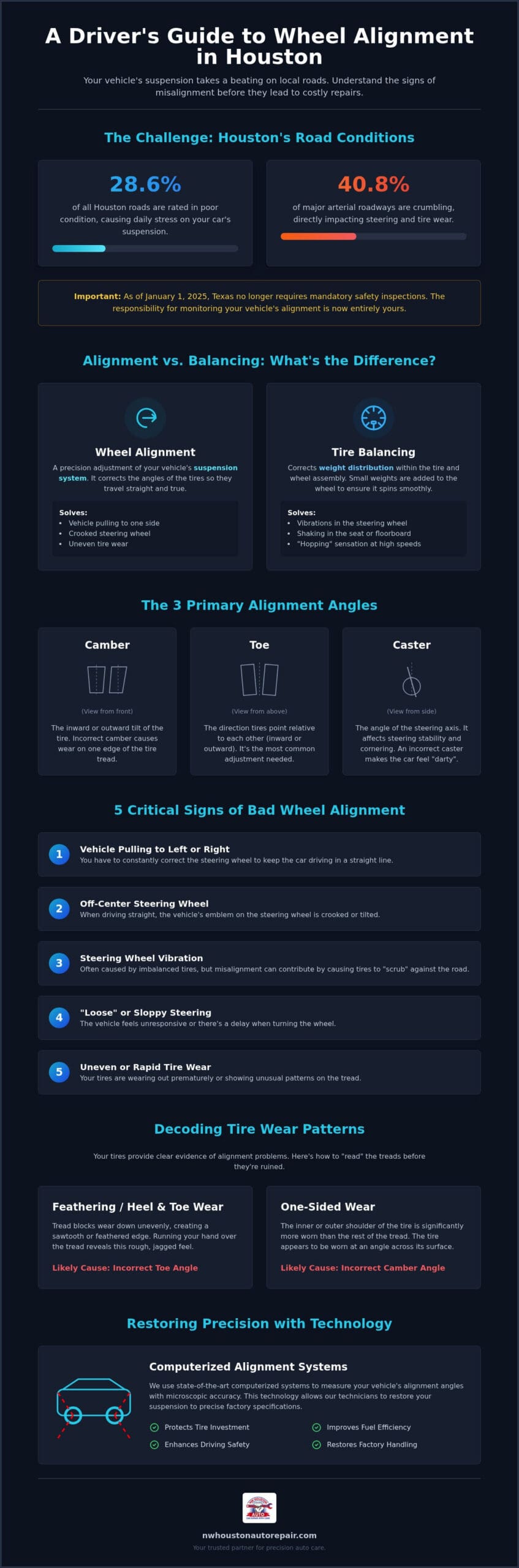
Did you know that nearly 28.6% of Houston roads are officially rated in poor condition? With 40.8% of our arterial roadways crumbling under heavy traffic and constant construction, your vehicle’s suspension takes a punishing beating every single day. It’s incredibly frustrating to feel your car constantly pulling toward the shoulder or to see your expensive tires wearing down months earlier than they should. We understand the stress of feeling a steering wheel vibration while navigating a heavy downpour on a congested highway. You deserve a vehicle that handles predictably and keeps your family safe.
In this guide, you’ll learn how to identify the most common signs of a bad wheel alignment before they lead to a dangerous blowout or an expensive repair bill. Since Texas ended mandatory safety inspections on January 1, 2025, the responsibility for monitoring your car’s steering and alignment rests entirely on you. We’ll show you exactly what to look for, explain why fixing it now saves you money, and help you find a trusted local partner for a precision fix. Let’s make sure your car is ready for whatever the Houston commute throws at it next.
Key Takeaways
- Understand that wheel alignment is a precision geometry adjustment of your suspension system, not just a tire service.
- Learn to identify the five most common signs of a bad wheel alignment, including vehicle pulling and an off-center steering wheel.
- Discover how to “read” your tire treads for feathering and heel/toe wear to catch handling issues before they ruin your tires.
- Recognize how Houston’s unique road challenges, from deep potholes to construction debris, directly impact your vehicle’s suspension settings.
- Explore how computerized alignment technology restores your vehicle’s factory-spec handling and protects your long-term tire investment.
Understanding Wheel Alignment: Why Precision Geometry Matters
Many drivers assume that a wheel alignment is a service performed on the tires themselves. In reality, it is a sophisticated adjustment of the vehicle’s suspension system, the complex network of components like control arms, ball joints, and tie rods that connect your car to its wheels. Think of it as a skeletal adjustment for your vehicle. When these mechanical parts shift out of place, you’ll start noticing the first signs of a bad wheel alignment, such as a subtle drift when you let go of the steering wheel on a flat road.
Precision geometry is the heart of this service. It ensures that the ‘contact patch’, which is the small area where your rubber actually meets the Houston asphalt, is perfectly flat and evenly distributed. If the geometry is off by even a fraction of a degree, your tires will drag across the pavement instead of rolling smoothly. Wheel alignment is the synchronization of tire angles to ensure the vehicle travels straight and true.
The Difference Between Alignment and Balancing
It’s easy to confuse these two services, but they solve entirely different problems. Tire balancing addresses weight distribution within the tire and wheel assembly. If a tire has a heavy spot, it causes a vertical hop that you feel as a vibration in your seat or floorboard. Conversely, a wheel alignment corrects the direction and angle at which the tires sit. While balancing stops the shaking, alignment stops the pulling and premature wear. Both are vital for a smooth ride, but they require different specialized equipment to fix properly.
Primary Alignment Angles: Camber, Toe, and Caster
To get a deeper Understanding Wheel Alignment, you have to look at the three primary angles our technicians measure during a suspension repair or check:
- Camber: This is the inward or outward tilt of the tire when viewed from the front of the car. Too much tilt in either direction causes the tire to ride on its edge rather than the full tread.
- Toe: This is the most common adjustment. It describes whether your tires turn inward (toe-in) or outward (toe-out) when viewed from directly above, much like being pigeon-toed or duck-footed.
- Caster: This angle views the steering axis from the side. It helps balance steering effort and stability. If your caster is off, your car might feel ‘darty’ or difficult to keep in a straight line, which are classic signs of a bad wheel alignment.
Our team uses computerized systems to measure these angles to a microscopic level of accuracy. This ensures your suspension is restored to factory specifications, protecting your tires and your safety on the road.
5 Critical Signs of a Bad Wheel Alignment You Should Not Ignore
Identifying the signs of a bad wheel alignment early can prevent a minor steering drift from turning into a dangerous safety hazard. When your suspension geometry is off, your vehicle essentially fights itself to stay on the road. This struggle creates heat and friction that destroys your tires and strains your steering components.
The most obvious symptom is vehicle pulling. You’ll feel a constant tug toward the left or right, requiring you to apply steady pressure to the wheel just to stay in your lane. Closely related is the off-center steering wheel. When you’re driving straight, your steering wheel’s logo should be perfectly level. If it’s cocked to the side even slightly, your alignment is definitely out of spec. Many drivers simply get used to a crooked wheel, but this is a clear warning that your tires aren’t pointing where they should be.
Don’t ignore a vibrating steering wheel. While this is often confused with wheel balance, misaligned tires can actually “scrub” against the pavement at opposing angles, creating a tremor through the column. Finally, watch for “loose” or “sloppy” steering. If your car feels unresponsive or takes a second to react when you turn the wheel, your alignment and steering components need immediate attention. According to the National Highway Traffic Safety Administration, maintaining proper tire health and alignment is critical for vehicle control, as detailed in their guide to Decoding Tire Wear Patterns. Ignoring these signs of a bad wheel alignment often leads to a much more expensive repair bill later.
The “Drift” Test: How to Safely Check for Pulling
To check your alignment, find a flat, level stretch of road with no traffic, like an empty parking lot. Briefly relax your grip on the wheel while traveling at a low, steady speed. Your car should continue in a straight line. Keep in mind that most roads have a “road crown,” a slight slope to the right designed for drainage. A tiny drift to the right might be normal, but a sharp veer or a pull to the left is a clear indicator of trouble. Fighting the wheel during a long Houston commute isn’t just exhausting; it’s a sign your car is working too hard. For drivers who face even greater stability challenges when towing a trailer, you can visit ProPride, Inc. to explore their advanced sway control solutions.
Sometimes, a sudden pull isn’t just a simple alignment issue but rather a damaged suspension component. Hitting one of Houston’s 51,000 potholes can easily bend a tie rod or damage a ball joint. Worn bushings or control arms can mimic alignment symptoms by allowing the wheels to shift under load. If your car handles unpredictably after a curb strike or collision, a professional car diagnostics check is the only way to confirm if you need a simple adjustment or a mechanical repair. If you’re feeling any of these symptoms, you can reach out to our team to schedule a precision inspection before the problem gets worse.
Decoding Tire Wear Patterns: What Your Treads Are Telling You
Your tires act as a visual report card for your vehicle’s suspension system. When everything is aligned, the rubber wears evenly across the entire surface. However, when the geometry shifts, the road begins to “record” those errors directly into your tread. Learning to read these marks is one of the most effective ways to catch the signs of a bad wheel alignment before you are forced to buy a new set of tires prematurely. According to the Car Care Council, checking for uneven tread is a primary way to spot signs of a bad alignment before handling becomes dangerous.
There are three specific patterns you should look for during your monthly inspection:
- Heel/Toe Wear: This creates a “sawtooth” appearance when viewed from the side. One side of the individual tread blocks wears down faster than the other, which often causes a noticeable humming sound at highway speeds.
- Feathering: This is a tactile symptom. If you run your hand across the tire ribs, the rubber feels smooth in one direction but sharp or jagged in the other. It usually indicates a “toe” setting that is significantly out of spec.
- Camber Wear: This is characterized by the inside or outside edge of the tire wearing down to the cords while the rest of the tread looks nearly new. It means the tire is leaning too far inward or outward.
Crucially, once these wear patterns are established, they often cannot be reversed. Even if we fix the alignment, the existing “memory” in the rubber will continue to cause noise or vibration. We can stop the damage from getting worse, but we cannot put the rubber back on the tire.
The Penny Test and Visual Inspections
A simple penny is your best diagnostic tool. Insert it into the tread grooves with Lincoln’s head upside down. If you can see the top of his head, your tread is too thin. Perform this test across the entire width of the tire. It is critical to check the “inner edge” specifically, as this area is often hidden from view by the wheel well. We recommend a professional tire rotation every 6,000 miles, which gives our technicians a chance to spot these developing patterns early.
How Misalignment Slashes Your Tire Life
When your wheels aren’t pointing straight, they undergo a process called “scrubbing.” Instead of rolling freely, the tires are essentially dragged sideways across the pavement. This acts like heavy-grit sandpaper on the rubber. A vehicle that is severely out of alignment can reduce total tire life by thousands of miles in just a few weeks of commuting. This is why we always prioritize a precision wheel alignment whenever you invest in new tires. It is the only way to protect your investment and ensure you get every mile you paid for.
How Houston Roads and Driving Habits Impact Your Alignment
Your car’s suspension is under constant siege on our local streets. While city crews work hard to patch the thousands of potholes that appear every year, the sheer volume of traffic on routes like the 610 Loop and Beltway 8 keeps the pavement in a state of flux. A single, jarring hit against a deep pavement gap or a sharp curb strike while parking can instantly bend a tie rod or knock a strut out of position. These mechanical shifts are the primary reasons you start noticing the signs of a bad wheel alignment during your daily commute.
The rapid growth in NW Houston also means you are likely navigating frequent construction zones. Driving over uneven pavement, metal plates, and road debris causes your suspension settings to shift gradually. Even if you avoid major impacts, the intense Houston heat plays a significant role in your vehicle’s health. Extreme temperatures accelerate the deterioration of rubber bushings and seals that hold your suspension components in place. When these parts dry out and crack, they lose their ability to maintain precise factory geometry. This leads to sagging springs and a slow drift in your alignment that you might not notice until your tires are already ruined.
Post-Collision Realities
If you’ve been involved in an accident, a professional collision repair is never truly complete without a precision alignment check. Even a minor “fender bender” can cause subtle frame shifts that aren’t visible to the naked eye. These shifts create a “dog-tracking” effect where the rear wheels don’t follow the front wheels correctly, leading to rapid tire wear and poor fuel economy. For a deeper look at the technical specifications our team has used since 1999, you can review our Precision Wheel Alignment in Houston reference guide.
When to Schedule a Check-Up
We recommend a professional alignment check every 6,000 miles to stay ahead of potential issues. A convenient way to remember this is to schedule it with every other oil change. However, don’t wait for a specific mileage milestone if you hit a major hazard or notice your car handling differently. Incorporating these inspections into your routine car maintenance prevents small geometry errors from becoming expensive mechanical repairs. If you suspect your vehicle has been compromised by a recent pothole hit, schedule an inspection with our specialists today to protect your tires and your safety.
Restoring Precision: The NW Houston Auto Repair Approach
At NW Houston Auto Repair and Collision, we know that a “close enough” alignment isn’t good enough for our neighbors. When you bring your vehicle to us because you’ve noticed the signs of a bad wheel alignment, we begin with a rigorous multi-point inspection. We examine your ball joints, tie rods, and control arm bushings to ensure there isn’t hidden mechanical damage masking a simple geometry issue. Our team has been family-owned and operated since 1999, and we’ve built our reputation on the belief that safety should never be a guessing game.
We utilize advanced computerized alignment systems to achieve microscopic accuracy. These systems allow our technicians to visualize your suspension angles in real-time, making adjustments that are precise to within a fraction of a degree. This isn’t just about technical mastery; it’s about providing a service that restores your car’s factory-new handling. We don’t just fix cars. We protect people. We treat every vehicle that enters our bays as if it were our own family car. This blend of high-tech precision and neighborly warmth is what sets us apart in the NW Houston community.
Beyond the Alignment: A Full Vehicle Health Check
A true precision fix requires looking at the bigger picture. During your visit, we don’t just adjust the angles and send you on your way. We verify that your tire pressure is set correctly, as uneven pressure can mimic the signs of a bad wheel alignment. Our technicians also look at critical safety points during a brake service check to ensure your stopping power matches your improved handling. We believe a comprehensive vehicle inspection is the best way to provide you with total peace of mind on the road.
Schedule Your Precision Alignment Today
Don’t let a minor drift turn into a major tire expense. If your steering wheel is off-center or your car is pulling toward the shoulder, it’s time to act. Our convenient NW Houston location is equipped to handle everything from routine maintenance to complex collision restorations with transparency and respect. Stop fighting your steering wheel and start enjoying a smoother, safer ride. Schedule your precision wheel alignment at NW Houston Auto Repair today and experience the difference that over 25 years of local expertise makes.
Protect Your Tires and Regain Control of Your Commute
Don’t let your car’s handling become a source of daily anxiety. Houston roads are tough, but your vehicle doesn’t have to suffer. By staying alert to the signs of a bad wheel alignment, you protect your expensive tires and ensure your steering remains responsive during heavy rain or highway merges. Whether it’s a crooked wheel or an unusual vibration, these symptoms are your car’s way of asking for a precision adjustment. Catching these issues early prevents small geometry errors from turning into costly mechanical failures.
Our team has been family-owned and operated since 1999. We combine the neighborly care of a local shop with the advanced computerized alignment technology required for modern vehicles. As suspension and collision experts, we go beyond simple fixes to ensure your entire steering system is dependable and safe. Stop fighting the drift and regain the smooth ride you deserve. Schedule your professional wheel alignment at NW Houston Auto Repair today! We look forward to keeping you and your property safe on the road.
Frequently Asked Questions
How much does a wheel alignment typically cost in Houston?
Prices for a wheel alignment in Houston vary depending on whether you need a two-wheel or four-wheel service and the complexity of your vehicle’s steering sensors. While some local shops offer basic alignments starting at lower rates, premium services involving steering angle resets typically cost more. It’s best to request a transparent quote that includes a full suspension inspection to ensure you aren’t paying for a “quick fix” that ignores underlying mechanical wear.
How long does a wheel alignment service take?
A standard wheel alignment service usually takes between 45 minutes and an hour under normal conditions. However, if our technicians discover seized bolts, heavily rusted components, or damaged suspension parts during the initial inspection, the process can take longer. We use computerized technology to speed up the measurement process, but we never rush the precision adjustments. We want to ensure your vehicle leaves our shop handling perfectly and safely for your commute.
Can I drive with a bad wheel alignment for a long time?
You shouldn’t drive with a bad alignment for an extended period because it creates a snowball effect of expensive problems. Ignoring the signs of a bad wheel alignment forces your tires to drag sideways, which can destroy a brand-new set of treads in just a few thousand miles. Beyond the financial cost, it compromises your safety by making the vehicle harder to control during emergency maneuvers. Correcting the issue early is always the most affordable choice.
Will a wheel alignment fix my steering wheel vibration?
A wheel alignment might fix a vibration if the tires are “scrubbing” against each other, but tremors are often caused by out-of-balance wheels or worn suspension parts. During our diagnostic process, we check for all potential causes. If the vibration occurs only at specific highway speeds, it’s likely a balancing issue. If it’s accompanied by a constant pull, it’s one of the classic signs of a bad wheel alignment that requires immediate geometry correction.
Do I need an alignment after getting new tires?
Yes, we highly recommend a wheel alignment whenever you invest in a new set of tires. Whether you are replacing factory tires or researching custom fitments with the Platinum Wheels tire size calculator, checking the suspension geometry is essential to prevent premature wear. An alignment ensures your new tires make flat, even contact with the road from day one. This simple step protects your investment and ensures you get the full mileage and fuel efficiency promised by the manufacturer.
Performing only a front-end alignment ignores the rear wheels that track the vehicle’s path. If the rear wheels are misaligned, the car may “dog-track,” meaning it travels at a slight angle even when the front wheels are straight. This causes uneven wear on all four tires and can interfere with modern electronic stability control systems. A comprehensive four-wheel alignment is the only way to ensure total vehicle harmony and predictable handling on the road.
Can a bad alignment affect my gas mileage?
Poor alignment definitely reduces your fuel efficiency because it increases rolling resistance. When your wheels aren’t pointing straight, your engine has to work harder to overcome the friction of tires dragging across the pavement. This extra effort consumes more fuel over every mile you drive. By restoring precision geometry, you reduce the strain on your powertrain and can see a noticeable improvement in your miles-per-gallon during those long, daily Houston commutes.
Is a wheel alignment covered by most car warranties?
Most new car warranties only cover wheel alignment for a very limited time, such as the first 12,000 miles or one year, because it’s considered a maintenance item. Alignment settings naturally shift due to potholes, curb strikes, and normal wear. Unless the misalignment is caused by a defective factory part, most extended or third-party warranties won’t cover the cost. It’s always a good idea to check your specific policy’s maintenance exclusions before scheduling service.