

What if your vehicle’s air conditioner is actually a safety-critical dehumidification system rather than just a luxury? In the thick of a Gulf Coast summer, a failing AC system turns every commute into an exhausting battle against stifling heat and unbearable humidity. You’re likely dreading an expensive compressor replacement or feeling confused by the industry shift toward newer refrigerants like R-1234yf. It’s stressful to wonder if a simple top-off will fix the problem or if there’s a hidden leak draining your wallet. We understand that local drivers need a dependable partner who prioritizes transparency over a quick fix.
This guide provides the expert insights you need to master a car ac recharge houston and restore ice-cold air to your cabin. You’ll discover the critical differences between R-134a and the latest environmentally friendly refrigerants mandated for 2026 models. We’ll also explain how precision diagnostics can identify leaks early, potentially saving you from major mechanical failures down the road. Stick with us as we break down the technical side of climate control with the neighborly warmth you expect from a family-run shop that’s served the community since 1999.
Key Takeaways
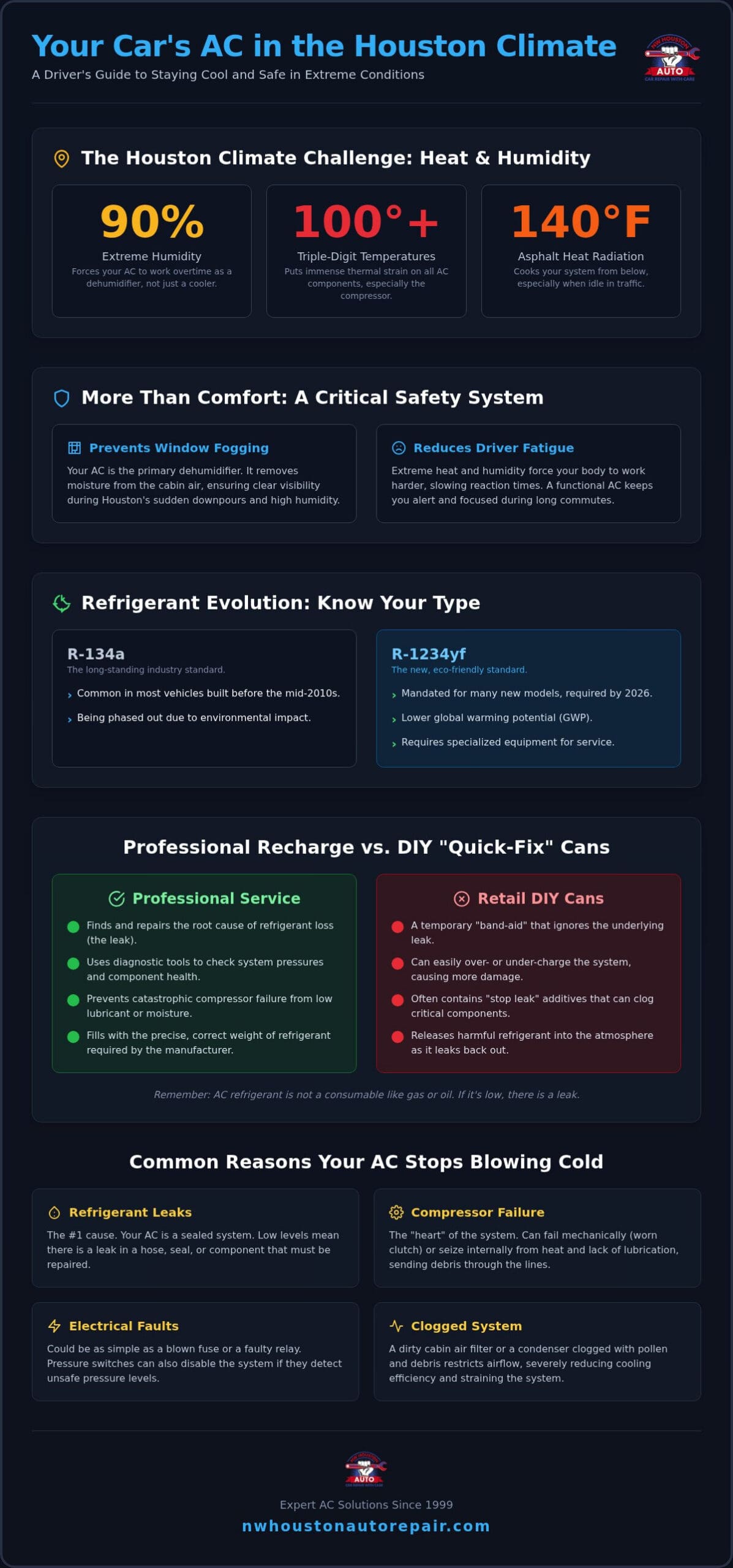
- Understand why your vehicle’s AC is a safety-critical dehumidification system, especially when battling Houston’s extreme 90% humidity levels.
- Learn why a professional car ac recharge houston is superior to “quick-fix” retail cans by identifying underlying leaks before they lead to expensive compressor failure.
- Navigate the transition between R-134a and R-1234yf refrigerants to ensure your newer 2026 model receives the precise cooling agent it requires.
- Identify early warning signs of system trouble, such as musty odors or a failing compressor clutch, to prevent small issues from becoming major repairs.
- Discover how precision diagnostics and collision-related AC restoration can keep your cabin ice-cold through the harshest Texas summers.
Understanding Car AC Performance in the Houston Climate
Your car’s air conditioning isn’t just a luxury for staying cool; it’s a complex heat-exchange loop designed to move thermal energy from inside the cabin to the outside air. While people often focus on the temperature drop, the system’s most critical job in Southeast Texas is removing moisture. Since 1999, we’ve seen how the history of automotive air conditioning has evolved toward higher efficiency, yet the basic physics remains the same. When you request a car ac recharge houston, you’re essentially restoring the system’s ability to carry that heat and humidity away from your family.
Houston’s notorious 90% humidity levels transform dehumidification into a safety necessity. Excessive moisture inside the car causes windows to fog rapidly, obscuring your vision during those sudden afternoon downpours. Beyond visibility, high heat and humidity contribute significantly to driver fatigue. A struggling AC system forces your body to work harder to stay cool, which slows reaction times during long Texas commutes. Because our local temperatures often hover near triple digits, your compressor works twice as hard as it would in a milder climate, making regular maintenance vital for long-term reliability.
The Science of Dehumidification and Cabin Health
The evaporator core acts as the front line for cabin health. As warm, moist air passes over the cold fins of the evaporator, the water vapor condenses into liquid and drains out of the vehicle. The evaporator core serves as the primary moisture-stripping component, ensuring the air circulating through your cabin remains dry enough to prevent window fogging and mold growth. If your cabin air filter is clogged with dust or pollen, airflow drops significantly. This restriction forces the system to run longer cycles, reducing overall cooling efficiency and putting unnecessary strain on your auto air conditioning repair needs.
Why Houston Traffic Brutalizes Your AC System
Idling on the Katy Freeway or I-45 presents a unique challenge for your vehicle. When you’re stationary, there’s no natural “ram air” hitting the condenser to help dissipate heat. Your condenser fan must work overtime to pull air through the system and maintain safe operating pressures. This task is made even harder by 140°F asphalt temperatures that radiate heat directly into your car’s undercarriage. These extreme conditions can cause pressures to spike, which is why a professional car ac recharge houston involves more than just adding gas; it requires verifying that your system can handle the brutal thermal load of a Houston traffic jam.
Common Reasons Your Car AC Stops Blowing Cold
Discovering warm air blowing from your vents during a Houston afternoon is a frustrating experience. While many drivers assume they just need a quick car ac recharge houston, refrigerant isn’t a consumable fluid like gasoline or oil. Your AC is a sealed, closed-loop system. If the refrigerant level is low, it means there’s a leak in a hose, seal, or component. Simply “topping it off” is a temporary band-aid that ignores the underlying issue and can lead to more expensive repairs as moisture enters the system.
The compressor serves as the heart of your climate control. It pumps refrigerant through the system at high pressure, but Houston’s extreme heat puts immense strain on its internal components. When the lubricating oil inside the system breaks down due to high thermal loads, the compressor can seize entirely. This often leads to internal mechanical failure that sends metal debris through the lines, requiring a complete system flush and component replacement to restore cooling.
Mechanical vs. Electrical AC Failures
Troubleshooting often starts with determining if the failure is mechanical or electrical. A common mechanical issue is a worn compressor clutch that no longer engages when you press the AC button. However, the problem could be as simple as a blown fuse or a faulty relay. Modern vehicles also use pressure switches as safety guardians; they disable the system if they detect pressures that are too high or too low. Because these systems are increasingly complex, our team specializes in auto electrical repair to find these invisible gremlins without wasting your time on unnecessary parts.
Environmental Factors: Dust, Pollen, and Debris
Houston’s unique ecosystem also plays a role in AC performance. Thick pine pollen and road debris can coat the condenser fins, which are located right behind your front grille. This “blanket” of debris prevents heat from escaping, causing the system to run at dangerously high pressures. Inside the cabin, a neglected air filter restricts airflow and forces the blower motor to work harder, eventually leading to its premature failure.
It is also vital to distinguish between different types of leaks. If you notice a sweet, syrup-like smell and fog on the inside of your windshield, you might have a leaking heater core rather than an AC issue. Conversely, musty odors often point to a leaking evaporator or a clogged drain line. Today’s vehicles use environmentally friendly refrigerants like R-1234yf, which require specialized handling and precision tools to service correctly. If your cabin isn’t staying ice-cold, reach out to our local team for a comprehensive diagnostic check before the next heatwave hits.
AC Recharge vs. Precision Repair: Choosing the Right Solution
Refrigerant is the lifeblood of your cooling system, but it never simply evaporates or gets “used up” like fuel. If your vents aren’t blowing cold, the fluid has escaped through a breach in the system. While some shops might offer a quick “top-off,” this ignores the fundamental physics of your vehicle. A professional car ac recharge houston involves a meticulous process of identifying the leak first, rather than just masking the symptom with more gas.
A professional service follows a strict protocol known as evacuation and recharge. Our technicians use specialized vacuum pumps to remove every trace of air and moisture from the lines. Moisture is the ultimate enemy of an AC system; it reacts with refrigerant to create acids that eat your components from the inside out. Following professional refrigerant handling guidelines ensures that old, contaminated oil is replaced with fresh lubricant, protecting your compressor from a premature death in the Texas heat.
Avoid the temptation of DIY “recharge cans” found at local retail stores. These products often contain chemical stop-leak sealants that claim to fix holes in hoses or seals. In reality, these sealants can gum up the delicate expansion valves and orifices of your system. Once a stop-leak product contaminates your lines, it can make future professional repairs impossible or significantly more expensive because the sealant clogs our recovery equipment.
The Shift to R-1234yf Refrigerant
Owners of vehicles built after 2018 need to be aware of the industry shift toward R-1234yf. This newer, eco-friendly refrigerant has a much lower global warming potential, but it requires highly specialized equipment to service. You can’t simply swap fluids; using the wrong gas will cause immediate and catastrophic damage. We provide expert car air conditioner repair for these modern systems, ensuring the precise weight of refrigerant is used down to the ounce.
When a Simple Recharge Isn’t the Answer
Microscopic leaks are common in the high-vibration environment of a car engine. If your AC works for a week after a recharge and then fails again, you have a mechanical breach that needs attention. We utilize UV dye tests to track down these invisible cracks in condensers or evaporator cores. For those concerned about the investment, we recommend reviewing our car ac repair cost houston guide to understand how early detection prevents the need for a total system overhaul.
Troubleshooting and Maintenance: A 2026 Driver’s Checklist
Before you schedule a car ac recharge houston, you can perform a few simple checks from your own driveway. Start your engine and turn the AC to its maximum setting. Listen for a clear, metallic “click” from the engine bay. This sound indicates the compressor clutch is engaging properly. If you hear silence instead, your system might be locked out due to low refrigerant pressure or a blown fuse. Next, take a flashlight and peer through your front grille. Look for bent fins or accumulated road debris on the condenser. Even a small plastic bag caught in the intake can significantly reduce cooling efficiency during a Texas heatwave.
Don’t ignore what your nose tells you. A musty or vinegar-like odor often indicates bacterial growth on the evaporator core, which thrives in our high-humidity environment. Additionally, check your passenger-side floorboard for dampness. Wet carpets usually point to a clogged evaporator drain line. When this drain is blocked, water backs up into the cabin instead of dripping onto the pavement. These small signs are your vehicle’s way of asking for attention before a minor blockage turns into a major repair bill.
Warning Signs You Should Not Ignore
Pay close attention to unusual sounds. A high-pitched squeal when the AC starts could mean your serpentine belt is slipping, or it might signal a failing compressor pulley. If you notice your headlights dimming significantly when the cooling kicks in, you should check our guide on car alternator repair houston to ensure your electrical system can handle the load. Intermittent cooling is another common red flag. If your air is ice-cold at 8:00 AM but turns lukewarm at noon, your system is likely struggling with a minor leak or a failing expansion valve that can’t keep up with peak thermal stress.
Preventive Maintenance for the Texas Summer
Preventive care is your best defense against expensive failures. Replace your cabin air filter every 12 months to maintain high airflow and protect your blower motor from overworking. We also recommend running your AC for at least ten minutes once a month during the winter. This simple habit keeps internal seals lubricated and prevents them from drying out and leaking. A professional system evaluation in early spring is far better than waiting for a June breakdown. Schedule your pre-summer AC inspection today to ensure your vehicle is ready for the road.
Master-Level AC Solutions at NW Houston Auto Repair
At NW Houston Auto Repair and Collision, we’ve spent decades refining a precision diagnostic process that moves beyond the “quick charge” mentality common at corporate chains. When you bring your vehicle in for a car ac recharge houston, you aren’t just getting a refill. You’re getting a comprehensive evaluation from a family-owned shop that has served this community since 1999. We understand that your time and money are valuable, so we focus on fixing the root cause rather than just masking a symptom.
Transparency is the cornerstone of our business. If your system has a breach, we don’t just tell you; we show you. Whether it’s a glowing UV dye trace on a hose or an electronic leak detector pinpointing a porous evaporator, we believe you should understand exactly where your investment is going. This honest approach has made us a dependable partner for thousands of local drivers who want technical mastery without the stiff corporate language.
Our expertise also extends into specialized collision repair. Front-end impacts frequently damage the condenser, receiver-drier, or delicate aluminum lines. We don’t just fix the bodywork; we restore the entire climate control loop to factory specifications. This integrated approach ensures your cabin remains a refuge from the Texas sun, even after significant vehicle malfunctions or accidents.
Why Precision Mastery Matters for Your Comfort
Precision mastery is essential for modern vehicles. Our team utilizes advanced refrigerant recovery systems to prevent contamination and ensure environmental safety. We stay ahead of the curve with specialized training on the 2026 R-1234yf standards, which require more delicate handling and higher accuracy than older systems. Our auto air conditioning service is designed for long-term reliability, providing you with the peace of mind that your car will stay ice-cold during the most brutal Houston commutes.
Schedule Your AC Check Today
Don’t wait until the first triple-digit day to realize your cooling is failing. Beat the summer rush by booking your inspection in early spring when our schedule is more flexible. We take pride in our heritage as a bold problem-solver that keeps your property dependable and your family safe. Book your Houston AC service now to experience the difference that 25 years of technical mastery and neighborly care can make for your vehicle.
Secure Your Cabin Comfort for the Seasons Ahead
Don’t let the stifling Texas humidity compromise your safety or your peace of mind behind the wheel. We’ve explored how a functional AC system is essential for visibility and driver focus; it is far more than a luxury. By choosing professional diagnostics over temporary retail solutions, you protect your vehicle’s complex components from expensive mechanical failures. Whether your car requires a modern R-1234yf service or a standard car ac recharge houston, precision matters.
Since 1999, our family-owned shop has specialized in complex auto electrical and AC diagnostics to keep our neighbors on the road. We take pride in our technical mastery and our commitment to transparent, honest service. You deserve a dependable partner who treats your vehicle with the care it deserves. Take action before the next heatwave transforms your commute into an ordeal.
Beat the Heat with Professional AC Repair in NW Houston
Stay cool, stay safe, and enjoy the drive. We are here to keep your vehicle dependable for years to come.
Frequently Asked Questions
How much does it cost to fix a car air conditioner in Houston?
Fixing a car’s climate control varies significantly based on the specific failure. A simple leak repair is very different from a full compressor replacement. We prioritize a thorough diagnostic process to find the exact source of the trouble before recommending any work. This transparency ensures you only pay for what your vehicle actually needs to stay cool during the most brutal Houston summers.
Why is my car AC blowing cold air then suddenly turning warm?
This symptom often points to a compressor clutch failure or a freezing evaporator core. When the system detects extreme pressure or temperature fluctuations, it may shut down as a safety precaution. In our local climate, high humidity can cause moisture to freeze on the evaporator fins, blocking airflow. Professional troubleshooting is necessary to determine if the issue is a mechanical part or an electrical sensor malfunction.
Can I just use a DIY recharge kit from an auto parts store?
We strongly advise against using retail “recharge cans” found in auto parts stores. Many of these products contain stop-leak additives that can permanently damage your internal components and gum up professional recovery machines. A proper car ac recharge houston requires a vacuum pump to remove moisture and air. DIY kits skip this critical step, which often leads to acidic corrosion inside your lines.
How long should a professional car AC recharge last?
A professional recharge should last for the remaining life of the vehicle if the system is completely sealed. Since air conditioning is a closed loop, the refrigerant does not get consumed or evaporate over time. If your cooling fades after a few months, it indicates a leak in a hose, seal, or component that requires a precision repair rather than just another fluid top-off.
What is the difference between R-134a and R-1234yf refrigerant?
R-134a was the industry standard for decades, but most vehicles built after 2018 use R-1234yf. This newer fluid is more environmentally friendly but requires specialized equipment and training to handle safely. These refrigerants are not interchangeable; using the wrong one can cause catastrophic damage to your compressor. Our technicians are fully equipped to service both older and modern systems with factory-level precision.
Why does my car’s air conditioning smell like dirty socks?
Musty odors are usually caused by bacterial growth on the evaporator core. Houston’s 90% humidity creates a damp environment where mold can thrive inside your dashboard. We can treat the system to neutralize these odors and ensure your cabin air remains fresh. Regularly replacing your cabin air filter also helps prevent debris from accumulating and contributing to these unpleasant smells.
Does a broken AC affect my car’s gas mileage or engine performance?
A malfunctioning AC system can definitely impact your vehicle’s efficiency. If a compressor is partially seized, it creates excessive mechanical drag on the engine, forcing it to work harder and burn more fuel. Additionally, driving with your windows down at highway speeds to compensate for a broken AC increases aerodynamic drag, which often reduces your gas mileage more than running a healthy air conditioner would.
How often should I have my car’s AC system inspected in Houston?
We recommend a professional system evaluation at least once a year. The best time to schedule a car ac recharge houston or a general inspection is early spring, well before the first major heatwave hits in June. Regular checks allow us to identify microscopic leaks or worn serpentine belts before they lead to a total breakdown. Consistent maintenance is the most affordable way to ensure long-term cabin comfort.