

You’re sitting at a red light on the West Loop when a sudden jolt sends your coffee flying and your heart racing. It’s just a minor tap, but in a city as fast-paced as ours, even a small bump can feel overwhelming. You’re likely wondering about insurance hikes, how to handle an aggressive driver, or the specifics of what to do after a minor car accident in Houston to stay legally compliant. It’s a stressful situation that requires a calm head and a clear plan.
We understand that your vehicle is more than just a way to get from point A to point B; it’s a vital part of your daily life. This guide provides a comprehensive 2026 recovery checklist designed to give you total confidence during the aftermath of a fender-bender. You’ll learn how to manage the Texas $1,000 damage reporting threshold and why professional collision repair is essential for catching hidden mechanical issues. We’ll cover on-scene safety protocols, legal requirements, and the best path toward restoring your car to its original, dependable condition.
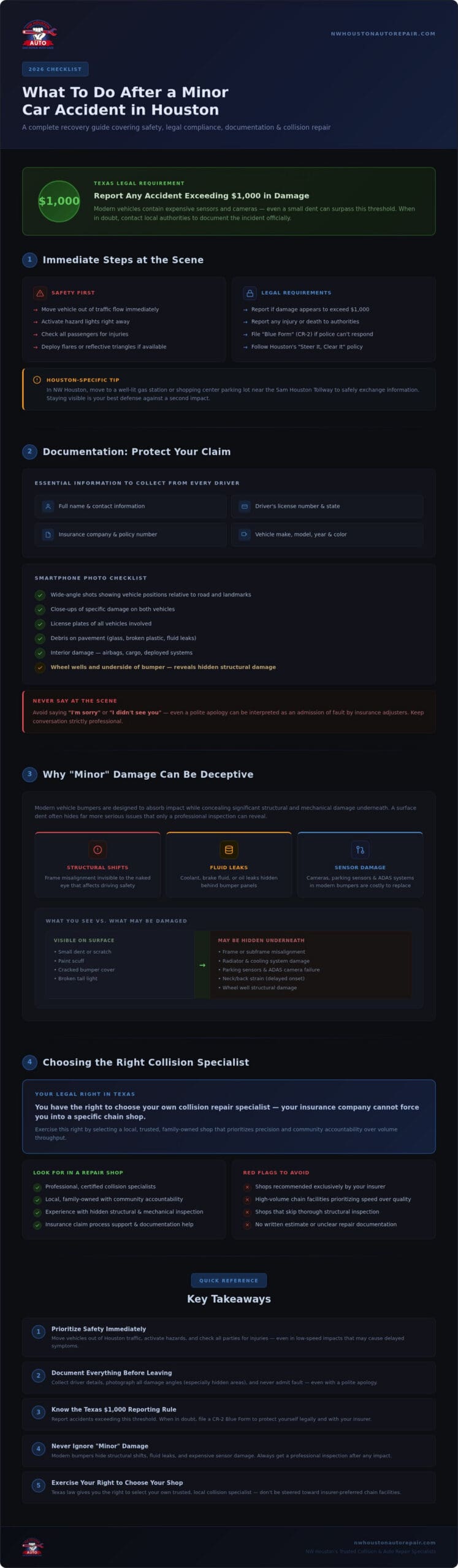
Key Takeaways
- Prioritize immediate safety by moving vehicles out of Houston traffic and checking all parties for injuries, even in low-speed impacts.
- Learn exactly what to do after a minor car accident in Houston to document the scene properly and protect your insurance claim without admitting fault.
- Exercise your legal right in Texas to choose your own trusted collision specialist rather than being forced into a big-box chain facility.
- Identify the hidden mechanical and structural risks that modern bumpers often conceal after a fender-bender.
- Restore your vehicle to its original condition by choosing a local, family-owned shop that emphasizes precision and community trust.
Immediate Steps at the Scene: Safety and Legal Compliance
The immediate seconds after a fender-bender on a busy Houston road are often the most critical. Your adrenaline is high, but you need to act decisively to protect yourself and others. Start by assessing the situation for any immediate danger. If your vehicle is still operational, move it out of the flow of traffic. This simple act prevents secondary accidents, which are common on high-speed stretches like the Beltway or 290. Once you’re in a safe spot, check every passenger for injuries. Even low-speed impacts can cause significant neck or back strain that doesn’t manifest until hours later. If anyone feels pain, call for medical assistance immediately.
Knowing what to do after a minor car accident in Houston involves understanding local legal requirements. In Texas, drivers are required to report any accident that results in injury, death, or property damage that appears to exceed $1,000. While a thousand dollars might have sounded like a lot years ago, modern vehicles are packed with expensive sensors and cameras. A small dent in a bumper can easily surpass this threshold. If you’re unsure, it’s always safer to contact local authorities to document the incident officially.
Navigating Houston Traffic Safety
Houston’s “Steer It, Clear It” policy is designed to keep our freeways moving. If you’re involved in a minor wreck without injuries, move your car to the shoulder or the nearest exit. In NW Houston, look for well-lit gas stations or shopping center parking lots near the Sam Houston Tollway to exchange information. Always activate your hazard lights immediately. If you have flares or reflective triangles in your emergency kit, use them to alert other drivers. For those outside the Texas area, you can learn more about Dependable Towing & Recovery Services to find similar 24-hour roadside and recovery support in British Columbia. Houston traffic is unpredictable; staying visible is your best defense against a second impact.
According to the Texas Transportation Code, you must notify law enforcement if the damage is significant or if there are injuries. A formal police report provides an objective record of the event. This document is vital when you file a collision repair Houston insurance claim. It prevents the other driver from changing their story later. If Houston police or Harris County deputies are unable to respond because the scene is “no-injury,” you should still file a “Blue Form” (CR-2) driver’s crash report. This ensures you have a paper trail for your insurance provider and legal protection.
Documenting the Incident: Protecting Your Vehicle and Claim
Once you’ve moved to a safe location, your focus must shift to gathering evidence. Documentation is your strongest shield against insurance disputes or repair delays. Knowing exactly what to do after a minor car accident in Houston means collecting more than just a phone number. You need a complete digital and written record of the event before anyone leaves the scene. This data ensures that your insurance provider has the facts they need to process your claim efficiently.
The Essential Information Exchange
Approach the other driver calmly. You must exchange specific details to satisfy Texas legal and insurance requirements. Collect the following information from every driver involved:
- Full name and current contact information.
- Driver’s license number and the state that issued it.
- Insurance company name and the specific policy number.
- Vehicle make, model, year, and color.
Keep the conversation strictly professional. Avoid apologizing or saying things like “I didn’t see you.” Even a polite “I’m sorry” can be interpreted as an admission of fault by insurance adjusters later. If the other driver refuses to provide their insurance details, don’t argue with them. Simply record their license plate number, take a photo of their car, and wait for law enforcement to arrive to handle the exchange.
Photography for Collision Restoration
Your smartphone is a powerful tool for ensuring your vehicle is restored correctly. Start with wide-angle shots that show the position of both vehicles relative to the road and nearby landmarks. These “context shots” help adjusters understand the mechanics of the impact. Next, take clear close-ups of the specific damage on both cars. Don’t forget to photograph license plates and any debris, such as broken glass or plastic, lying on the pavement. You should also take pictures of the interior if any airbags deployed or if cargo was damaged.
It is vital to capture images of often-overlooked spots, specifically focusing on hidden areas like wheel wells and the underside of the bumper. These photos often reveal structural shifts or fluid leaks that a surface-level glance might miss. If you’re concerned about the roadworthiness of your vehicle after seeing the damage, get in touch with a local expert to discuss your situation.
Finally, record the environmental factors. Houston’s weather can change in an instant; wet pavement or low sun glare can play a major role in how a minor collision happens. Note the exact time and the specific intersection or block number. If bystanders saw the impact, ask for their names and phone numbers. Their independent accounts are often the deciding factor in complex insurance claims where stories might conflict.
Dealing with Insurance and Initial Estimates
Once you’ve secured your scene documentation, notify your insurance provider immediately. Most policies require prompt reporting; even for minor fender-benders, delays can complicate your claim. When you call, stick to the facts you recorded at the scene. Don’t guess about damage costs or fault; simply state that an incident occurred and you’re beginning the recovery process. This is a vital part of what to do after a minor car accident in Houston to ensure your coverage remains intact and the clock starts on your claim. Have your photos and the other driver’s information ready before you dial.
Your Right to Choose a Repair Shop
Many drivers feel pressured to use an insurance company’s “preferred” shop. These corporate chains often prioritize the insurer’s bottom line by using aftermarket parts or rushed labor schedules. In Texas, you have the legal right to select any auto body repair facility you trust. A local, family-owned shop works for you, not the insurance giant. We emphasize technical mastery and safety because we’ve served the Houston community since 1999. We’ll identify every issue, from a scuffed bumper to a compromised sensor, ensuring your car returns to its pre-accident condition. You don’t have to settle for the shop the insurance company suggests.
Scrutinizing Initial Claims Estimates
Expect the first estimate from an insurance adjuster to be lower than the actual cost of a quality restoration. Adjusters often base these figures on a surface-level visual inspection or photos from a smartphone app. This approach frequently misses hidden structural damage or internal mechanical faults that aren’t visible from the outside. If you are wondering what to do after a minor car accident in Houston when the estimate seems too low, remember that the first number isn’t final. If the initial check doesn’t cover the full restoration, our team will file a “supplemental” claim. This standard process involves documenting the additional damage found during the vehicle teardown and submitting it to the insurer for approval. For more detailed advice on handling these early stages, read our guide on collision repair. We take pride in our transparent approach to service and will walk you through every line item on the estimate so you understand exactly what your car needs.
Why “Minor” Damage Can Be Deceptive
A parking lot tap might leave nothing but a scuff on the plastic. Don’t let that fool you. Modern vehicles use energy-absorbing materials designed to protect passengers by sacrificing the car’s internal structure. This means the exterior plastic bumper often pops back into shape, hiding crushed brackets or cracked reinforcement bars underneath. When a bumper absorbs an impact, the energy has to go somewhere. Often, it travels through the frame rails, causing subtle shifts that aren’t visible without specialized measuring equipment. Part of knowing what to do after a minor car accident in Houston is recognizing that a visual check is never enough. You need a professional diagnostic to ensure the car’s safety systems are still functional and reliable.
Hidden Mechanical and Electrical Issues
Even a low-speed impact can send a significant shock through the chassis. This force often results in the need for a precision wheel alignment. If your steering wheel feels slightly off-center or the car pulls to one side, the suspension components have likely shifted out of spec. Additionally, modern bumpers are crowded with Advanced Driver Assistance Systems (ADAS) sensors. These delicate components control your blind-spot monitoring, parking cameras, and automatic braking. A jarring impact can misalign these sensors or crack internal wiring, necessitating expert auto electrical repair to restore your vehicle’s safety features. Ignoring these faults can lead to safety system failures when you need them most.
The Importance of Paint Correction
Houston’s humidity is relentless and unforgiving. A small chip in your clear coat is an open invitation for oxidation to take hold. If left untreated, a minor scratch becomes a focal point for rust that can spread quickly beneath the surrounding paint layers. Professional auto paint correction goes far beyond a simple touch-up pen. It involves meticulously leveling the surface, matching the factory color, and resealing the area to provide a durable barrier against the elements. This process protects the underlying metal and preserves the vehicle’s resale value over the long term. For a deeper look at typical fixes our team handles, see our guide on The 5 Most Common Collision Repairs in Houston.
Our family-owned shop has been identifying these hidden issues since 1999, ensuring that a “minor” wreck doesn’t turn into a major mechanical failure down the road. We take pride in our technical mastery and our commitment to keeping your property dependable. If you suspect your vehicle has hidden damage after a recent bump, schedule a comprehensive inspection with our experts today to ensure your peace of mind.
Choosing the Right Houston Collision Specialist
Selecting a repair facility is the final, most critical step in your recovery. You need a partner who values your safety as much as you do. While many shops focus on quick cosmetic fixes to satisfy insurance quotas, a true specialist looks deeper. They provide a comprehensive diagnostic of all vehicle systems to ensure no structural or mechanical compromise remains. Transparency is the bedrock of a good relationship; you should receive clear, methodical explanations of every repair and a fair, honest pricing structure. For those in other locations, such as New Zealand, using a trusted resource like My Auto Shop can help you find professional mechanics who maintain these same high standards of care.
Deciding what to do after a minor car accident in Houston often leads drivers to big-box retailers, but these facilities frequently lack the personal touch and technical precision of a local establishment. Look for a team that has deep roots in the community and a history of excellence. A long-standing reputation isn’t just a point of pride; it’s a testament to consistent quality and ethical business practices. You want experts who use precision tools and high-quality materials to return your property to its original, dependable state. This ensures your vehicle’s longevity and preserves its value for years to come.
We’ve been family-owned and operated since 1999. Our heritage is built on a balance of professional authority and neighborly warmth. We treat every customer like a member of our own community because you are. Our technical mastery allows us to handle a vast range of needs under one roof. Whether you require a specialized brake repair or complex collision restoration, our team is equipped for the task. We position ourselves as your dependable partner, guiding you through the stress of vehicle malfunctions with a calm, transparent approach.
Final Steps to Vehicle Restoration
Before you drive away, your vehicle undergoes a rigorous final inspection. We verify that every sensor is calibrated, every fluid level is correct, and every panel is perfectly aligned. This is an essential part of what to do after a minor car accident in Houston to ensure your car is ready for the high-intensity demands of our local commutes. We don’t just fix the surface; we restore your peace of mind. Your car should feel as solid and safe as it did the day you bought it. If you’re ready to get back on the road with total confidence, contact our expert team today for a thorough post-accident inspection and restoration plan.
Restore Your Peace of Mind and Vehicle Safety
A minor fender-bender doesn’t have to disrupt your life for long. By prioritizing on-scene safety, documenting the details thoroughly, and looking past surface-level damage, you protect both your investment and your passengers. Understanding what to do after a minor car accident in Houston is the first step toward a successful recovery. Modern vehicle systems are complex; what looks like a simple scratch often hides structural or electrical issues that require a professional eye to uncover.
Since 1999, our family-owned facility has served as a trusted partner for Houston drivers. We specialize in precision auto paint correction and structural repair, using comprehensive diagnostics to identify both mechanical and body damage. We’re here to ensure your car is as dependable as it was before the impact. Don’t leave your safety to chance or settle for a rushed corporate repair. Get a Professional Collision Inspection and Estimate today. We’ll handle the technical details with mastery and care so you can get back to your daily routine with total confidence.
Frequently Asked Questions
Do I have to call the police for a minor fender bender in Houston?
Yes, you should call if there is any injury or if property damage appears to exceed $1,000. In a busy city like Houston, the police might not dispatch an officer to a no-injury scene. However, making the call creates a record of your attempt to report it. This is a critical part of what to do after a minor car accident in Houston to protect your legal interests and satisfy insurance requirements.
Is it okay to just exchange numbers and not call insurance?
Exchanging numbers without involving insurance is risky and generally not recommended. The other driver might seem friendly at the scene, but they could later claim injuries or hidden vehicle damage that you didn’t see. Most insurance policies require you to report any accident promptly. If you wait and the other party files a claim weeks later, your provider might deny coverage because you failed to notify them according to your contract.
How long do I have to report a car accident in Texas?
Texas law requires you to file a crash report within 10 days if the accident resulted in injury, death, or property damage of $1,000 or more and wasn’t investigated by an officer. You’ll use the CR-2 form, often called a Blue Form. For insurance purposes, most providers expect notification within 24 to 72 hours. Reporting early ensures that evidence is fresh and your claim moves forward without unnecessary technical delays.
Can a minor accident cause hidden frame damage?
Modern vehicles are designed with crumple zones that absorb impact energy by deforming. Even if your plastic bumper cover looks perfectly fine, the metal reinforcement bar or frame rails underneath could be bent or cracked. This hidden damage can compromise your vehicle’s structural integrity and safety in a future collision. We use precision measuring equipment to identify these subtle shifts that are impossible to see with the naked eye during a surface inspection.
What if the other driver in the Houston accident is uninsured?
If the other driver doesn’t have insurance, you’ll likely need to use your own Uninsured Motorist (UM) coverage. You should always call the police to get an official report, as most insurance companies require this for UM claims. Since Houston has a significant number of uninsured drivers, having a documented scene and a professional repair estimate from a trusted shop is vital for getting your vehicle restored to its original condition through your policy.
Should I take my car to the insurance company’s recommended shop?
You have the absolute legal right in Texas to choose any repair shop you trust. Insurance companies often suggest “preferred” shops because they have agreements to keep costs low, which sometimes involves using aftermarket parts. A local, family-owned facility works for you, not the insurance company. We prioritize technical mastery and high-quality materials to ensure your car is safe and dependable, regardless of which insurance provider is paying for the restoration.
Will a minor accident show up on my car’s Carfax report?
It usually will if a police report was filed or an insurance claim was processed. Most repair facilities and insurance providers report data to national databases. While an accident record can impact resale value, having a documented, high-quality repair from a reputable shop can help. It proves that the vehicle was restored to factory standards by experts, which can be a reassuring point for a future buyer who values safety and precision.
How can I tell if my car’s alignment was knocked out by a minor bump?
Pay close attention to how your vehicle handles immediately after the impact. If the steering wheel is off-center when you’re driving straight, or if the car pulls toward one side, your alignment is likely compromised. You might also notice new vibrations in the steering wheel or unusual tire noise. Checking the alignment is an essential step in what to do after a minor car accident in Houston to prevent premature tire wear and mechanical failure.